
Related videos:
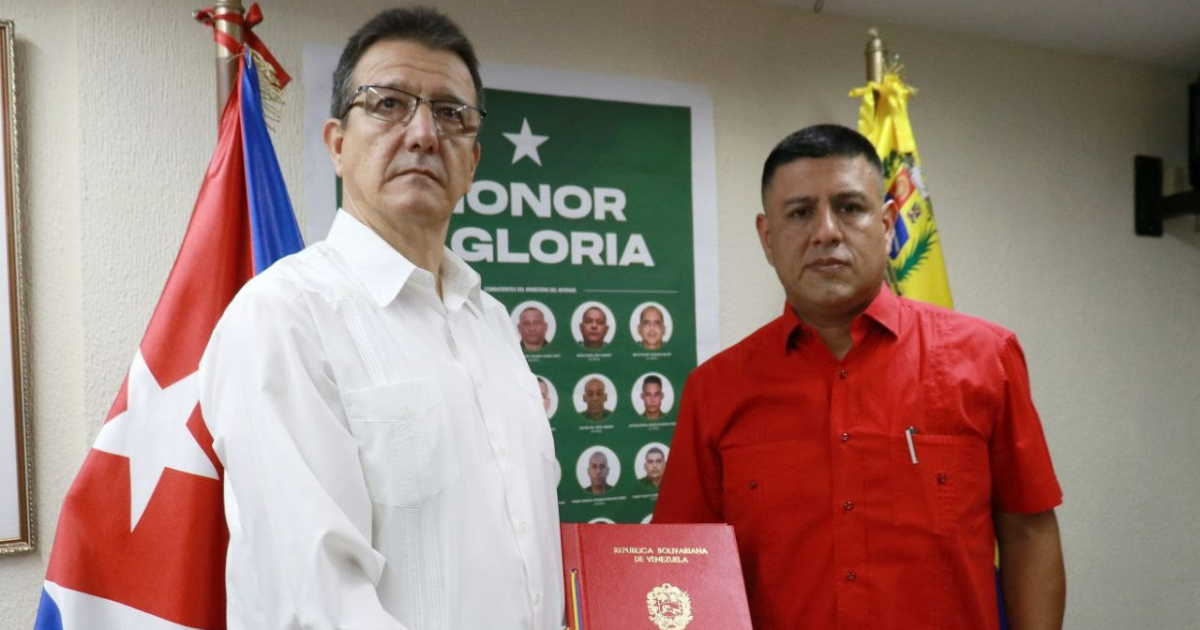
The intelligence officer Jorge Luis Mayo Fernández, identified for his involvement in espionage and political repression activities, continues to serve as Cuba's ambassador in Venezuela, despite the allegations linking him to crimes against humanity in several Latin American countries.
The diplomat recently participated in an official event at the port of La Guaira, where the 145th anniversary of the arrival of José Martí in Venezuela was commemorated. The event, organized by the Cuban Embassy and local authorities, was attended by the chavista governor José Alejandro Terán and other Venezuelan officials.
During the ceremony, speakers paid "tribute to the fallen Cuban and Venezuelan heroes during the vile imperialist aggression of January 3," referring to the U.S. military operation that culminated in the capture of Nicolás Maduro and Cilia Flores.
Mayo Fernández's continued leadership of the diplomatic mission in Caracas reinforces the close relationship between the Cuban regime and the Chavista power structure, even in a political transition scenario.
After Maduro's fall, Delcy Rodríguez assumed the interim presidency under the supervision of the United States, but Havana has made efforts to maintain its presence and influence within the Venezuelan institutional framework, especially in sectors related to intelligence, defense, and binational social programs.
The regime of Miguel Díaz-Canel keeps a high-ranking official from the G2 at the helm of its embassy in Caracas as part of a strategy aimed at protecting Cuban interests in Venezuelan territory and ensuring control over the medical, technical, and advisory missions that are still operational.
The presence of an intelligence agent in that position also serves the purpose of closely monitoring the evolution of the new political landscape following Maduro's fall.
In a context of transition and uncertainty, Havana seeks to preserve the energy and cooperation agreements that have guaranteed subsidized oil and financial support for years, which are essential to sustain the weakened Cuban economy.
According to the project Represores Cubanos, Jorge Luis Mayo Fernández is a senior official of Department M-II of the Intelligence Directorate (G2), specializing in operations in Latin America and the Caribbean.
Deserters from the apparatus itself accuse it of advising on mechanisms of repression and political persecution, as well as participating in espionage activities during its diplomatic missions in Argentina, Nicaragua, Venezuela, and the United Nations.
The public record of the diplomat outlines a career spanning more than three decades within the regime's structure. Educated at the Higher Institute of International Relations (ISRI) between 1984 and 1989, he began his career in 1999 as Third Secretary at the Cuban mission to the UN.
In 2004, he was assigned to Argentina as Second-in-Command of the Mission, a position he held until 2008. He later served as Second-in-Command of the Mission in Venezuela from 2010 to 2016 and was appointed ambassador to Nicaragua in 2021, before taking on his current role in Caracas.
Exile analysts and international observers agree that their presence in Venezuela holds both symbolic and operational significance. "The presence of a G2 agent in Caracas is a survival maneuver for the Castro regime. Cuba seeks to maintain access to intelligence and political networks in a country where it has historically operated without checks and balances," said a security expert consulted by CiberCuba.
Mayo Fernández's continued hold on the position also highlights the mutual dependence between both regimes. Despite the change of power in Venezuela, residual chavismo remains an essential ally for castrismo, both in terms of oil supply and security cooperation.
With the weakening of the Caracas–Havana axis, the Díaz-Canel government faces an increasingly isolated scenario and the loss of its main energy support.
Maintaining an intelligence network in Caracas, as several sources agree, is part of the regime's strategy to retain negotiating power in Washington and control the political narrative amid the regional reordering following Maduro's fall.
Filed under: