
Related videos:
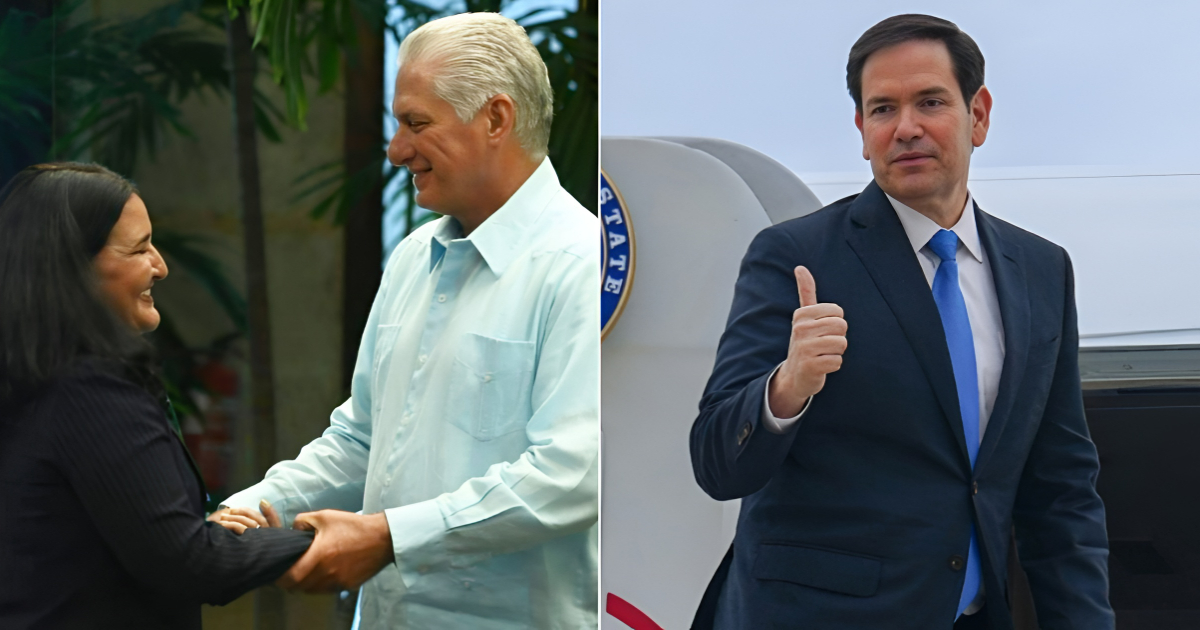
Johana Tablada de la Torre, Deputy Director General for the United States at the Ministry of Foreign Affairs of Cuba, reignited conversations on social media with a message that was as lengthy as it was aggressive against U.S. Secretary of State, Marco Rubio.
In her diatribe —published on her social media and filled with personal attacks— Tablada de la Torre not only accused Rubio of being a “fascist,” “bandit,” and “executioner,” but also directly labeled him as “inept.”
The problem, of course, was not in the insult, but in the irony. Because if there is one word that Cubans repeat with near patriotic unanimity to describe the government of Miguel Díaz-Canel, it is precisely that: inept.
It’s enough to remember the comments following last year's national blackouts, when the president himself tried to appear optimistic amid the electric collapse. The social networks erupted in mockery and rage: “corrupt, stupid, incompetent, and inefficient,” users wrote, fed up with excuses and slogans.
Since his arrival to power in 2018, the adjective became synonymous with the ruler designated by Raúl Castro and, by extension, with the apparatus that sustains him.
That's why, when Tablada de la Torre decided to use the same epithet against Rubio, the people quickly recognized the "failure". If anyone embodies ineptitude in present-day Cuba, it is not in Washington, but in the Palace.
The message from the official, which consisted of over a thousand words, was presented as a plea against the "economic war" waged by the United States, but it read more like yet another chapter of her personal grievances against the Cuban-American who currently leads the State Department.
Tablada de la Torre accused Rubio of manipulating U.S. foreign policy, sabotaging ships, threatening communities, and even controlling the Secretary of Defense. In the middle of the text, amid references to the Bible, conspiracy theories, and old slogans from the “revolution,” the rhetorical gem appeared: “Rubio is the true incompetent.”
The phrase had the opposite effect of what the diplomat imagined. Instead of a blow to Washington, it provoked laughter on Cuban social media and among the exile community. Many interpreted it as a Freudian slip: an involuntary confession of what Cubans have long thought about their own leaders.
The tone of the publication also revealed the exhaustion of the official discourse. References to the "criminal blockade" and "imperial suffocation" sound increasingly hollow in the face of a reality where shortages, blackouts, and mass migration can no longer be explained by an external enemy.
While Tablada de la Torre repeats the mantras of half a century ago, Cubans survive on remittances, ingenuity, and a patience that is wearing thin with the frequency of blackouts.
His fixation on Marco Rubio —whom he has almost obsessively mentioned for years— seems to be the last resort of a regime that needs enemies to justify its failures. Instead of diplomacy, it offers tirades; instead of dialogue, insults.
But the most striking thing was that, in her attempt to ridicule the senator, the ambassador appointed by Díaz-Canel ended up adopting the most popular insult among Cubans against the leader of the so-called “continuity”.
Because if there is one thing that Cubans immediately detect, it is an official blunder. And when Tablada de la Torre wrote "the true incompetent," millions knew that the adjective had aimed at the wrong target and found the undeniable reference.
In a country where hospitals are shutting down, epidemics are thriving, prices are skyrocketing, and young people are emigrating, the term has an exclusive owner. The "incompetent" is neither in Washington nor in Miami... It is in Havana, smiling, recording optimistic messages while the country is falling apart.
Filed under: