
Related videos:
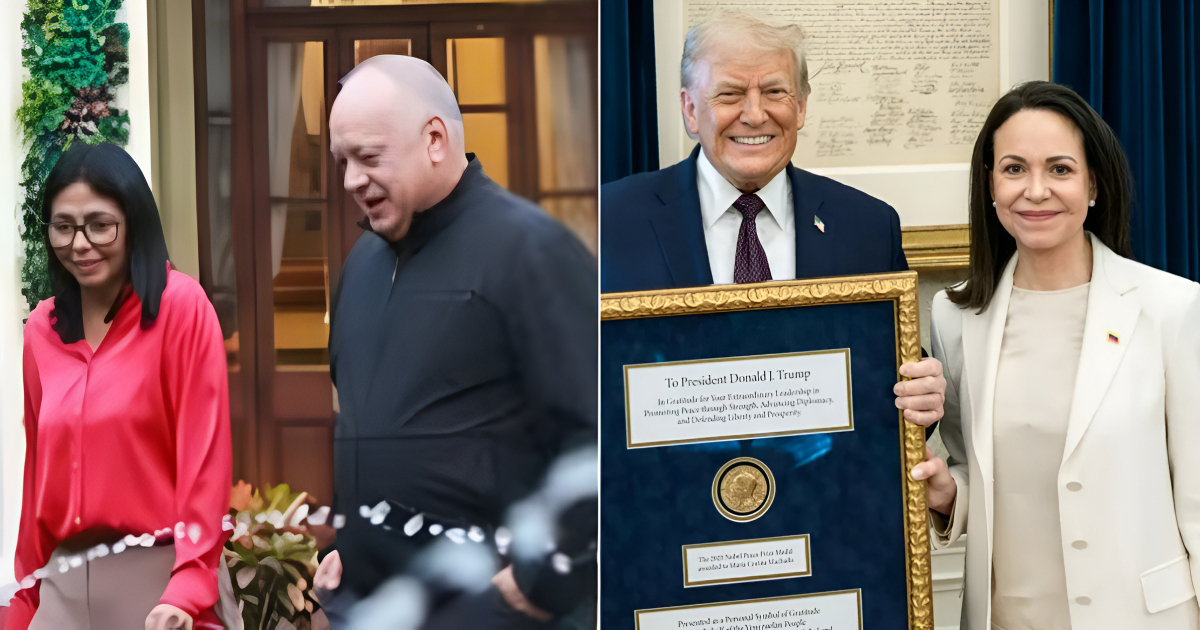
Washington would be discreetly working on an alternative plan for Venezuela in light of the possibility that the fragile balance maintained by Delcy Rodríguez may collapse.
According to a report by journalist David Alandete, published in ABC, the administration of President Donald Trump has begun to design a “Plan B” based on the creation of an emergency technocratic council, a sort of provisional structure that would take over the management of the country if the current interim leader of chavismo loses control.
The goal, according to sources consulted by the Spanish newspaper, is not an immediate democratic transition, but to ensure stability and avoid chaos following the capture of Nicolás Maduro on January 3, in a military operation ordered by Trump and executed by U.S. special forces.
At the White House, the key word at this moment is not "democracy," but "stability," noted the advisors quoted by Alandete.
An "emergency" technocratic advisory
The plan, inspired by the Peace Council that Trump is advocating for Gaza, is conceived as a temporary governing body made up of civilian experts, without partisan quotas or political ambitions.
It would have limited competencies in critical areas such as the economy, energy, health, infrastructure, and internal security, in order to keep essential services running while the political power in Venezuela is reorganized.
“The only thing worse than authoritarian continuity is chaos,” a source from the U.S. presidential circle reportedly said, reflecting the pragmatic priority of avoiding a total collapse of the chavista state.
The White House believes that the bureaucratic apparatus still under Rodríguez's control serves a useful purpose in maintaining order, but it does not see it as sustainable. In this scenario, the technocratic council would act as an "institutional parachute," activated only if the regime collapses or if Delcy is displaced by an internal coup.
Delcy, the provisional piece
Alandete details that Trump maintains direct contact with Delcy Rodríguez, whom he has even described as a "valid interlocutor."
However, those praises do not stem from ideological sympathy, but rather from a strategy to control the transition process. In the words of a source cited by the journalist, the Chavista vice president is, for the time being, "a functional tool" to prevent a power vacuum and contain violence.
The report also revealed that Delcy had held secret meetings in Doha with CIA agents and Russian officials months before Maduro's downfall.
These meetings, held under Qatar's mediation, aimed to explore scenarios for a controlled exit of the dictator and ensure the regime's survival without resorting to direct confrontation with Washington.
María Corina, the strategic asset
While Delcy fulfills a temporary role, opposition leader María Corina Machado remains on the sidelines of the transitional machinery.
According to the text, Trump and his Secretary of State, Marco Rubio, seek to protect their political image and avoid taking on unpopular responsibilities during the stabilization phase. The idea is to reserve this for a future electoral process, once the new institutional order is established.
An American diplomat cited by ABC summarized the reasoning as follows: “You can't place María Corina in a position where she bears the cost of stabilization”.
Oil and Borders: The Underlying Interests
Trump's plan for Venezuela is based on two strategic axes: oil and borders.
Washington aims to prevent a power vacuum from turning the country into fertile ground for criminal networks and hostile alliances with Russia, Iran, China, or Cuba. At the same time, it seeks to create conditions to reactivate the Venezuelan energy industry under U.S. licenses and supervision.
Analysts like Walter Molina interpret that this approach confirms that Trump's priority is not to overthrow chavismo, but to redesign the Venezuelan state under Western oversight.
For Molina, the current "rodrigato"—as he refers to Delcy Rodríguez's provisional power—is functional as long as it is under U.S. supervision. However, if that oversight were to break, chavismo would revert "to its inevitable nature: authoritarian and allied with Moscow and Havana."
For this reason, the White House is quietly moving forward with an emergency plan that could be activated within hours. In the words of a source quoted in the report, "it's not a perfect government, it's a possible government."
Filed under: