
Related videos:
China defended the Havana government on Friday following the new measures announced by U.S. President Donald Trump against countries that supply oil to Cuba.
The spokesperson for the Chinese Ministry of Foreign Affairs, Guo Jiakun, described the actions aimed at increasing economic pressure on the Island as "inhumane."
According to a report from Russia Today, Jiakun stated that Beijing "strongly supports Cuba in defending its national sovereignty and security," in direct response to the decree signed by Trump on January 29.
The Chinese reaction comes after the U.S. president declared a "national emergency," considering that the situation in Cuba poses an "unusual and extraordinary threat" to the security and foreign policy of the United States.
Based on that statement, Washington established a scheme that allows for the imposition of an additional "ad valorem" tariff on imports from any country that sells or supplies, directly or indirectly, oil to the Island.
Guo emphasized that China firmly opposes any attempt to deprive the Cuban people of their right to survival and development.
In his statement, he reiterated Beijing's rejection of the "blockade," unilateral sanctions, and all forms of coercion against Havana, a position that China has maintained for years in international forums.
The executive order signed by Trump aims to cut off one of the main sources of economic support for the Cuban regime: the supply of oil from abroad.
Washington aims to prevent the Island from continuing to receive crude oil and financial resources, especially from allies like Venezuela, whose energy support has dramatically decreased since Maduro's capture on January 3.
Cuba is experiencing a moment of extreme fragility, characterized by prolonged power outages, halted production, and an almost absolute dependence on imported oil.
In that context, the United States is attempting to close the last avenue of survival for the Cuban energy system following the loss of support from Caracas.
This decision aligns with a broader strategy revealed by The Wall Street Journal, which stated that the White House is actively working to provoke a regime change in Cuba before the end of 2026, taking advantage of what U.S. officials describe as a "historic window of opportunity."
The U.S. president himself has been explicit in his diagnosis: "Cuba seems like it's about to fall. I don't know how they will be able to hold on," he said recently.
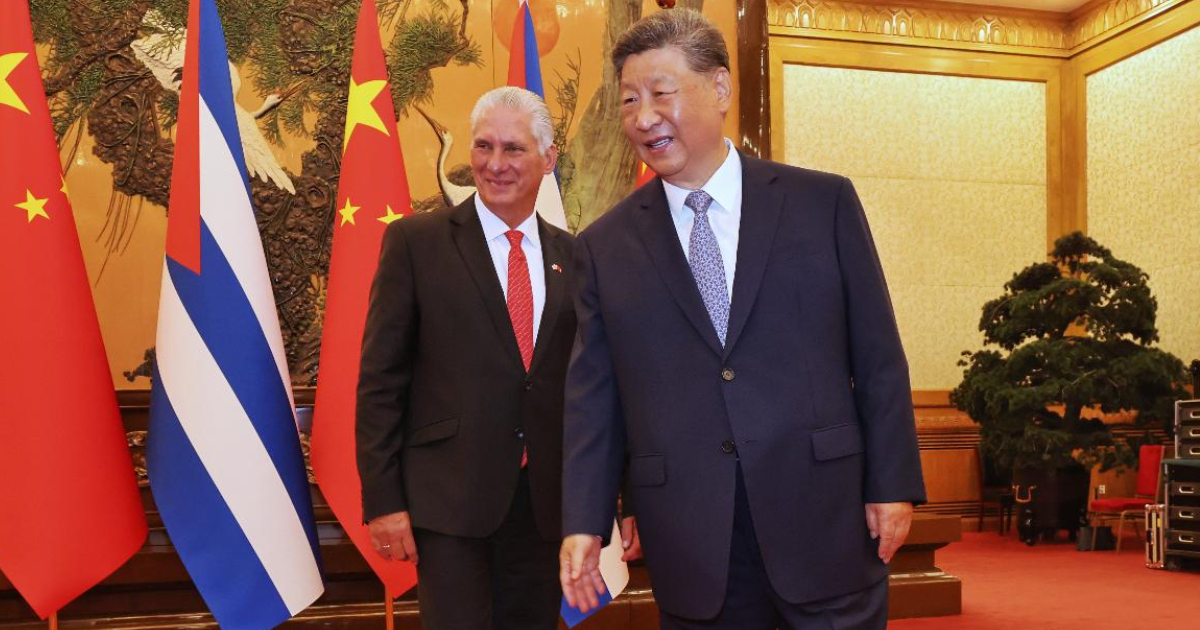
Days before Trump's announcement, the Chinese government had already reaffirmed its political support for Havana and had called on the United States to lift the sanctions and the embargo.
Guo Jiakun then declared that China would continue to provide support and assistance to Cuba "within its capabilities," and expressed his confidence that the Cuban people would be able to overcome their difficulties under the leadership of the Communist Party and the government of the Island.
Beijing accused Washington of "violating international law" and of depriving the Cuban people of their right to survival and development, in addition to undermining regional peace and stability.
On January 20th, Chinese President Xi Jinping approved a new round of aid for the island, which includes emergency financial assistance valued at $80 million and a donation of 60,000 tons of rice.
The Chinese position aligns with that of Russia, another ally of the Cuban regime that has provided loans, food, and technology in exchange for geopolitical influence in the Caribbean in recent years.
Moscow described the reports about an alleged U.S. plan to impose a total naval blockade on Cuba as "alarming" and asserted that the United States would not be able to replicate the Venezuelan scenario on the Island.
The permanent representative of Russia to the UN, Vasili Nebenzia, stated that the United States will not be able to replicate in Cuba the scenario of Venezuela, where it launched a military attack and took Nicolás Maduro away.
"In Cuba, that wouldn't work. I believe that, despite the rhetoric that Americans have been using lately regarding Cuba, for now, it is just rhetoric. Because in Cuba, it will not be easy if they want to repeat something similar to what happened in Venezuela," asserted the high-ranking diplomat, as quoted by Russia Today.
Filed under: