
Related videos:
Sometimes I wonder if what is happening in Cuba is not, more than a political tragedy, a human paradox.
A country plunged into a deep crisis, where daily life has become a series of shortages: endless blackouts, salaries that are insufficient, young people leaving, hospitals lacking resources, families separated. A population that, for the most part, knows exactly why it is in this situation. They speak of it in hushed tones, in private, in line, in their homes, in private messages. There is not much confusion about the causes. There is awareness.
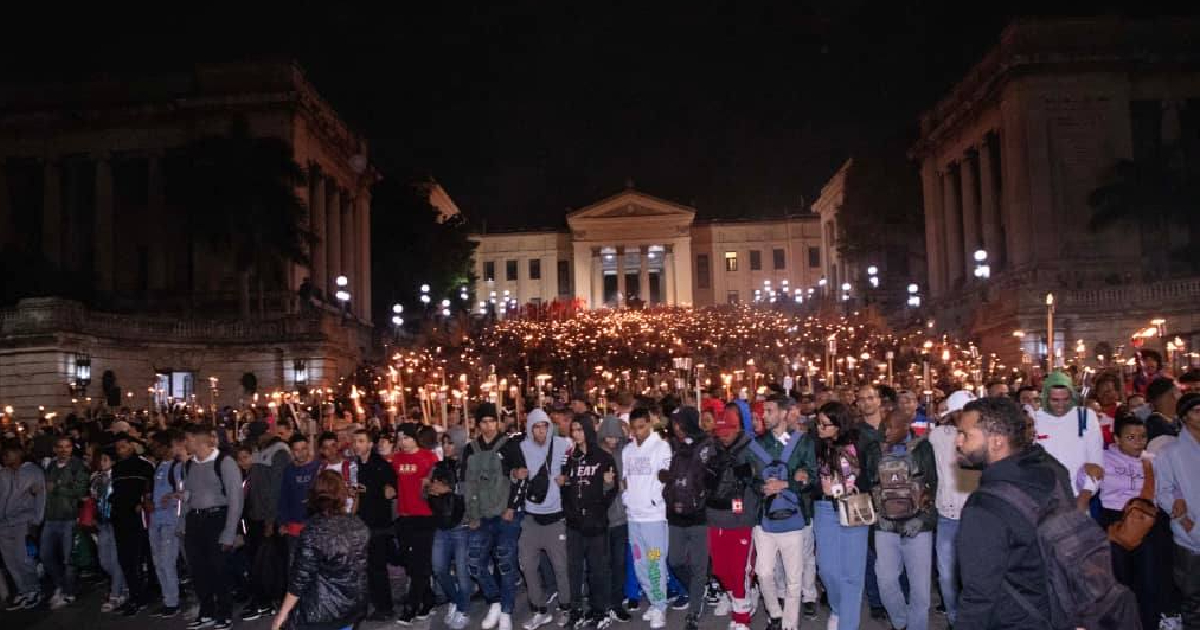
And yet, the streets fill up when the government calls. Marches, events, rallies, symbols, slogans. Crowds visible in a country where the invisible is exhaustion.
There lies the paradox: how can such widespread awareness coexist with public behavior that seems to deny it?
The simple explanation would be to talk about fanaticism or manipulation. But that would be too superficial. The reality is more complex and uncomfortable. It's not just about believing or not believing. It's about living in a system where dissent comes with real, everyday, cumulative costs. Where not conforming can mean losing opportunities, being labeled, or being left out. In a country where almost everything depends on the State, obedience is not always ideological; often, it is simply a means of protection.
Then the march stops being a political expression and becomes an act of survival. People don't go because they are convinced; they go because they cannot not go. They don't shout out of faith; they shout to avoid standing out. They don't participate out of enthusiasm, but rather out of inertia.
This creates a kind of dual reality: one private, critical, and lucid; and the other public, ritualistic, and disciplined. A society where thinking one thing and saying another is not moral hypocrisy, but psychological adaptation.
The most unsettling aspect is not just that this exists, but that it is used as an argument. These images are constantly showcased by the regime's defenders as proof of legitimacy: to assert that those of us who think differently are mistaken, that the people truly support them, and that dissent is either a minority or fabricated. Often, this is echoed in comments, debates, and social media: the crowd as definitive "evidence."
But that reading ignores something essential: presence is not the same as adhesion. In contexts of political control, public image does not necessarily reflect social truth. It primarily reflects the system's ability to organize, pressure, and produce scenes. It does not demonstrate conviction; it demonstrates power.
From the outside, one begins to ask another, even tougher question: Is it worth raising your voice for those who seem unable to raise it for themselves? Does it make sense to expend energy defending a people who, at least on the surface, continue to support the system that is sinking them?
It’s a legitimate question. It stems from weariness, not from disdain. From the fatigue of shouting while others remain silent or march.
But perhaps that's where the final layer of the paradox lies. The true triumph of the system is not only that people obey, but that even those who see the injustice start to doubt whether empathy still makes sense. That resignation becomes contagious. That each person thinks only of saving themselves.
Cuba is not a society defeated by a lack of intelligence. It is a society exhausted by an excess of fear, control, and time. Not unconvinced, but trapped. Not loyal, but weary.
And perhaps the most honest thing that can be said today is not that the people support what oppresses them, but that they have learned to live within a permanent contradiction: knowing that something is wrong, but feeling that confronting it is more dangerous than enduring it.
That is, at its core, the Cuban paradox: a collective awareness that exists but fails to transform into collective action. A clarity that finds no outlet. A country that knows but cannot.
Filed under:
Opinion article: Las declaraciones y opiniones expresadas en este artículo son de exclusiva responsabilidad de su autor y no representan necesariamente el punto de vista de CiberCuba.