
Related videos:
Things of life. Miguel Díaz-Canel appeared on Thursday before the cameras to say that he never said what was indeed said.
In a special broadcast transmitted by the official channels of the Presidency of Cuba and widely shared on institutional networks, the leader denied that the country has entered a State of War.
He denied it, he denied it a second time, and he denied it again, despite the fact that just days earlier, the National Defense Council he presides over had approved—literally—“the plans and measures for transitioning to a State of War.”
"The statement from the Defense Council is not saying that we are entering a State of War; it is saying that we are preparing in case we need to enter a State of War at some point," the leader clarified.
The appearance, far from conveying control or firmness, had the air of a containment operation.
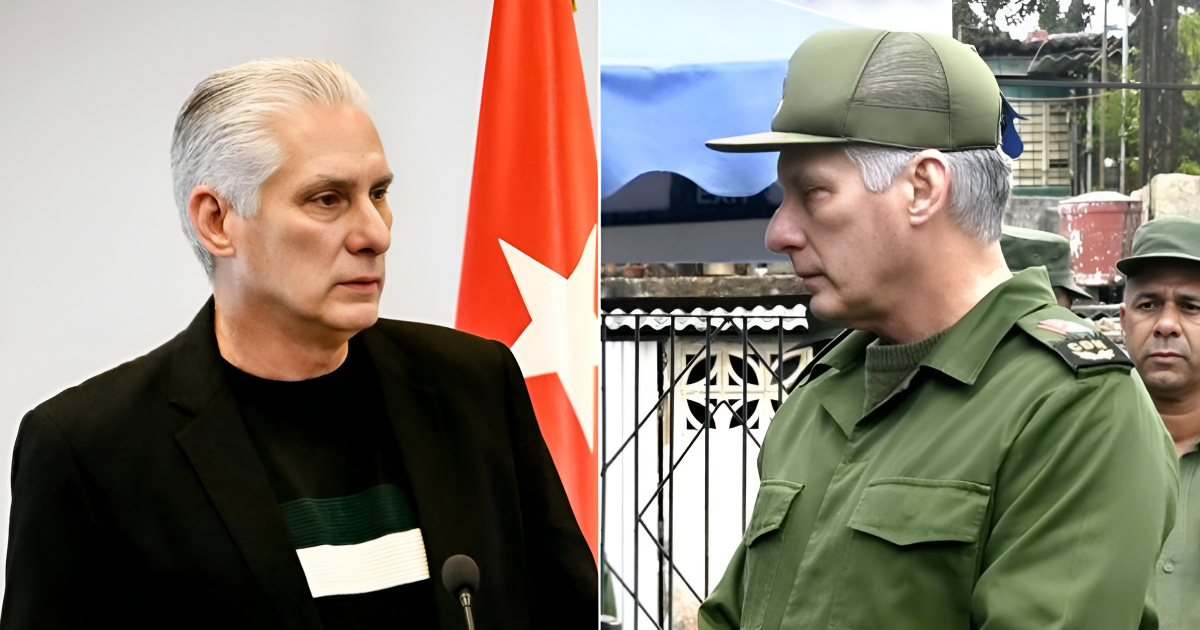
Díaz-Canel appeared visibly anxious, with a fragmented speech, frequent hesitations, and body language characterized by constant swaying, clear signs of discomfort and insecurity.
It was not the image of a confident leader, but rather that of someone forced to correct a narrative that had gotten out of hand.
From that carefully controlled stage, the ruler insisted that Cuba is "a country of peace," which poses no threat to the United States and has never declared war. According to his explanation, discussing defensive preparedness does not equate to being at war.
However, the official account complicates that distinction: Saturdays have been proclaimed National Defense Days, university students, militias, and brigades have been mobilized, and defensive plans have been updated from the municipal level to the National Defense Council.
All of this —he explained— is part of the doctrine of the "War of All the People," presented as a purely defensive concept, inherited from Fidel Castro and reiterated by Raúl Castro. A doctrine that, according to Díaz-Canel, does not consider any aggression, but rather the defense of sovereignty against external threats.
The problem is the immediate context. Palacio's clarification comes after weeks of a markedly belligerent discourse.
In mid-January, state media reported unambiguously that the National Defense Council had approved the "transition to a State of War." Shortly thereafter, the Ministry of Revolutionary Armed Forces proclaimed its willingness to "fight to the death for socialism."
At the same time, official networks were filled with images of military exercises, trenches, rifles, controlled explosions, and epic music, creating a setting more reminiscent of war than peace.
In that atmosphere, the sudden insistence that "it was never said" what was published by Granma and Cubadebate does not seem like a mere misunderstanding, but rather a calculated retreat. The preparation is not denied, the military rhetoric is not dismantled, but the word that carries legal, political, and symbolic implications—war—is avoided.
Díaz-Canel attempted to close that semantic gap by explaining that, following the events of January 3 in Venezuela and the regional tensions, his government decided to implement a comprehensive defensive preparation plan.
In that context, he emphasized, the "Plan for a transition to a State of War, if necessary," was updated, something that, according to him, was published transparently. The problem, he stated, was not the content itself, but its "manipulation" by what he referred to as the system of "media intoxication" at the service of the United States.
During the appearance, the leader appointed by General Raúl Castro listed visits to military units and defensive exercises in which, he assured, the people participate, including students engaged in tasks in defense areas.
Everything was presented as evidence of revolutionary consciousness and popular support, with no room for uncomfortable questions or dissenting voices.
Outside the set, however, the reality is less epic: prolonged blackouts, food shortages, lack of fuel, and an exhausted population. Inside the studio, the message was different: there is no State of War, but the country must behave as if it could enter one at any moment.
Díaz-Canel did not deny the belligerent language or the preceding rhetorical escalation. He denied having crossed the formal line.
And in that precision—uttered with nervousness and gestures of insecurity—lies the essence of the retreat: to maintain the epic nature of the confrontation, to lessen the internal fear, and to avoid facing the consequences of having perhaps invoked, too quickly, the most feared word of all.
Filed under: