
Related videos:
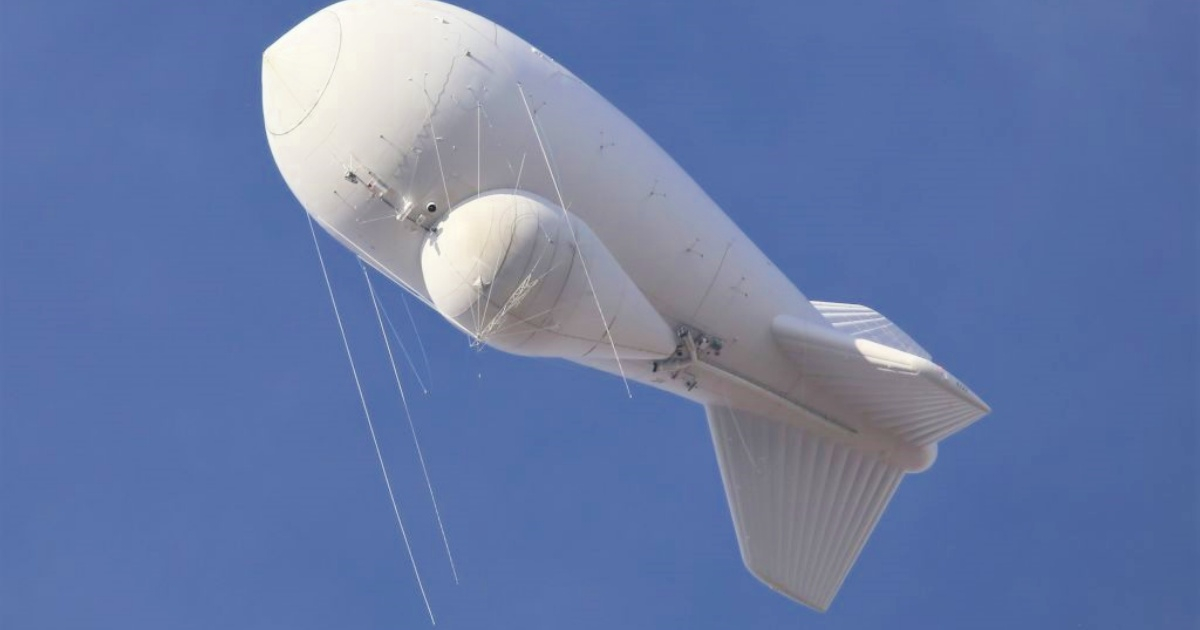
A special stratospheric balloon, registered in the United States and designed to monitor the surrounding airspace, was launched over the Florida Straits, near Cuban airspace.
The news was reported by the Russian agency TASS, which cited a source from air traffic control.
"The stratospheric balloon, designed for continuous monitoring and control, even across national borders, is currently operating at a low altitude - about 2.5 kilometers - and is located over the Florida Bay, near Key West, USA.", stated the agency's source.
He stated that local air traffic controllers have informed all users of the airspace about the launch of that device.
In early January, a similar stratospheric balloon was repeatedly sighted over Puerto Rico and near Venezuelan airspace.
The artifact periodically flies over the Atlantic and the Caribbean at altitudes above 18 km, which does not interfere with passenger air traffic.
The balloon N807XR: surveillance from Cayo Cudjoe
Although TASS does not identify the model, records from FlightRadar24 and open sources allow the device to be linked to the balloon N807XR, known as the Tethered Aerostat Radar System (TARS), operated by the United States Customs and Border Protection (CBP).
This balloon is stationed over Cayo Cudjoe, about 145 kilometers north of Havana, from where it provides long-range surveillance.
Popularly nicknamed "the eye in the sky," this system can elevate powerful radars and detect aircraft or vessels at low altitudes at distances of up to 322 kilometers, surpassing the limitations of the Earth's horizon.
Its installation is not new, but its activation has coincided with a noticeable increase in the presence of U.S. military and intelligence around Cuba.
Part of a larger pattern of surveillance
The appearance of the balloon adds to a series of maneuvers that the United States has carried out in recent weeks, intensifying its air and maritime patrols around the Island.
As part of Operation Southern Spear, led by the Southern Command and the Fourth Fleet of the U.S. Navy since 2025, at least three warships have recently been operating near Cuban territorial waters.
On February 4, a reconnaissance plane RC-135V/W Rivet Joint, considered one of the main electronic surveillance platforms of the U.S. Air Force, flew over the northern coast of Cuba from east to west before returning to Florida.
This pattern has been observed with other aircraft such as the MQ-4C Triton drone (Global Hawk), specialized in wide-area surveillance, and the P-8A Poseidon, used for maritime patrol, anti-submarine warfare, and anti-surface operations.
A climate of political and military tension
This increase in intelligence activity coincides with a hostile shift in U.S. policy towards Havana.
On January 29, President Donald Trump signed an executive order declaring the Cuban regime to be a "threat" to U.S. national security and warning of the possibility of imposing tariffs on countries that supply oil to the Island.
The order has been interpreted as a direct warning to Cuba's allies such as Venezuela and Mexico, and as a prelude to a possible escalation of sanctions amid the election campaign in the United States.
Air and naval surveillance could be viewed, in this context, as a means to exert pressure on Havana, gather critical intelligence, or even prepare for future coordinated actions.
The alert issued by Russia revives echoes of the Cold War, when the Caribbean was a stage for tensions between superpowers. Although the balloon identified by TASS appears to serve technical purposes and routine surveillance, its deployment near the Island—alongside military maneuvers and sanctions—reinforces the perception that Washington is reactivating its pressure tactics on Cuba.
Russia, which has strengthened its ties with the Cuban regime in recent years, interprets these movements as a regional threat. The denunciation of the stratospheric balloon could be seen not only as a gesture of support for Havana but also as part of the global rivalry between Moscow and Washington, which is now also extending to the Caribbean.
Filed under: