
Related videos:
The Russian government has responded to the concerns of the United States following the landing of a Russian military cargo plane at an airbase in Cuba, asserting that it is a routine operation within the framework of bilateral cooperation with the island.
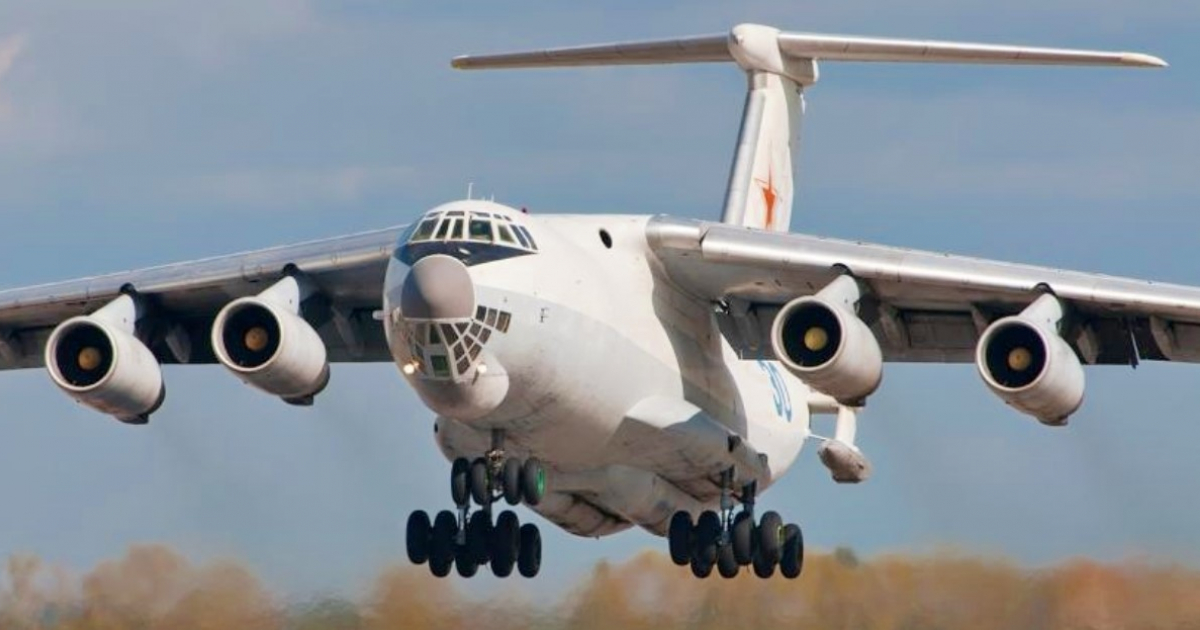
The aircraft in question—a sanctioned state-operated Ilyushin Il-76—was detected last weekend at the military airfield of San Antonio de los Baños, south of Havana, which raised alarms in Washington.
From Moscow, military expert Alexander Mijailov downplayed the incident and dismissed any threatening interpretation of the flight.
"The landing of the Russian Il-76 aircraft in Cuba is not unusual and is part of routine international visits and cooperation between Moscow and Havana," stated in remarks to the newspaper Pravda.
“We have established technical-military and political-military cooperation with Cuba. We exchange periodic visits and hold joint events as part of international cooperation. Our planes fly periodically to Cuba, which is a completely normal practice. Therefore, I see no commotion or cause for concern in this matter,” he emphasized.
Moscow aligns with Havana
"Russia has always opposed pressure on Cuba and continues to support it. We condemn any attempt to blockade the island or impose new sanctions," Mijailov stated, highlighting that cooperation with Havana is crucial for ensuring its internal stability.
"For Cuba, this is a matter of survival: it needs energy resources, electricity, and technology. Russia and China continue to be key partners in helping Cuba withstand external pressure," the analyst added.
Mijailov argues that Washington's real concern is not the timely landing of the plane, but rather the gradual strengthening of ties between Cuba, Russia, and China, which the United States views as a direct threat to its historically established sphere of influence.
"The alarming reaction of the United States to the flight of the Russian plane is likely related to the increasing influence of Russia and China in the Caribbean region," he warned.
And it went further: "For Americans, any contact between Cuba, Russia, and China is part of a geopolitical game that they see as a threat to their interests. But Cuba is a sovereign state and is not obliged to ask for permission from the United States."
In its analysis, Washington—and not Moscow—has been the true generator of tensions in the hemisphere.
"it is Washington, not Moscow, that has been generating tension on the island for decades. Other countries are hesitant to openly assist Havana due to pressure from the United States, so today Cuba can only rely on itself, along with support from Russia and China," Mijailov concluded.
A flight that worries Washington
The Russian Il-76 aircraft, capable of transporting up to 50 tons of heavy cargo, belongs to Aviacon Zitotrans, a Russian state airline included in the sanction lists of the United States, Canada, and Ukraine.
According to public flight records, the aircraft departed from Russia and made stops in St. Petersburg, Sochi, Mauritania, and the Dominican Republic before landing in Cuban territory.
Although the Cuban government has not provided details about the content of the cargo, U.S. analysts have pointed out that this same aircraft has been used in the past to transport advanced air defense systems to Venezuela, fueling speculation about a possible military reinforcement to the island.
The flight pattern resembles movements that occurred in October 2025, when the same Il-76 flew over Venezuela, Nicaragua, and Cuba amid escalating tensions between Caracas and Washington.
Days later, the United States carried out the operation that led to the capture of Nicolás Maduro, an event that completely altered the regional balance and left Havana without its main political and energy support.
Now, the new flight of the Russian cargo plane is happening in an equally tense context: the administration of Donald Trump has taken a tougher stance towards the government of Miguel Díaz-Canel, recently declaring a "national emergency" and describing the Cuban regime as an "unusual and extraordinary threat" to the security of the U.S.
In addition, it has imposed sanctions on any country that supplies oil to the island without Washington's authorization.
A coded message or a routine maneuver
So far, neither the Cuban nor the Russian government has revealed the exact contents of the shipment.
That silence, combined with the aircraft's history and its passage through countries that have permitted its transit despite the sanctions, has fueled speculation about a potential shipment of military technology or energy assistance.
What seems clear is that, for Russia, the Caribbean is once again a strategic space for presence and geopolitical projection, and Cuba – despite its economic fragility – remains an indispensable ally.
This Wednesday, Vladimir Putin reiterated his support for the Cuban government during a videoconference with Chinese President Xi Jinping.
Filed under: