
Related videos:
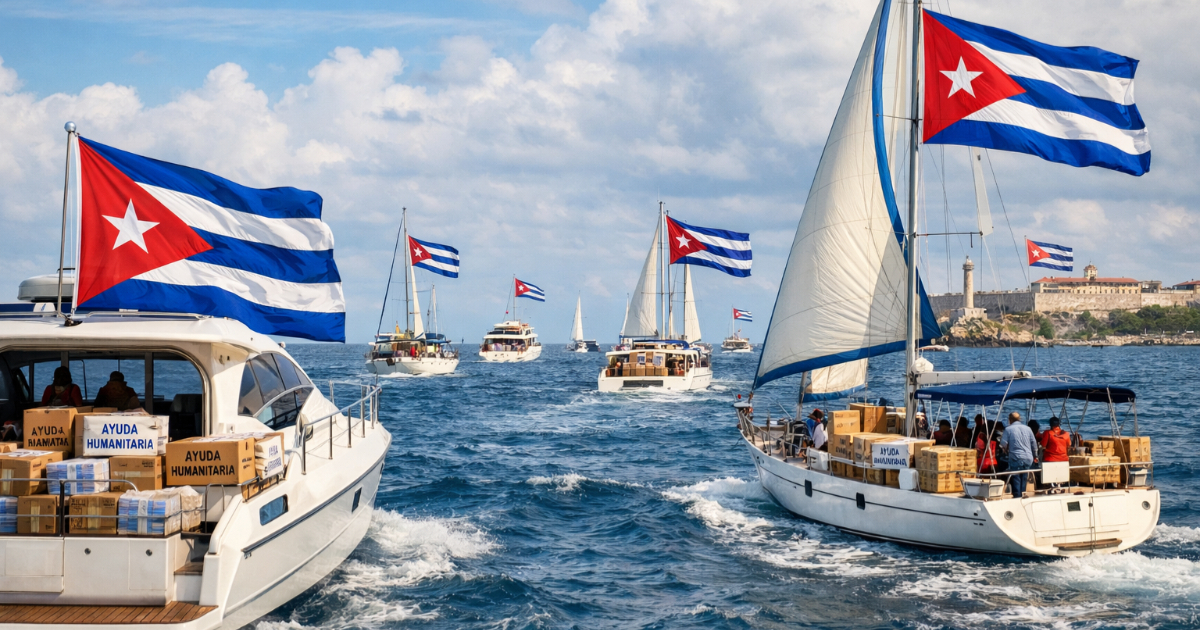
The call for an international flotilla to bring aid to Cuba instantly sparked a response from the exile community. It was not a diplomatic statement or an institutional announcement. It was a direct challenge: “Let the Cuban government get ready, because if they come in, we will too.”
The phrase was uttered by the Cuban activist Salomé García Bacallao on , following the announcement by a coalition of leftist movements of the so-called Flotilla "Nuestra América," an initiative aimed at reaching the island in March with food and medicine to "break the blockade" of the United States.
The post quickly went viral. Under the tags #RightToReturn and #IfTheyEnterSoDoWe, dozens of Cubans inside and outside the country began to envision a different scene with boats leaving from Miami —and from any point of exile— not to support the regime, but to stand with the people in the streets.
“Good idea to join the flotilla,” wrote a user. “Save me a spot there,” commented another. “The matules are ready.” “From Miami to Havana.” The responses blend enthusiasm, irony, and pent-up anger after years of forced separation.
The announcement of the international flotilla was presented as a gesture of solidarity in light of the serious crisis facing the island. Its organizers—including American activist David Adler and former British Labour leader Jeremy Corbyn—claim that the mission aims to send essential supplies and denounce what they describe as "collective punishments" against the Cuban people.
In promotional materials, the promoters claim that the administration of Donald Trump "is suffocating the island," and assert that the consequences are "deadly" for newborns, the elderly, and the sick. They also compare the initiative to the Global Sumud Flotilla, which attempted to deliver humanitarian aid to Gaza.
However, the reaction from the exile community has shifted the focus to another question: who decides who can enter Cuba?
For many expats, the debate is not just about medicines or food, but about rights. More than a million Cubans have left the country in recent years, amidst endless blackouts, chronic shortages, and a collapsed economic system. Many of them face restrictions on returning freely or doing so without conditions.
"Cubans do not want humanitarian crumbs; we want human rights," wrote a user in the comments. Others questioned how the flotilla has official permission while thousands of Cubans still cannot return without fear of reprisals.
The discussion also highlighted the polarization. Some defended the international initiative as a legitimate act of solidarity. Others labeled it a "propaganda spectacle" and reminded that the country’s structural crisis cannot be solely attributed to the embargo, but also to decades of mismanagement and a lack of deep reforms.
There were even voices that went further and called for the organization of a "Freedom Flotilla," a symbolic mobilization that would highlight the right of Cubans to enter and exit their own country without political restrictions.
At its core, the exchange reveals something deeper than an ideological divide. For the Cuban who left—who left behind parents, children, or siblings—the idea of foreign boats entering the island while he cannot do so freely touches a raw nerve.
The “Nuestra América” flotilla is set to depart in March for the Caribbean. Whether it will reach its destination remains to be seen. What it has already accomplished is reigniting a slogan that encapsulates the frustration of a generation marked by exile: if the waters are opened for some, they should be opened for all.
Filed under: