
Related videos:
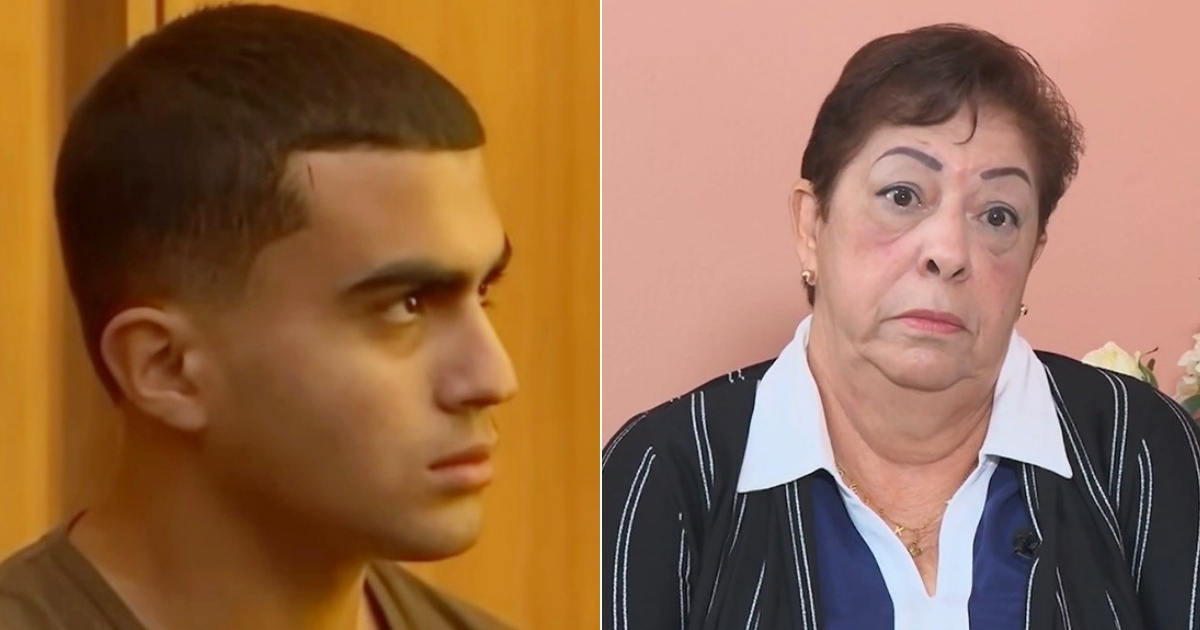
The story of Isabel Acosta is marked by a contradiction that is impossible to simplify: the grief for her murdered daughter and the unconditional love for the grandson who confessed to killing her.
Since Derek Rosa pled guilty to the murder of his mother, Irina García, the family faces not only a judicial sentence but also a fractured grief that does not allow for easy answers.
In her first public statements after the agreement with the prosecutor—given to journalist Gloria Ordaz for Telemundo 51—the teenager's maternal grandmother has shared remarks that have caused a great deal of emotion.
“I gave birth to her. She is my daughter, but I raised him. They are two different loves,” she stated while explaining how she lives with two connections that she cannot and does not want to compare.
Far from framing it in terms of forgiveness or punishment, Isabel speaks of feelings that, she asserts, cannot be measured with the same yardstick.
Her testimony reveals the intimate drama of a mother who lost her daughter while, at the same time, she refuses to abandon the grandson who is currently serving a 25-year prison sentence.
The case shook southern Florida in October 2023, when Derek, then 13 years old, called 911 and confessed to stabbing his mother with a kitchen knife in the family apartment in Hialeah.
Two years later, just before the trial began, the teenager pleaded guilty as part of a deal with the prosecution: 25 years in prison and 20 years of probation.
He is currently serving his sentence at the Suwannee Correctional Institution, a state prison in Florida.
But beyond the verdict, his grandmother's words reveal an intimate and heart-wrenching conflict.
“I will support him until the last day of my life”, he assures.
Isabel continues to refer to Derek as her "angel"; "My angel forever," she repeats, as if that conviction were the only support possible amidst the tragedy.
When asked if he forgives him for what he did to his daughter, he does not respond in legal or moral terms: he speaks of love.
"I love her. She is my youngest daughter, my spoiled daughter... but the boy, they make you feel old, I don't know. I can't even explain how this is," she points out.
And it acknowledges something that summarizes its internal conflict: “The scale always tips in favor of the child.”
Every day, she assures, she lives with both absences.
“Every day I live it with her. I tell her that I love her a lot, that I always keep her in my thoughts. I talk to her”; but he also admits: “I go to sleep and wake up thinking about him, wondering what he is doing.”
Her love for Derek, she claims, "transcends boundaries," even after he confessed to the crime.
"He is my life. He is my grandson, as if he were my son, and I can't help that. Let anyone criticize me if they want," he says, asserting that he doesn't care about others' opinions: "You have to feel what I feel."
He admits that he doesn't know where he finds the strength to endure this duality. “I don’t know if it’s compassion, pity, but it’s something that overwhelms me. I can’t.”
There is something else that stands out: she has never asked him why he did it, and she says she doesn’t want to know for now. “I don’t want to know. Maybe someday, but not at the moment. I don’t know the reasons, I don’t know.”
It also does not clearly state whether the sentence was fair; and when asked if justice was served for Irina, he replies: "I cannot contradict myself."
Regarding the judicial agreement that avoided the trial, she notes that it was an agreement made by the lawyers with Derek and that she respects that.
Amid the public controversy surrounding the case—including revelations that Derek had been diagnosed with autism and attention deficit—the family insists that they never saw any signs that would have foreshadowed a tragedy of such magnitude.
The minor's father, José Rosa, attended every court hearing and has stated that he cannot understand how something like this could happen.
While Derek embarks on his life within the prison system, his grandmother holds an unbreakable promise.
"I love him with all the strength of my soul, and I hope he behaves well wherever he is, because I will always support him, and so will his family," she added.
And it concludes with a phrase that summarizes her stance towards the world and herself: “I only know that he is in that place and that I will always be there for him.”
In that apartment where the portrait of the grandson dressed in white coexists with the ashes of the murdered daughter, Isabel Acosta lives in a contradiction she does not attempt to resolve.
Between condemnation and mourning, he has chosen not to ask, not to judge, and not to abandon.
Filed under: