
Related videos:
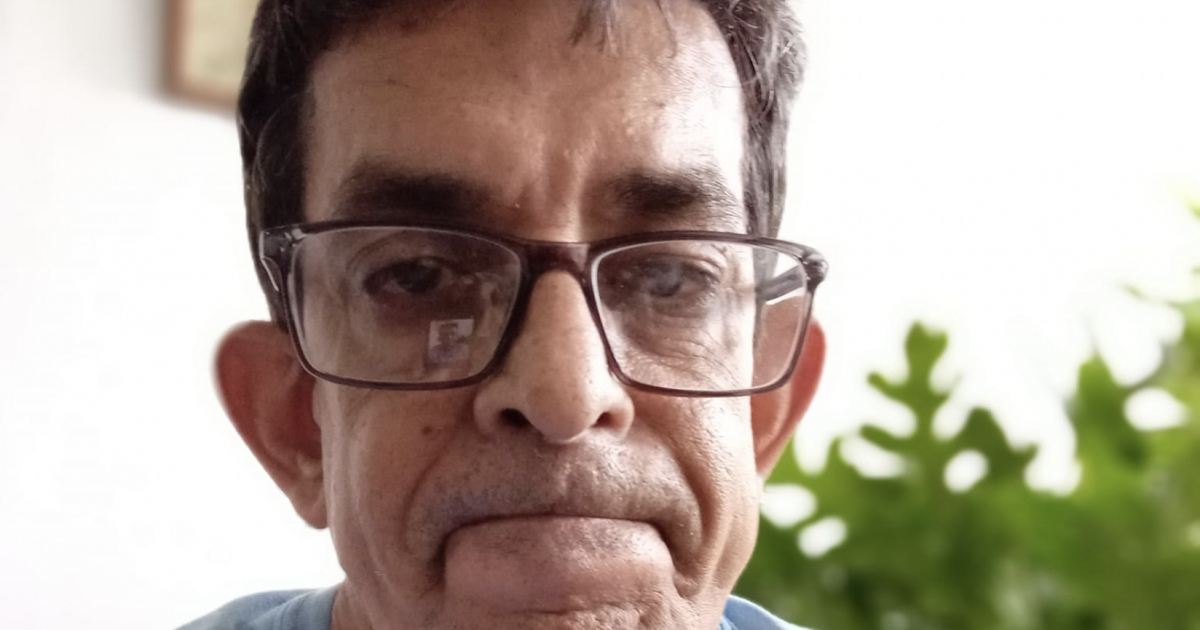
The Cuban comedian Ulises Toirac posted a reflection on Facebook regarding the burning of garbage in public spaces and warned about its potential consequences for health, the environment, and safety in neighborhoods of Havana and other cities in the country. In his post he highlighted a practice that has become increasingly visible amid the waste collection crisis.
"A serious issue. Very serious. And with implications that go far beyond 'solving the visible problem,'" he wrote at the beginning. In the text, he pointed out that when trash is burned in the street, "you are not eliminating the problem: you are transforming it into another, more invisible... and more dangerous."
Toirac explained that municipal waste is not composed solely of paper or dry leaves, but also includes “Plastics (PVC, PET, polystyrene),” “Organic waste,” “Synthetic textiles,” “Batteries,” “Household medical waste,” and “Chemicals.” When burned uncontrolled, he stated, “Dioxins and furans (highly carcinogenic) are released,” “Fine particulate matter (PM2.5) is produced that penetrates the lungs,” and “Heavy metals (mercury, lead) are released.”
The comedian also warned that in a dense city like Havana, smoke can linger at street level and not disperse easily. "In summary: what doesn't go into the truck goes into the lungs," he summarized.
In addition to the immediate impact on public health, he mentioned environmental consequences such as "local air pollution," "deposit of toxic substances in soils," and "increased black carbon (contributes to climate change)." He emphasized that informal burning "has no filters or controlled combustion chambers. It is not industrial incineration. It is crude combustion."
In his publication, he also included fire risks—“The fire can spread to buildings”—potential injuries to people, and indirect economic damages associated with the increase of diseases and the deterioration of the urban image.
Regarding the background of the problem, he pointed out: "If the cause is a lack of fuel for collection, the real problem is not the garbage: it’s the energy logistics." He added that burning waste "does not reduce the total volume of solid waste," "does not solve future accumulation," and "does not create a sustainable system."
Divided reactions
The post generated over a thousand comments. Numerous users supported the analysis and agreed that "the remedy is worse than the disease" and that burning trash "is a risk for everyone."
Several people reported experiencing direct effects. "I'm suffering. I have asthma," wrote one user. Another commented: "I live in Jesús María, and I've been having terrible shortness of breath for a week, along with a cough that keeps me from sleeping." In another message, it says: "My house is across from a garbage dump, and every time they set it on fire, all that toxic smoke, as you rightly said, infests the house."
There were also those who defended the burning as a desperate response to the prolonged accumulation of waste. "What are we supposed to do if they haven't collected the trash in over a month?" asked one person. Another pointed out, "If they don't burn it, the pollution and diseases are still the same; the most advisable thing to do is to collect it."
Some comments pointed directly to institutional decisions. “I took the time to ask two citizens in Mariano; they were making a fire in a dumpster and told me they worked in public services but didn’t have a truck to pick up the garbage due to the shortage of oil, so they were sent to burn it,” wrote a user, who clarified that they did not know if that explanation was “true or false.”
The debate also included proposals such as reinstating animal traction for waste collection or expanding recycling in neighborhoods.
Crisis in waste collection
The discussion takes place amid a visible crisis in garbage collection in the capital. Authorities have acknowledged the accumulation of waste and the establishment of over a hundred transfer or temporary storage points while seeking alternatives due to the lack of fuel.
According to information released by the state press and analyzed in this analysis, 122 transfer points or temporary collection sites for urban solid waste were identified as being in the certification process, in addition to intermediate facilities and spaces in the installations of the Recycling Business Group, along with the reorganization of electric tricycles to support the collection efforts.
Among the measures announced, there was also mention of the possibility of relying on animal-drawn vehicles in certain municipalities and establishing collection frequencies of twice a week, in a context marked by fuel shortages.
In recent days, specific reports have also emerged regarding the burning of garbage in residential areas. In sections of the Metropolitan Park of Havana, residents of Puentes Grandes raised concerns about a waste burning site located, as they reported, “just 50 meters from the Clinical Surgical Hospital of 26 and in the midst of a densely populated neighborhood of elderly people and children.” A social media post warned that “respiratory issues are already starting to be felt. Carbon monoxide KILLS. We don’t know the health and environmental costs of burning all types of waste.” The situation was reported in this report, which also includes similar complaints from Lawton, Regla, and Diez de Octubre regarding the accumulation and burning of garbage in the heart of the urban area.
While logistical difficulties persist, social media exchanges reflect the concern of many citizens about the health and environmental effects of a practice that, as Toirac warned, can shift the problem from the street corners to the lungs.
Filed under: