
Related videos:
The United States publicly congratulated Honduras for ending the agreement that allowed the presence of Cuban doctors in that Central American country, in a decision that represents a new blow to one of the main financing mechanisms of the Havana regime.
The statement was made by senior official Jeremy Lewin, Under Secretary of State for External Assistance, Humanitarian Affairs, and Religious Freedom, through his account on X.
"We congratulate Honduras for asserting its health sovereignty and ending its dependence on Cuban Medical Brigades. The Cuban medical missions are among the worst examples of modern human trafficking, with workers imprisoned abroad to generate income for the crisis-stricken Cuban regime," he wrote.
The message places at the center of the debate what Washington has been denouncing for years: that the Cuban regime's medical services export system operates under coercive conditions and involves the state’s significant appropriation of salaries.
The statement not only supports the Honduran decision but also presents it as an act of sovereignty and a break from a system that the United States considers abusive.
End of the agreement in Honduras
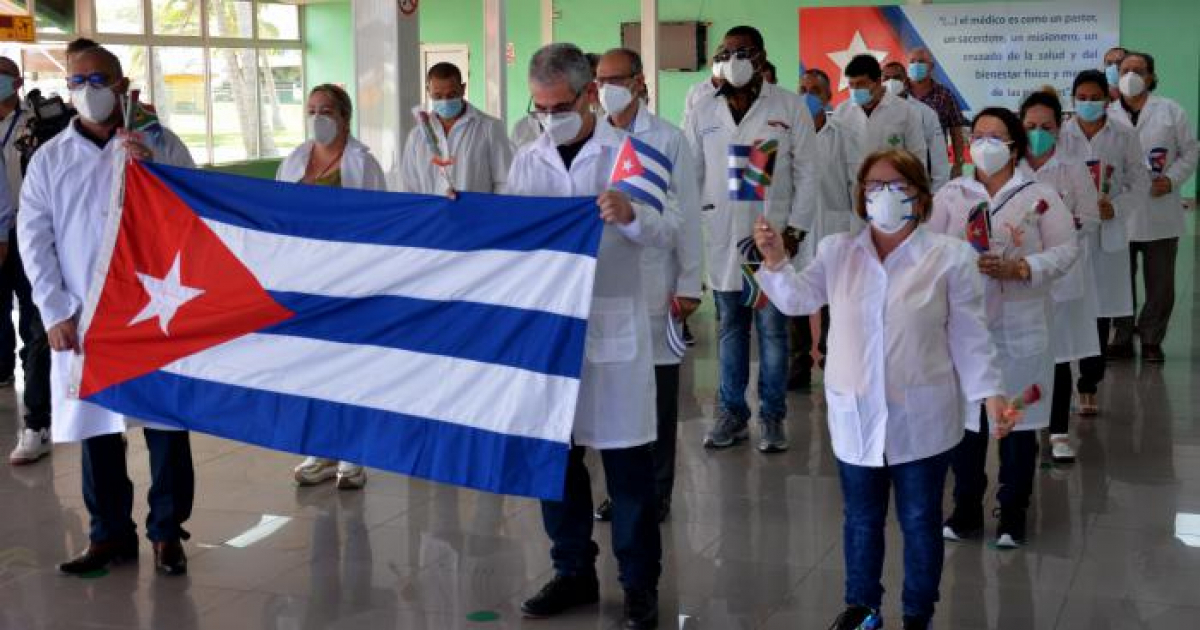
The U.S. reaction comes after official sources confirmed that 128 Cuban doctors will have to leave Honduras following the government's decision not to renew the agreement signed two years ago.
The contract, signed during the administration of leftist President Xiomara Castro, expires this week. The current administration of President Nasry Asfura, backed by his U.S. counterpart Donald Trump, has decided not to extend the agreement.
"The departure of Cuban doctors is a decision of foreign policy," stated the Secretary of Communications, José Augusto Argueta.
For his part, the Deputy Minister of Health, Eduardo Midence, affirmed that the professionals will be replaced by accredited national or foreign personnel: "We will work to hire Honduran or foreign doctors properly accredited by the Medical College."
According to Gonzalo Valerio from the Honduras-Cuba Friendship Association, the 128 specialists are awaiting the coordination of a charter flight to return to the island in early March.
One of the main programs developed by the brigade was ophthalmological care through the so-called Miracle Mission, inaugurated decades ago by the dictator Fidel Castro.
As of October 2025, approximately 44,000 consultations and nearly 7,000 surgeries had been performed, according to official data. Honduran authorities assured that the clinics will not close and that services will continue under other professionals.
Honduras thus joins Guatemala and Antigua and Barbuda, which have canceled similar agreements, while Guyana has considered paying Cuban doctors directly following pressure from Washington, which has labeled these missions as mechanisms of forced labor.
The true interest of Cuba
The export of medical services is a primary source of foreign currency for the Cuban regime. The Honduran decision directly affects this flow of income at a time when the island is experiencing one of the worst economic crises in decades.
The reaction from Havana was swift. The Deputy Minister of Foreign Affairs, Carlos Fernández de Cossío, described it as a "crime" to deprive a country of its legitimate sources of income.
Beyond the rhetorical defense of "health labor," the statement revealed the financial burden this model of professional exportation poses for the regime, as it is considered its primary source of foreign currency in recent years.
A firm stance from Washington
Lewin's message falls within a tougher stance towards the Cuban regime.
Days earlier, the official stated: "For 70 years, the Cuban people have suffered under a brutal regime that has not only stripped them of their political and civil rights but also of any economic opportunity. The regime has deliberately kept the country in misery to maintain its total control."
In his position, linked to external assistance policy and as senior advisor to Secretary Marco Rubio, Lewin is involved in overseeing international aid programs and strategies for countries in crisis.
His emphasis on economic freedom as a solution directly targets the model of state control that, according to Washington, keeps Cuba in a state of precariousness.
And his congratulation to Honduras reinforces international pressure against a system that the United States denounces as concealed labor exploitation under the guise of medical cooperation.
In the midst of a critical social and economic situation on the Island, the Honduran decision represents not only a diplomatic shift but also a new challenge to the mechanism that has served as a financial lifeline for the Castro regime for years.
Filed under: