
Related videos:
Four dead, several injured, an exchange of gunfire in territorial waters, and accusations of "terrorist motives": the incident that occurred on the morning of February 25th off the coast of Villa Clara has not only resulted in a tragic toll and numerous questions but also a striking silence from the Cuban power elite.
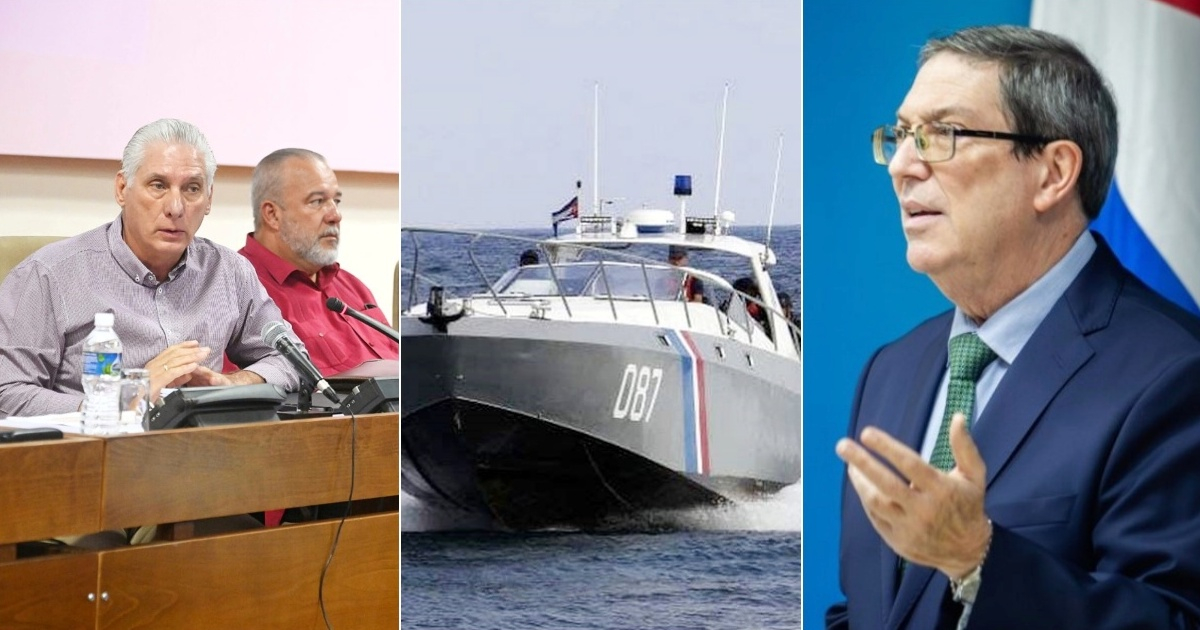
As of the publication of this note, neither the designated president Miguel Díaz-Canel, nor the prime minister Manuel Marrero Cruz, nor the foreign minister Bruno Rodríguez Parrilla have made any public statements regarding an event that has the potential for diplomatic impact with Washington and involves Cuban citizens residing in the U.S.
The silence maintained until now fits a known pattern: the Cuban regime’s tradition of ignoring, downplaying, or reacting late to sensitive issues, especially when they could incur political costs or compromise the official narrative.
The absence of statements stands in stark contrast to the magnitude of the event and the speed with which other actors—both inside and outside of Cuba—have reacted.
A pattern of silence and control of the narrative
In sensitive episodes—from social protests to migration crises or high-impact violent events—the initial reaction of the political power in Cuba tends to be silence.
The initial versions are left in the hands of bodies such as the Ministry of the Interior or official media, while the top leadership refrains from making immediate statements.
Only when the narrative is fully framed, or when internal and external pressure demands it, do broader political statements usually emerge.
In this case, following the armed confrontation with fatal outcomes, the discourse has been limited to statements from MININT.
There have been no appearances, social media messages, or references in public statements by the country's main leaders.
Why is the Cuban ruling elite silent in the face of such a serious incident? The event has implications that go beyond national security.
It also strikes a sensitive chord in a migrant community marked by decades of tensions, mistrust, and violent episodes in the Florida Strait. Four people died under circumstances that, so far, have only been recounted by one side.
The absence of high-level political statements can be interpreted as a containment strategy while investigations are underway.
But it also fits into a repeated practice: allowing the security apparatus to control the initial narrative, buying time, and, if necessary, reacting later with a fully developed discourse.
In a fragile regional context and with tense bilateral relations, every word—or every silence—carries weight.
And for now, the silence of the Cuban ruling elite in the face of an armed confrontation that left dead and injured in national waters does not seem coincidental, but rather consistent with a way of managing crises that prioritizes control of the message over the immediacy of information.
The confrontation
According to a report from the Ministry of the Interior (MININT), a speedboat registered in Florida (FL7726SH) was detected operating within Cuban waters, approximately one nautical mile northeast of the El Pino channel, in Cayo Falcones, municipality of Corralillo, Villa Clara province.
According to the official version, a surface unit of the Border Guard Troops, consisting of five personnel, approached the vessel to identify it. At that moment—according to the statement—fire was opened from the “infringing” boat against the Cuban military.
During the exchange of gunfire, the commander of the Cuban vessel was injured. The official report stated that four individuals were killed aboard the boat and six others were injured, who were evacuated and received medical attention.
Subsequently, the authorities provided more information and identified Michel Ortega Casanova as one of the deceased, while the identification processes for three other victims continue.
The MININT assured that the vessel was carrying ten armed individuals who intended to enter the national territory for "terrorist purposes," according to preliminary statements from those detained.
Among those arrested are Amijail Sánchez González, Leordan Enrique Cruz Gómez, Conrado Galindo Sariol, José Manuel Rodríguez Castelló, Cristian Ernesto Acosta Guevara, and Roberto Azcorra Consuegra. Additionally, Duniel Hernández Santos was detained in Cuban territory, allegedly linked to the reception of the group.
Authorities reported the seizure of assault rifles, handguns, homemade incendiary devices, bulletproof vests, telescopic sights, and camouflage uniforms.
They also noted that some of those involved have criminal records and that two of them were listed in national databases related to previous investigations.
The names of Amijail Sánchez González and Leordan Enrique Cruz Gómez also appear on the list that the regime updated last July and presented to the UN as part of its national list of individuals considered terrorists.
The Silence in Havana
Meanwhile, in Cuba, the highest political leadership has not added a single word to the official narrative.
The latest post by Miguel Díaz-Canel on social media was dedicated to the Parliamentary Public Hearing celebrating 50 years of the People's Power. In it, he called to “revitalize participation, defend sovereignty, and keep hope alive for a better tomorrow.”
Manuel Marrero Cruz also focused his message on the parliamentary commemoration, describing it as a tribute to Fidel Castro and reiterating the maxim that "the power of the people, that is true power."
On his part, Foreign Minister Bruno Rodríguez shared an analysis from the Media Observatory of Cubadebate on how, according to him, the United States government "demonizes" Cuba using pejorative labels and propaganda tactics. He also did not mention the shooting in Cuban waters.
Reactions in the United States
At the same time, the incident, which involves a vessel registered in Florida and Cuban citizens residing in the U.S., triggered an immediate reaction in Washington.
The Secretary of State, Marco Rubio, stated that the U.S. government will verify the events “independently.” Rubio warned that the initial reports are incomplete and that they will use official channels—including the embassy in Havana—to accurately determine what happened.
Vice President JD Vance stated that the situation is being monitored, although he acknowledged that they do not yet have sufficient details: "I hope it’s not as serious as we fear. But I can't say more because I simply don't know more."
The Miami-Dade County tax collector, Dariel Fernández, characterized the statement as an unverified propaganda narrative lacking independent sources.
Mayor Daniella Levine Cava called for a comprehensive and immediate assessment of the incident, emphasizing the need for complete transparency and accountability.
Congresswoman María Elvira Salazar demanded that U.S. authorities urgently clarify what happened, while Congressman Carlos A. Giménez called for determining whether any of the victims were citizens or legal residents of the United States.
The contrast is evident. While Washington announces independent verifications and politicians from South Florida demand transparency, the Cuban ruling elite remains silent in the face of an incident that resulted in four deaths and several injuries, involving high-caliber weapons and potentially further straining the already complex bilateral relations.
Filed under: