
Related videos:
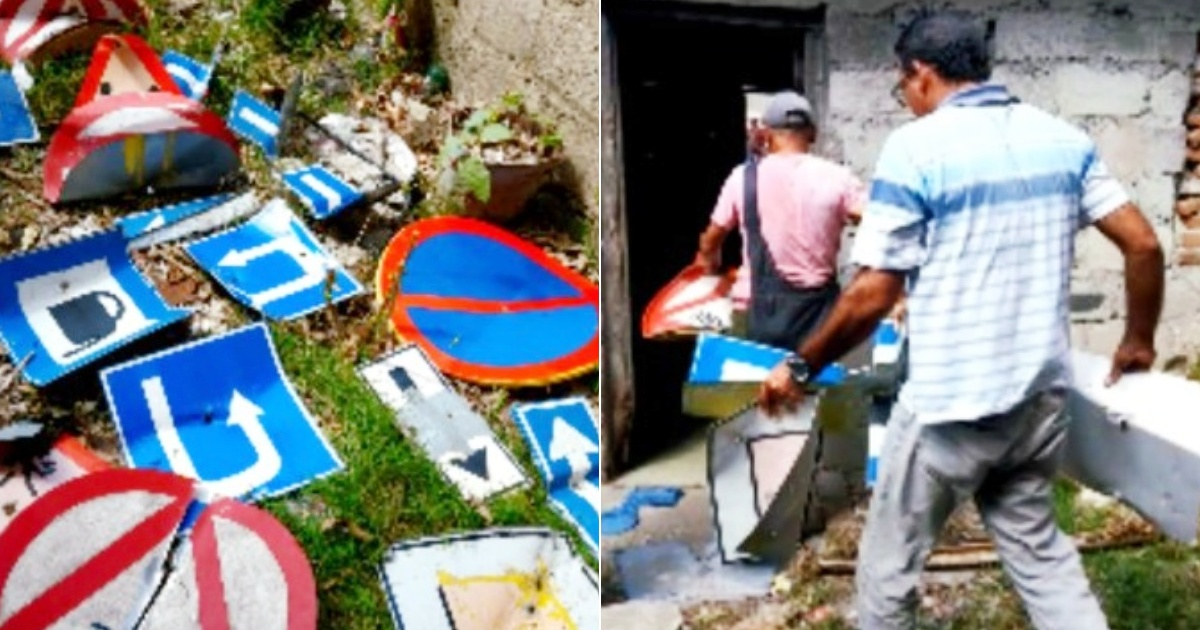
A police operation in the city of Guantánamo dismantled a storage point for stolen traffic signals and led to the arrest of at least two individuals linked to this illicit activity.
The police intervention took place on Friday morning at a residence located at the intersection of Crombet and 7 Oeste.
In the property, dozens of road signage elements were found that had been stolen from various locations in the city, as reported on Facebook by the official profile Guantánamo y su verdad.
According to the publication, the operation "enabled the dismantling of a collection point for stolen traffic signs" and revealed an illegal business that "profited from the road safety of the population."
Numerous metal supports used in signage -known as purlin- were found on the property, which would have been torn down from the streets and avenues of the city.
According to the initial investigations cited by the official source, the materials were intended for the informal market. There, the metal extracted from the signals would be sold for other uses, taking advantage of the high demand for these materials.
The publication explained that this type of crime not only involves the theft of public property but can also endanger drivers and pedestrians.
"Beyond the metal, what they really steal is the driver's orientation, the warning to the pedestrian, and the prevention of an accident", warned the official source.
The case is related to an incident that occurred the night before the operation, when residents of Camilo Cienfuegos Avenue witnessed a police patrol detaining a man as he was allegedly attempting to remove a traffic sign in the middle of the street.
That individual, now in custody, would be one of those involved in the network that stored materials in the intervened residence.
So far, there are two detainees, although authorities have indicated that the investigation is ongoing and further arrests are not ruled out.
The investigations are now focused on identifying other participants and, especially, potential receivers who were purchasing the stolen items, which would fuel the cycle of theft of public property.
One of the agents involved in the operation emphasized the role of the residents in clarifying the case: "The collaboration of the population has been crucial," he stated.
Public Reactions: Between Indignation and Debate
The post sparked extensive discussion among users on social media, with opinions reflecting both outrage at the crime and criticism of the country's social situation.
Some internet users considered that the removal of traffic signs constitutes an extremely dangerous act.
"Ignoring or removing a traffic signal is likely to cause accidents with unequal consequences for the economy and for precious and innocent lives," commented a user.
Others called for severe penalties for those who commit such crimes.
"Due to the seriousness and the potential for an accident that this may cause, the penalty should be no less than 10 to 15 years in prison," stated another commentator.
Several participants also noted that the theft of these structures is often motivated by the sale of metal.
"I imagine they don’t sell it as signs. They sell it for the metal to melt it down and make other things," wrote an internet user.
However, the debate also veered into political and social interpretations. Some attributed such events to the economic crisis that Cuba is experiencing.
"If there weren't so many miseries, this wouldn't happen... misery only brings that," commented one user, while another replied that "this has nothing to do with communism but with a lack of respect and bad habits."
Other users recalled that the disappearance of traffic signals is not an isolated phenomenon.
“They have been stealing that for a while... I once saw two people climbing Pintó with two signs in the early morning,” a commentator reported.
Beyond the police discovery, the case brings to the forefront a problem that traffic safety experts often warn about: inadequate signage can lead to serious accidents.
The disappearance of signals such as "Stop," "Yield," or traffic warnings disrupts the orientation of drivers and pedestrians, increasing the risk at intersections and high-traffic roads.
Filed under: