
Related videos:
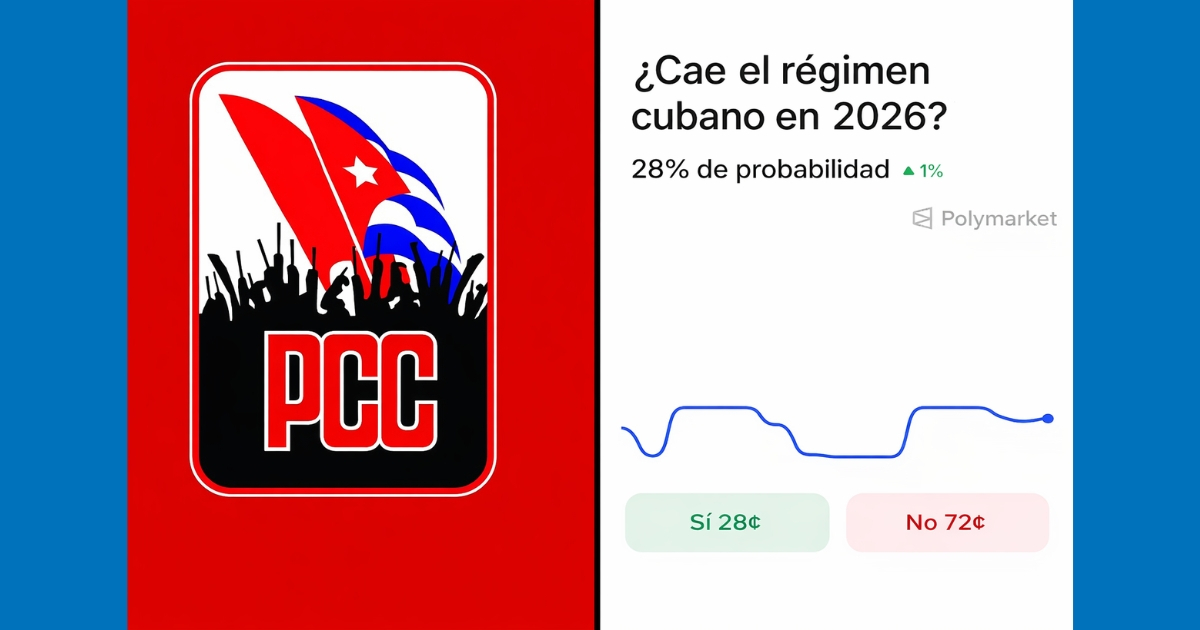
Polymarket launched a new prediction market about Cuba titled Cuban regime falls 2026?, which assigns a probability of 28% —with an upward trend— that the Communist Party of Cuba will lose control of the government before December 31, 2026. The platform announced the launch with a brief message on social media: “New market on Polymarket: Does the Cuban regime fall this year?”.
The market is resolved with a "Yes" if the PCC ceases to exert de facto control over the Cuban government, according to credible reports, and has already accumulated a trading volume of 1,500 dollars, with a liquidity of 10,600 dollars.
This new market is part of a series of bets related to Cuba that reflect the growing perception of instability of Miguel Díaz-Canel's regime. Other Polymarket markets estimate a 42% chance that Díaz-Canel will leave the presidency before June 30, a 60% chance before December 31, a 44% chance of a military clash between the U.S. and Cuba, and a 20% chance of a U.S. invasion in 2026. Kalshi, a regulated platform, goes further: it estimates a probability ranging from 48% to 67% that Díaz-Canel will leave power before 2027, with a trading volume of $2.7 million.
The trigger for this perception of vulnerability was the arrest of Nicolás Maduro on January 3 by Delta Force of the U.S. in Caracas, during the so-called "Operation Absolute Resolution," in which 32 Cuban escorts from MININT were killed. Following this event, the odds of Díaz-Canel's departure on Polymarket rose from 10% to a peak of 61% on January 4, before correcting to the current range of 27% to 30%.
The pressure from Washington didn't stop there. On January 29, Trump signed an executive order declaring Cuba an “unusual and extraordinary threat to the national security and foreign policy of the United States” and implemented a blockade on oil tankers headed to the island. The chargé d'affaires Mike Hammer warned that “2026 could be crucial” for Cuba.
This is supplemented by reports of secret negotiations between Marco Rubio and Raúl Guillermo Rodríguez Castro, known as “El Cangrejo” and the son of Raúl Castro, during a meeting in Saint Kitts on the sidelines of the CARICOM summit. According to these reports, Washington seeks a negotiated solution that would involve the removal of Díaz-Canel but would preserve the Castro family.
Trump himself confirmed the negotiating interest by stating: “They want to negotiate; Marco Rubio, with me.” The regime labeled the reports as a ‘media campaign’, although Deputy Minister Carlos Fernández de Cossío acknowledged “informal message exchanges” with the U.S.
In that context, Díaz-Canel reappeared this Wednesday following a weekend of silence, posting a video of a meeting with the International Assembly of Peoples. “The threats of Yankee imperialism are intensifying,” he wrote, in what seemed to be an attempt to project a sense of normalcy. Internally, however, Prime Minister Manuel Marrero Cruz admitted that Cuba is facing “practically a wartime economy,” with prolonged blackouts, food shortages, and an annual inflation rate of 12.5% in January 2026.
Polymarket, founded in 2020 and with over 445,000 monthly active users, is regarded as a more accurate barometer of collective perception than traditional polls because its participants stake real money. The key difference of this new market compared to previous ones is its scope: it does not only inquire about the departure of Díaz-Canel, but also about the collapse of the PCC as a power structure, a much broader wager that, until recently, seemed unthinkable.
Filed under: