
Related videos:
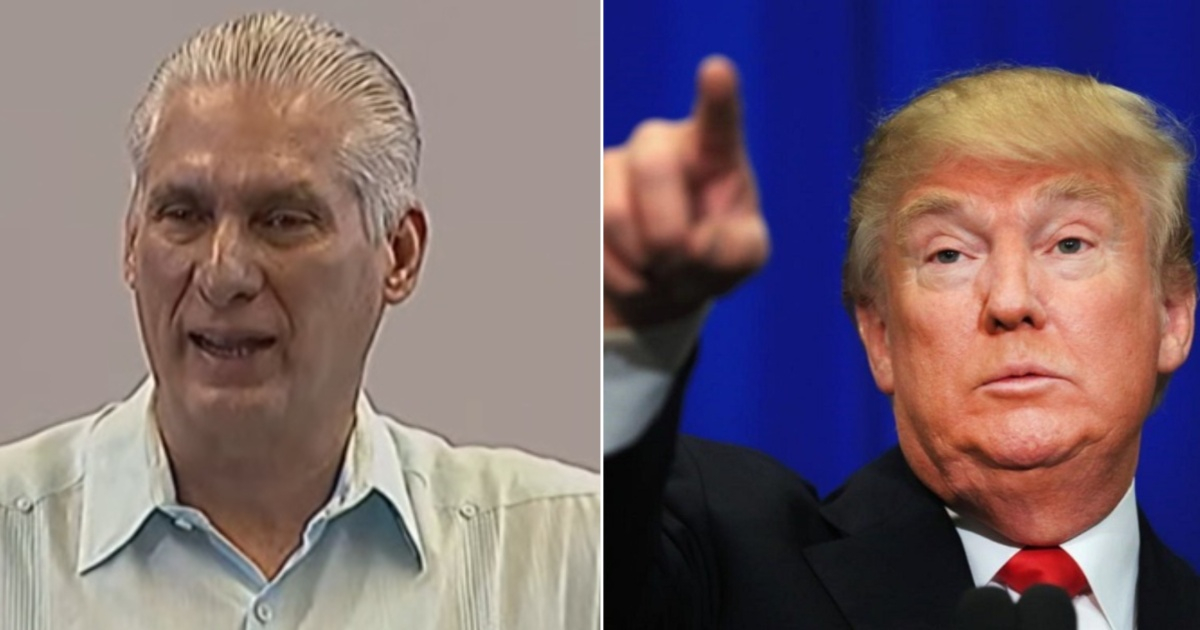
Donald Trump reacted on his social media Truth Social to the Cuban regime's official acknowledgment of conversations with U.S. officials.
In that space, he shared a note from USA Today with the headline: “Cuba confirms talks with Trump officials, raising hopes for an agreement with the United States.”
The gesture of the Republican leader came after Miguel Díaz-Canel publicly acknowledged that Cuban representatives have engaged in discussions with Washington to seek dialogue-based solutions to the bilateral differences.
Trump's statement reinforces a narrative that his circle has been maintaining for weeks and that had been repeatedly denied by Havana.
Díaz-Canel confirmed on Thursday, during a meeting with the Political Bureau, the Secretariat of the Central Committee, and the Executive Committee of the Council of Ministers, that Cuban officials have held talks with representatives of the United States government.
The video containing those statements was broadcast this Friday by Canal Caribe, prior to a meeting between the leader and the state media.
During that intervention, Díaz-Canel stated that the contacts have been conducted "at the highest level" and specified that they are led by him and Raúl Castro, whom he referred to as "the historic leader of our revolution," in addition to being coordinated with the top structure of the Party, the State, and the Government.
According to his explanation, the discussions pursue four objectives: to identify the most pressing bilateral issues, to find solutions, to gauge the willingness of both parties, and to explore areas of cooperation for regional security. He also stated that the process must be conducted "on the basis of equality and respect for the political systems of both states."
The Cuban leader's public admission contrasts with the official stance held until just a few days ago.
On January 12, Díaz-Canel himself had denied the existence of those conversations, characterizing them as "technical contacts in the migration field."
In February, the Deputy Foreign Minister Carlos Fernández de Cossío stated that "that dialogue has not begun," and that on March 10, the regime once again denied negotiations.
The current recognition represents a "180-degree turn" from the narrative upheld for weeks by the Cuban official apparatus.
Trump's reaction occurs in a context of increasing pressure on Havana.
The negotiations with the regime
Following the capture of Nicolás Maduro on January 3, Cuba lost a supply of about 30,000 barrels of Venezuelan oil per day, which accounts for 40% of its energy needs.
This is compounded by simultaneous blackouts that in February affected up to 58% of the Island, with a generation deficit of 1,754 megawatts, and more than 240 new sanctions imposed by the Trump administration, which also designated Cuba as an "unusual threat."
In parallel, outlets such as Axios and the Miami Herald had reported contacts between Secretary of State Marco Rubio and Raúl Guillermo Rodríguez Castro, grandson of Raúl Castro, known as “El Cangrejo,” a colonel and former personal security chief of the former Cuban leader.
A senior Trump official described those exchanges as “discussions about the future” and “remarkably friendly.” Furthermore, on March 7, Trump publicly stated that “Marco Rubio is talking to Cuba right now” and that he could close a deal “in an hour.”
Trump has been saying for some time that there was dialogue and that Marco Rubio was in charge, but they denied it from Cuba.
That observation encapsulates the political core of the episode: the U.S. president seized the public confirmation of Díaz-Canel to amplify it on his own platform and, in doing so, highlighted the contradiction between the regime's previous denials and its later acknowledgment.
Filed under: