
Related videos:
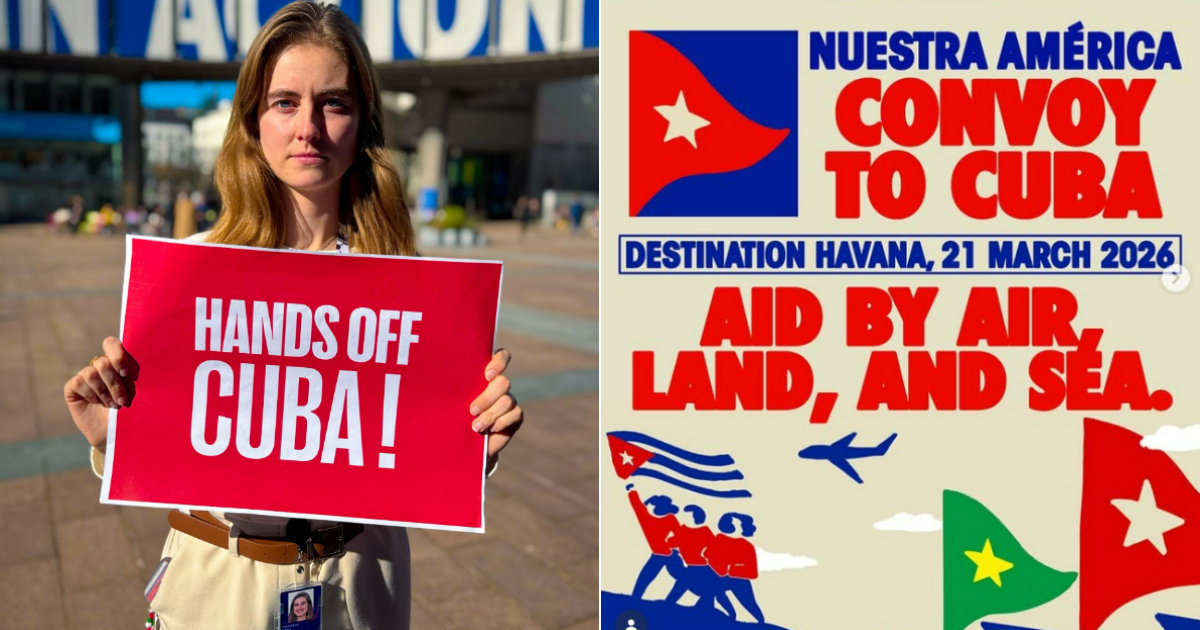
The French-Swedish MEP Emma Fourreau, a member of the French leftist movement La France Insoumise (LFI), announced that she will be traveling to Cuba in the coming days to join the international convoy “Nuestra América,” an initiative aiming to converge in Havana on March 21 with humanitarian aid, which has generated considerable controversy both on and off the island.
“In a few days, I'm heading to Cuba. In support of the Nuestra América flotilla to break the U.S. blockade and march alongside the Cuban people,” wrote Fourreau on the social media platform X. In her message, she added that her trip aims to denounce what she termed “imperialism” and the alleged “criminal aggression” of U.S. President Donald Trump.
The announcement places her among the international figures who have publicly supported the initiative. Among them is also climate activist Greta Thunberg, who recently defended the convoy and accused Washington of provoking the energy crisis on the island.
Thunberg's statements had already sparked a strong response among Cubans on social media, many of whom criticized her for repeating the regime's narrative without mentioning political repression or the lack of freedoms in the country.
A controversial initiative
The "Nuestra América" convoy initially emerged as a maritime flotilla driven by international activists with the stated goal of bringing food, medicine, and supplies to Cuba and denouncing U.S. sanctions.
As the weeks went by, the initiative evolved into a broader operation by air, sea, and land, with international delegations intending to meet in Havana.
Its promoters argue that the Cuban crisis is primarily due to Washington's sanctions. However, numerous analysts and Cuban citizens point out that the country's deterioration is also a result of decades of poor economic management, political control, and a lack of structural reforms by the regime.
Critiques from Exile
The decision by Fourreau sparked a wave of reactions on social media, particularly among Cubans both on and off the island.
Many questioned why European politicians with broad democratic freedoms would travel to Cuba to denounce supposed external aggressions while not mentioning the authoritarian nature of the Cuban political system.
The debate also reignited a slogan that emerged following the initial announcement of the flotilla: “If they enter, we will too”.
The phrase, circulated by exile activists, poses a direct challenge to the Cuban regime: if foreign ships can arrive on the island in the name of solidarity, then Cuban emigrants should also be able to return freely to their country.
For many exiles, the central issue is not the arrival of humanitarian aid, but rather the fact that millions of Cubans cannot enter or leave their own country without political restrictions.
The figure of Emma Fourreau
Fourreau belongs to La France Insoumise, the movement founded by Jean-Luc Mélenchon and situated on the radical left of the French political landscape.
The party maintains a very critical political stance towards the United States, NATO, and the liberal economic model, and has defended on various occasions favorable positions towards allegedly leftist dictatorships in Latin America.
Elected as a Member of the European Parliament in 2024, Fourreau is part of the left-wing parliamentary group in the European Parliament.
As a member of the European Parliament, you receive a base salary of about 10,075 euros gross per month (around 7,800 euros net). In addition, you receive a monthly allowance of approximately 4,950 euros for general expenses —intended to cover office, communications, and political activities— and daily allowances of about 350 euros for each official working day in Brussels or Strasbourg.
These figures reflect the usual salary level of European parliamentarians, but they have also been used by some critics to highlight the propagandistic nature of the initiative, which resorts to performative solidarity instead of opting for direct financial aid from the pockets of activists like Fourreau, who have high incomes.
A contrast with Cuban reality
The monthly salary of a Europarliament member like Fourreau is equivalent to about 700 average state salaries in Cuba.
On the island, the average salary in the state sector is currently around 6,500 Cuban pesos per month, which, based on the informal exchange rate, is approximately between 11 euros per month, depending on the market rate.
Even the daily allowance of 350 euros that MEPs receive for attending official sessions greatly exceeds the monthly income of an average of thirty Cuban workers.
In practical terms, a single day of parliamentary diet amounts to several years of state salary in Cuba.
This contrast has been repeatedly mentioned by users on social media, who question how European leaders can talk about the reality of the island without experiencing the living conditions faced by its citizens.
A journey amidst a deep crisis
Fourreau's journey takes place during a time of significant economic decline in Cuba, characterized by prolonged blackouts, shortages of food and medicine, uncontrolled inflation, and increasing social unrest.
In recent weeks, isolated protests have been reported related to power outages and shortages.
While international activists discuss solidarity with the island, many Cubans remember that the crisis cannot be explained solely by external factors.
For them, the discussion about the international convoy reflects a deeper conflict: the divide between those who interpret Cuban reality from the outside and those who experience it daily within the country.
Filed under: