
Related videos:
The Cuban regime once again sold a false hope this week, as Cubans endure the sixth total disconnection of the National Electric System (SEN) in the last 12 months, leaving the island without electricity from end to end.
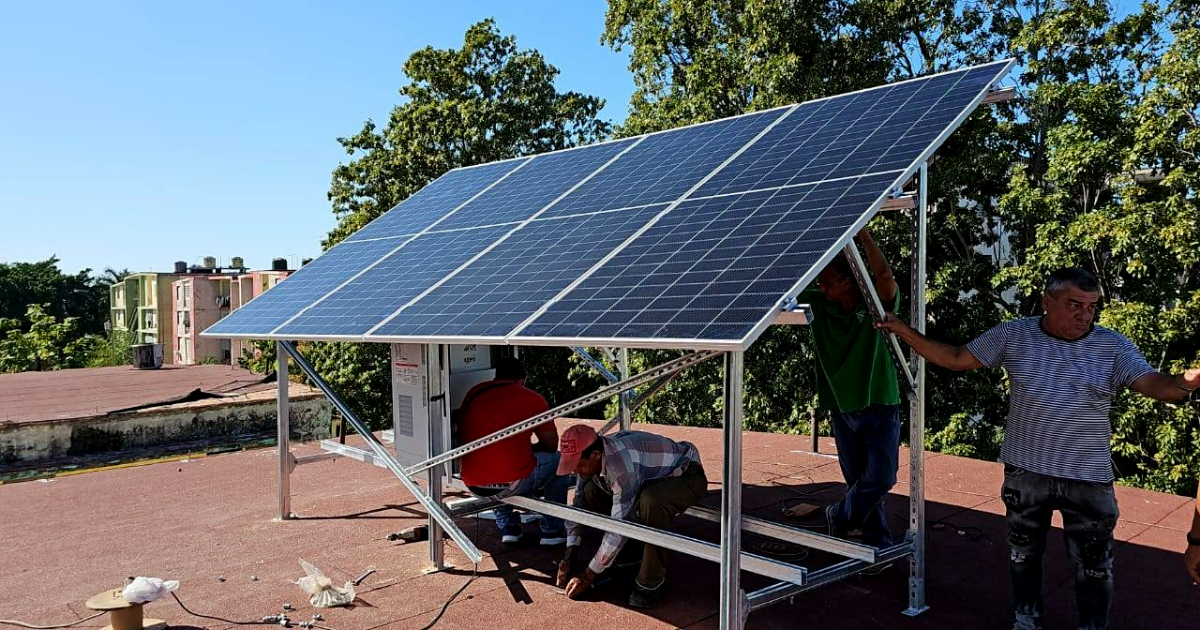
However, this Sunday the Ministry of Foreign Affairs (MINREX) announced on its social media that Spain will send food, hygiene items, and solar panels as part of an aid package from AECID, including solar systems for medical centers and cooperatives.
But the key question is not what arrives, but what changes.
Because Cuba has been receiving international assistance for its energy system for years. The European Union has allocated at least 18 million euros to the sector, with specific projects such as the program EE-FRE Local, which amounts to over 11.7 million dollars.
This is supplemented by other initiatives and funds routed through international agencies and bilateral cooperation.
The result, however, is difficult to justify.
After years of implementation, one of the main projects has managed to install just over a hundred photovoltaic systems in isolated communities, benefiting only a few hundred people.
The electricity generated by these facilities is insignificant compared to the structural deficit of the Cuban electric system, which leaves millions without power for hours every day.
Meanwhile, the country has experienced half a dozen national blackouts in recent months. The national electric system operates on the brink of permanent collapse, with outdated power plants, a lack of fuel, and infrastructure unable to meet demand.
The official reports from Spanish cooperation acknowledge what the propaganda overlooks: lack of clear indicators, delays, execution difficulties, and an impact that is "hardly measurable".
Since 2021, even direct bilateral cooperation has practically come to a standstill due to the country's economic crisis.
But there is an even more critical element: the regime's absolute control over the aid.
All international cooperation in Cuba goes through the Ministry of Foreign Trade (MINCEX), meaning through the state apparatus itself. There is no independent execution, no effective external control, nor real accountability mechanisms.
Money flows in, is channeled through state structures, and gets diluted in fragmented, slow, or outright unfinished projects.
The result is a model that prioritizes narrative over impact.
Workshops are organized, strategies are designed, technicians are trained, and small pilot systems are installed that serve as showcases. Yet the national electrical system—the one that impacts millions of Cubans—remains unchanged in its precariousness.
The new shipment announced by Spain fits perfectly into that pattern. Solar panels for certain specific centers can alleviate isolated situations, but they will not resolve a structural energy crisis that requires massive investments, profound reforms, and a completely different management approach.
None of that is on the table.
Instead, the regime continues to use each aid package as a propaganda tool, attributing the crisis to the "blockade" while receiving millions in international cooperation that do not result in visible improvements for the population.
The paradox is evident: Europe finances Cuba's energy transition, yet Cuba continues to experience daily blackouts.
And while new solar panels are arriving, the country remains in the same darkness.
Filed under: