
Related videos:
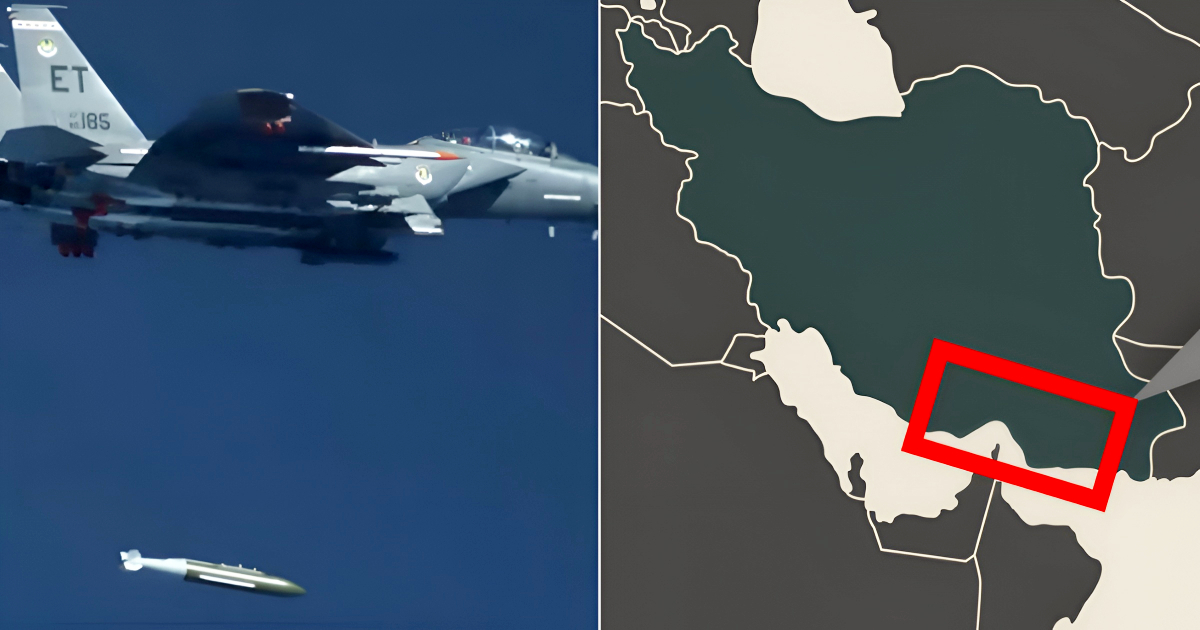
The United States Central Command (CENTCOM) confirmed yesterday that its forces successfully employed multiple 5,000-pound penetrating munitions against Iranian missile sites reinforced along the coast of Iran, near the Strait of Hormuz, as part of the so-called Operation Epic Fury.
A few hours ago, U.S. forces successfully deployed several 5,000-pound penetrator munitions against fortified Iranian missile sites along the coast of Iran, near the Strait of Hormuz.
The Iranian anti-ship cruise missiles at these locations posed a risk to international shipping in the Strait," CENTCOM noted on its official X account, a post that garnered over 2.5 million views in just a few hours.
The munitions used are the GBU-72/B, known as Advanced 5K Penetrator, 2,300-kilogram precision guided bombs equipped with a GPS/INS guidance system, specifically designed to destroy bunkers and hardened, deeply buried targets.
They represent an intermediate capacity between the conventional 2,000-pound bombs and the Massive Ordnance Penetrator of 30,000 pounds, and can be launched from platforms such as the B-1B and the F-15E.
The attack marks the first confirmed use of this type of penetrator ammunition against Iranian anti-ship missile arsenals in the Strait region. Iran deploys missiles such as the Noor, derived from the Chinese C-802 with a range of up to 300 kilometers, and the Khalij Fars, an anti-ship ballistic missile with a similar range and a warhead weighing 450 kilograms, stored in fortified and underground facilities.
The Epic Fury Operation was launched on February 28 at 1:15 AM by the United States and Israel, with attacks on more than 1,000 Iranian targets in the first 24 hours. By March 16, the operation had struck over 5,000 targets and recorded more than 6,000 combat flights.
Among the confirmed Iranian casualties are Ayatollah Alí Jamenei, Chief of Staff Abdorrahim Musavi, Minister of Defense Aziz Nasirzadeh, the secretary of the Supreme National Security Council, Ali Larijani, the commander of the Basij militia of the Revolutionary Guard, Gholamreza Soleimani, and the commander of the Islamic Revolutionary Guard Corps Mohammad Pakpur.
Iran responded to the offensive with a partial blockade of the strait, reducing maritime traffic from 153 daily transits to just between 4 and 13, which caused the price of Brent oil to soar above 120 dollars per barrel. At least between 8 and 11 merchant ships have been damaged by Iranian drones and missiles since March 2.
On March 10, CENTCOM destroyed 16 Iranian mining ships in the area, and on March 14, it bombed Kharg Island, which manages 90% of Iranian crude oil exports.
President Donald Trump stated that the United States "does not need help from anyone," following the refusal of NATO, Japan, Australia, and South Korea to participate in joint escort missions in the strait, and pointed out that he is not ready to stop the attacks.
For their part, analysts at J.P. Morgan warned that oil producers in the Middle East would only withstand 25 days if the strait, through which 20% of the world's oil passes, were to close completely.
The President of the Iranian Parliament, Mohammad-Bagher Ghalibaf, responded with a statement summarizing Tehran's position: the Strait of Hormuz "will not return to its pre-war state."
Filed under: