
Related videos:
The recent announcement by the Cuban government to allow Cubans residing abroad to invest and own businesses on the island has generated expectations within the diaspora.
However, legal experts and analysts warn that, in practice, this supposed economic opening lacks real guarantees and could pose a significant risk for those who choose to invest their capital in the country.
The Minister of Foreign Trade, Oscar Pérez-Oliva Fraga, stated that Cuba would be willing to accept investments from Cubans abroad, even in strategic sectors such as the deteriorated national infrastructure. The statement was presented as a sign of economic flexibility amid the deep crisis the island is facing.
However, behind the announcement, the same structural problems persist that have historically hindered investment: an independent judiciary system, a slow and opaque state bureaucracy, and a legal framework that can be modified at discretion.
One of the main obstacles is the absence of a true rule of law. Legal experts consulted by the Miami Herald indicated that there are no independent courts in Cuba capable of protecting investors in the event of conflicts.
Judicial decisions are driven by directives from the State itself, leaving business owners —both national and foreign— in a position of extreme vulnerability.
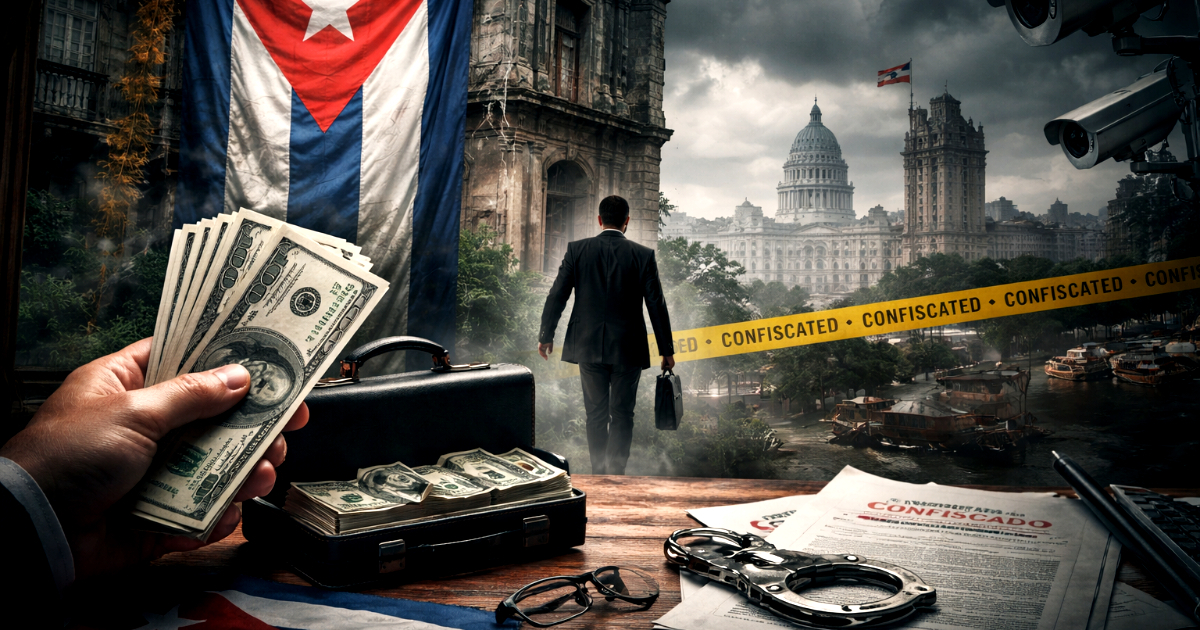
This is compounded by a particularly sensitive element: the confiscation of assets, which remains included within the Cuban legal framework.
Historically used as a tool for political and economic control, this figure allows the state to expropriate businesses under various justifications, creating distrust among potential investors, especially in Miami, where descendants of families who lost their properties after the revolution reside.
The background reinforces these concerns. In recent years, several entrepreneurs have been prosecuted, imprisoned, or stripped of their businesses on the island.
Cases like that of Canadian businessman Cy Tokmakjian, or more recently that of Cuban-American Frank Cuspinera Medina —who reported from prison the fabrication of charges to justify the expropriation of his company— highlight the real risks of doing business in the country.
Moreover, the regulations that were supposedly going to allow Cubans abroad to invest in the island are not even fully in effect.
Experts indicate that the immigration law mentioned by the authorities, which would include the figure of investors from abroad, has not been officially published in the Gazette, therefore it is not in effect, which prevents its effective implementation.
There is also no clarity regarding the requirements to access the “resident investor” category, which increases uncertainty.
State control over key sectors of the economy adds more barriers. In Cuba, all banks belong to the State, which allows for the restriction of capital movement.
In fact, since the end of 2025, numerous foreign companies have reported difficulties in transferring funds out of the country.
The situation is even more complex in areas such as agriculture and real estate development. The State owns about 80% of arable land, and private land ownership is extremely limited.
Even in urban areas, the land remains state-owned, which complicates any long-term investment projects.
From a political standpoint, there are also no signs of structural change. The United States Secretary of State, Marco Rubio, recently stated that the measures announced by Havana are insufficient to address the country's economic crisis.
Furthermore, U.S. sanctions remain in effect and require specific authorizations for any type of investment, which adds another layer of complexity.
In this context, the apparent openness of the regime is viewed more as an attempt to attract foreign currency than as a genuine reform of the economic model.
Without legal guarantees, without institutional transparency, and with a history of arbitrariness, investing in Cuba remains, for many, a high-risk gamble.
As long as there are no profound changes in the political and legal systems, experts agree on a clear conclusion: despite official announcements, the actual conditions for investing in the island remain extremely precarious.
Filed under: