
Related videos:
Turkish turbines will start generating in April
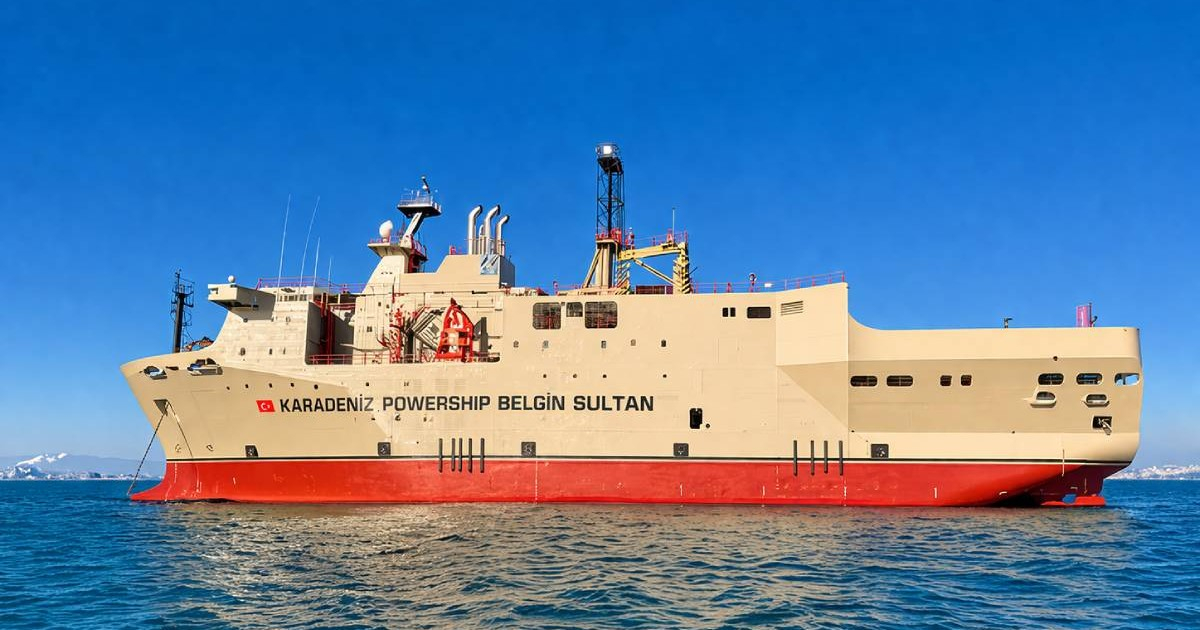
The Ministry of Energy and Mines of Cuba confirmed this Monday that the two active Turkish barges on the island will begin generating electricity in the second half of April, once the Russian fuel that arrived at the end of March is available for use.
"Currently, two barges are operating in Cuba, Belgin Sultán and Erol Bay, with an installed capacity of 124 MW. No other barges have been added in the last few hours. Following the arrival of the Russian fuel, they will be generating electricity in the second half of this month", the ministry posted on its social media.
Arrival of Russian oil
The fuel arrived aboard the Russian tanker Anatoly Kolodkin, which docked at the port of Matanzas at the end of March with approximately 730,000 barrels of crude oil, equivalent to 100,000 metric tons. The unloading of the cargo took 96 hours.
The state-owned company CUPET detailed that fuel will be distributed primarily for distributed electricity generation, the Mariel and Moa plants, essential services, and the production of fuel oil intended for the barges themselves. Cuba had not received stable shipments of oil since January 2026, which further worsened the already deteriorated national electricity system.
The Kremlin acknowledged that the shipment was discussed in advance with Washington before being carried out. The Russian spokesperson Dmitri Peskov publicly defended it on March 30 with a straightforward statement: Russia says it must help Cuba and not remain on the sidelines.
An electrical system in crisis
The announcement comes at one of the most critical moments for the Cuban electrical system.
This Monday, the Antonio Guiteras Power Plant —the largest generator in the country, responsible for between 20% and 25% of the national thermal capacity— was taken offline from the National Electroenergy System at 3:00 a.m. due to a puncture in the boiler, with a forecast of being out of service for 72 hours.
During the entire first week of April, blackouts exceeded 1,600 MW daily, affecting 100% of the territory for 24 hours. The highest impact of the week was recorded on April 1: 1,945 MW at 7:50 p.m.
Recent data from SEN
The situation has not improved in the first days of April. According to the official report from the National Electric System (SEN), the service was affected for 24 hours on April 6 and continued to experience interruptions in the early morning of the 7th. The maximum impact reached 1,871 MW at 8:50 PM.
At 6:00 a.m. on April 7, the system availability was only 1,200 MW compared to a demand of 2,518 MW, resulting in an impact of 1,337 MW. By noon, a similar impact was anticipated, around 1,250 MW.
Among the main incidents reported are breakdowns at the Unit 2 of the Felton Power Station and the Antonio Guiteras Power Station itself, as well as maintenance work at several plants: unit 5 at Mariel, units 3 and 6 at Renté, and unit 5 at Nuevitas. Additionally, there are limitations in thermal generation that keep about 366 MW offline.
Forecast for today's peak hours
For peak hours, authorities anticipate the partial entry of the Energás Boca de Jaruco power plant with about 40 MW combined. Nevertheless, availability is estimated to be only 1,240 MW against a maximum demand of 3,080 MW, which would result in a deficit of 1,840 MW and a projected impact close to 1,870 MW.
In parallel, renewable generation remains insufficient to compensate for the structural deficit. The 54 new photovoltaic solar parks produced 3,518 MWh, with a peak capacity of 514 MW during hours of maximum radiation, a contribution that fails to reverse the energy crisis.
In that context, the contribution of the two barges - a combined 124 MW - represents a marginal improvement.
The shipment of 730,000 barrels is equivalent to only about seven to ten days of total consumption in the country, which requires between 90,000 and 110,000 barrels per day to maintain its electrical system under normal conditions.
Reduction of the fleet of barges
The Turkish barges from Karpowership have been operating in Cuba since 2019 as a temporary solution to the crisis in the electrical system, caused by the deterioration of thermal power plants and a chronic lack of fuel.
At its peak, Cuba operated up to eight barges with a combined capacity of over 500 MW. The fleet gradually diminished due to the Cuban government's failure to make payments, until in September 2025, Minister Vicente de la O Levy publicly acknowledged that Cuba could only afford two units: specifically Belgin Sultán and Erol Bay.
This Monday, the Cuban government also denied reports from Turkish media and analyst Falcon -based on tracking automatic identification signals from vessels- suggesting the arrival of a new barge in Havana, thus ruling out any immediate expansion of the floating fleet.
Filed under: