
Related videos:
The most historic images ever taken by these cameras from deep space were captured by the four GoPro cameras mounted on the wings of the solar panels of NASA's Orion spacecraft, during the sixth day of the Artemis II mission last Monday.
The photographs were taken during the lunar flyby on April 6, 2026, when the crew —commander Reid Wiseman, pilot Victor Glover, specialist Christina Koch, and Canadian Jeremy Hansen— was over 400,000 kilometers from Earth, surpassing the record for the maximum distance achieved by humans, which had been set by Apollo 13 since 1970.
The first image shows the Moon backlit by the Sun during a total solar eclipse lasting nearly an hour, a phenomenon impossible to observe from Earth under those conditions. Also visible in the frame are Saturn, just below the lower right edge of the Moon, and Mars at the far right of the image.
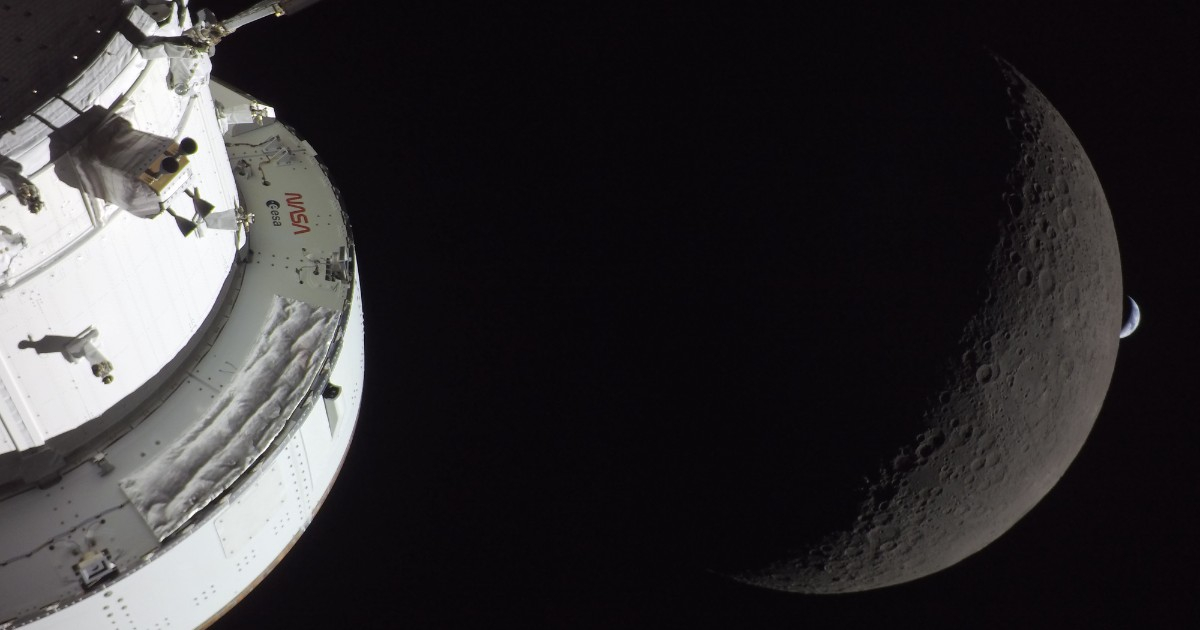
The second photograph, taken at 6:42 p.m. ET on that same day, captures the Moon and the Earth in a single frame. The Earth appears as a small crescent moon about to "set" below the lunar horizon, tiny compared to our natural satellite.
The third image documents the end of the eclipse, with the Sun peeking over the left edge of the Moon, creating the characteristic "diamond ring" effect. During the totality of the eclipse, with the lunar surface in complete darkness, the crew reported having observed six flashes of meteorite impacts on the lunar surface, caused by meteoroids traveling at thousands of miles per hour, a finding of scientific value for the study of lunar risks.
The fourth image shows the Orientale basin, an impact crater 600 miles in diameter surrounded by mountains that stretches across both the near and far sides of the Moon. It is only partially visible from Earth, which is why this photograph represents the first time human eyes have seen it in its entirety.
The four highly modified GoPro HERO4 Black units designed to withstand the extreme conditions of space are part of NASA's official Orion Imagery System and serve as inspection tools during critical moments of the mission. In addition, National Geographic equipped the crew with additional GoPros to document daily life on board as part of the "Return to the Moon" project.
The Orion spacecraft left the gravitational influence of the Moon last Tuesday and began its final return to Earth, with a landing expected in the Pacific Ocean on April 10, 2026. "GoPro was built for missions like this: small, rugged, and adaptable cameras that provide reliable performance in the most extreme conditions imaginable. From the ocean to the mountains to deep space, the mission remains the same."
Image Gallery
A historic image: Orion, the Moon, and Earth in the distance
The Moon appears silhouetted against the solar glow in an image captured by the Orion spacecraft during the Artemis II mission.
Eclipse from Orion: this is how the Moon appeared in front of the Sun
The Moon appears in silhouette against the solar glow in an image captured from the Orion spacecraft during the Artemis II mission.
The moment when the Sun reappears after the lunar shadow
A fine solar glimmer emerges behind the dark disc of the Moon, creating one of the most dramatic scenes recorded during the mission.
Lunar craters in detail from the Artemis II spacecraft
The image reveals craters and surface features of the Moon with great clarity, while part of the Orion structure remains visible in the frame.
Filed under: