
Related videos:
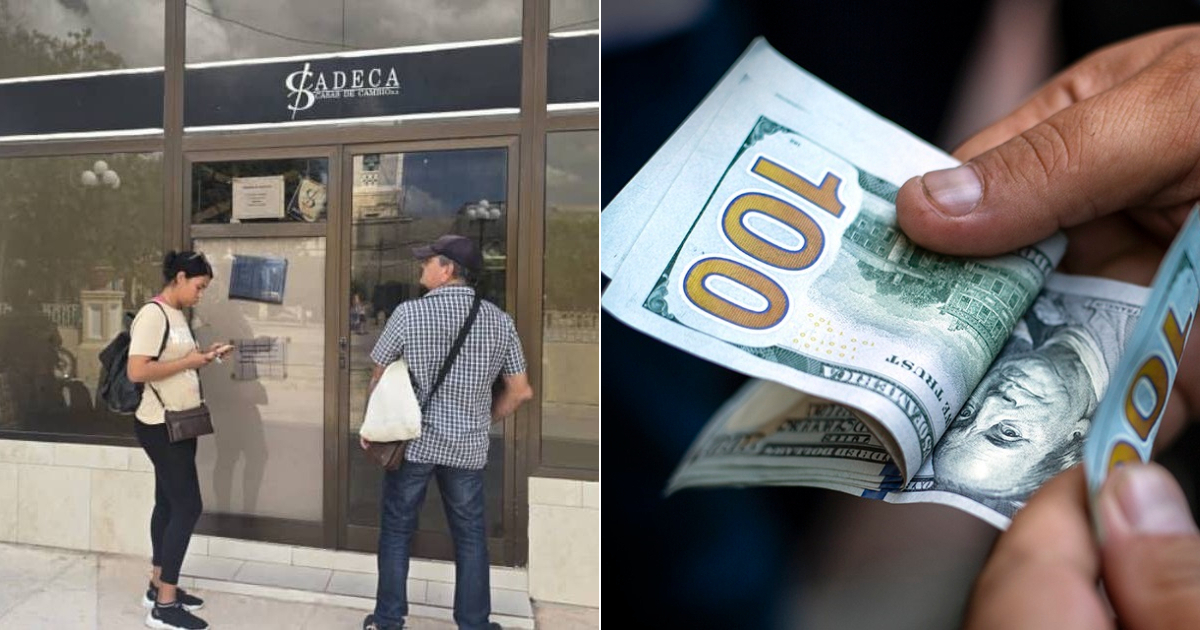
The Cuban state-run communist press has reported news stating that Financiera CIMEX S.A. (Fincimex) announces that remittances from abroad can be received in cash in dollars at the Currency Exchange offices (Cadeca). In this case, beneficiaries will have the option to withdraw the received cash or deposit all or part of the remittance amounts into their Clásica accounts, a financial product that offers discounts and additional advantages.
This news was announced by Fincimex itself on its Facebook page. This company is a fundamental element within the Cuban financial system due to its access to foreign currency, which has been playing an increasingly important role in balancing the external accounts of the weakened Cuban economy.
It is worth noting that Fincimex began its operations upon its establishment in Panama in January 1984, as an integral part of the CIMEX Group; however, its services were primarily developed in Cuba starting in 1995, during the "Special Period," with a focus on managing remittances and financial services, receiving official authorization from the Central Bank of Cuba (BCC) in 1999. Among other functions, the entity was authorized to carry out the following:
- Financing of export operations
- Management of remittance cards
- Financial leasing operations
- Short-term financing for domestic purchases
Thus, Fincimex's evolution in the Cuban economy has established it as a key institution within the national financial system, due to its specialization in managing international remittances. In fact, its leading role was strengthened when it began to play a predominant part in the money transfer process to Cuba, managing to channel 41% of the remittances received on the island and controlling nearly 95.7% of official transactions.
An exponential growth in activity was achieved by developing strategic alliances with other entities specialized in remittance management, such as Western Union, which established 407 payment points in Cuban territory, and shortly thereafter with Small World Financial Services, allowing for the consolidation of a network for the remittance process.
The launch of Small World in June 2024 highlighted the significant fragility of the traditional remittance management system in Cuba, which led to the adoption of digital platforms. However, this had to contend with substantial obstacles, such as technological limitations, as only 63% of Cubans have stable internet access, and the reliance on intermediaries, since the commissions accumulated between senders and receivers drive up the cost of the service.
And here comes the most relevant part: currently, Fincimex operates under the direct control of Grupo de Administración Empresarial S.A. (GAESA), an organization closely linked to the Cuban military sector. This connection, for which there is no official data available, has captured the interest of international organizations and the U.S. Department of the Treasury, which formally designated Fincimex in 2020 as an entity under the control of the Cuban Revolutionary Armed Forces.
Analysts highlight that the company's favorable results have been driven by the direct involvement and control of Fincimex by GAESA, under the direction of the FAR, consolidating a military control structure that manages financial entities on the island, with GAESA acting as the sole supervisor of strategic operations in the sector.
The benefits of the military and business relationship between Fincimex and GAESA are reflected in three very concrete outcomes:
Firstly, to play a central role in the foreign exchange management system, as approximately 74.3% of every $100 that Cuba receives in remittances is withheld through taxes and markups in MLC stores.
Secondly, the vertical integration, which has allowed GAESA to control the entire financial cycle, from card issuance (Fincimex) to final consumption in commercial establishments (TRD, CIMEX).
Third: institutional support, which is manifested in the licenses from the BCC and the preferential access to state infrastructure that provides Fincimex with significant operational advantages.
The integration of Fincimex into this military-business system reflects the strategy of the Cuban government to maintain centralized control over international financial operations, not only in remittances in general but also in all operational activities of GAESA in tourism and hospitality, retail, import and export, financial services, construction, real estate, and maritime transport, among others.
These facilities for remittance recipients seem to fall within a Fincimex strategy to broaden the options for managing the money that Cubans receive from abroad, with the aim of facilitating access to foreign currency while encouraging savings through the Clásica card.
This service has been launched by the entity to celebrate the third anniversary of the card, which has established itself as a payment instrument that provides benefits to its holders.
Fincimex is actively engaged in the management of cards for commercial distribution on the Island, with exclusive authorization from the Central Bank of Cuba to handle remittance cards throughout the country. Notably, the AIS (American International Service) is directly related to remittances and is accepted in over 10,000 establishments nationwide. In particular, there are the Clásica cards for purchases in MLC, which provide access to 586 specialized stores; the Clásica OFA card, aimed at foreign visitors, offering discounts on tourist services; and the Clásica card, created for payments in physical dollars, mainly used at gas stations and selected businesses. This card offers unlimited reloading and discounts of 5-10% at Cimex, Caribe, and Turismo Gaviota stores.
With these cards, Cubans receive money from abroad on prepaid cards, make purchases at authorized stores, and withdraw cash from ATMs. Now, with the measure announced by Fincimex, they will be able to access foreign currency in the Cadecas.
Leaving foreign currency in the hands of the recipients, in strong currency, is an important qualitative leap that deserves attention, but no one should fear that it will lead to a eventual dollarization of the Cuban economy. Not so much because of the amount of remittances, which reach 20% of the population, but due to the increasing asymmetry (and injustice) in the management of money coming from families abroad.
Filed under:
Opinion article: Las declaraciones y opiniones expresadas en este artículo son de exclusiva responsabilidad de su autor y no representan necesariamente el punto de vista de CiberCuba.