
Related videos:
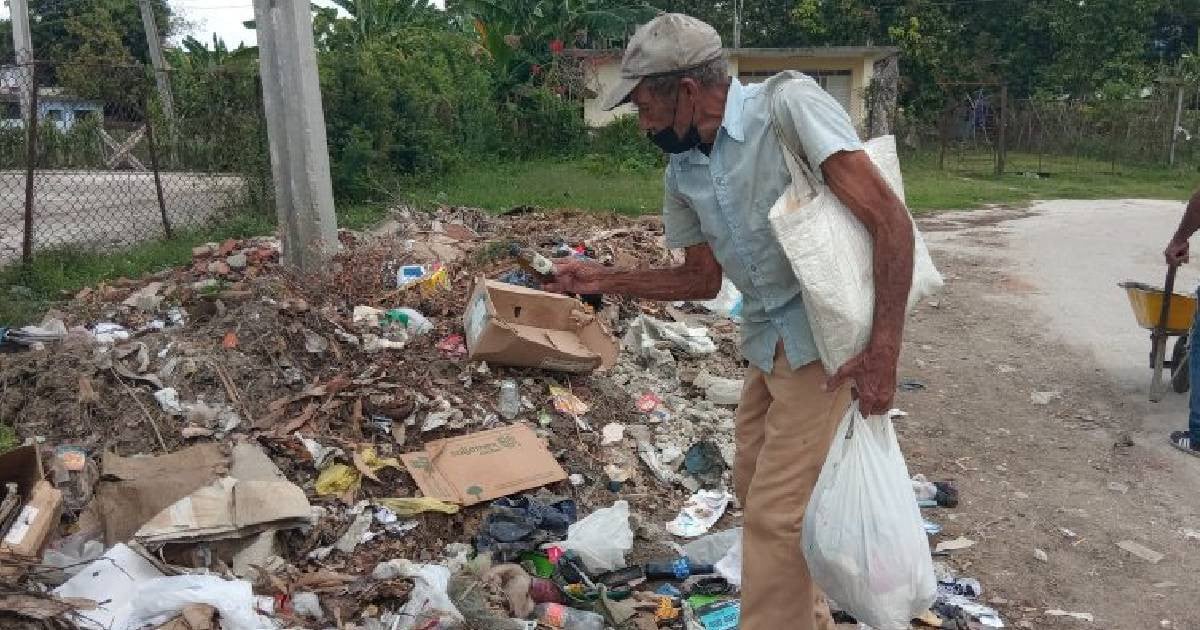
The official newspaper La Demajagua published on Friday the profile of an elderly resident in Bayamo who collects cans and bottles in landfills to survive, a story presented as an example of "effort," despite revealing the precariousness of pensions in Cuba.
According to the media outlet, Jacinto Gutiérrez Medina, born in 1950 and a resident of the Roberto Reyes neighborhood in Granma's capital, collects aluminum cans, copper, bronze, and bottles of rum and beer in the landfills that have proliferated in the city due to the shortage of fuel for garbage trucks.
The text, titled "Jacinto, a Pause on the Hill," portrays the elder as an example of "intelligent" people who do not let themselves be defeated, romanticizing what is actually a direct consequence of the collapse of the Cuban social security system.
Jacinto himself says it bluntly: "What they pay me from the checkbook… does not meet my needs in life."
In her "best months," she estimates having gathered between 7,000 and 9,000 pesos by selling those materials, a figure that contrasts with the minimum pension of 4,000 Cuban pesos, less than 10 dollars at the informal exchange rate, which the regime set after the increase in September 2025.
At the end of the report, the journalist notes almost as a picturesque detail the most revealing confession of the elderly man, who lowers his voice before saying it: "I'm desperate to sell those bottles... to make some profit... and to eat." The phrase summarizes the tragedy that the text attempts to disguise as heroism.
This case follows a systematic pattern of the Cuban state-run press, turning neglect into virtue and misery into propaganda.
In March, media outlets aligned with the regime presented as "creativity" the funeral transports using horse-drawn carts that a cooperative in Bayamo began to provide due to the lack of fuel.
Earlier, in January, the official journalist Oliver Zamora Oria described an image of barefoot children in dilapidated parks as "tender."
In April 2025, the official newspaper Granma celebrated as an "achievement" the rescue of homeless individuals in Santiago de Cuba who had lived for years on the streets in plain sight of the authorities.
In all cases, the official narrative avoids questioning the structural causes, which include the failure of the economic model, inflation, and the institutional neglect of the most vulnerable.
The reality for Cuban retirees is devastating. According to a survey conducted by the Independent Trade Union Association of Cuba between September and October 2025 with 506 people in five provinces, 99% of retirees state that their pension does not cover basic needs such as food, housing, and medication.
The Cuban Observatory of Human Rights documented that 79% of individuals over 70 years old are unable to have three meals a day, and 90.7% of retirees work informally after retirement to survive.
Cuba has 1,774,310 registered retirees according to the National Office of Statistics and Information, and the Family Care System barely serves around 67,000 people with a budget amounting to about 14,600 dollars for the entire country in 2026.
Jacinto also recalls, without apparent irony, that he recycled during the regime of dictator Fulgencio Batista (1901-1973). "I recycled when Batista was in power, and we lived off that."
Seventy years later, the dictatorship that promised to end that precariousness returns it to the same dump.
Filed under: