
Related videos:
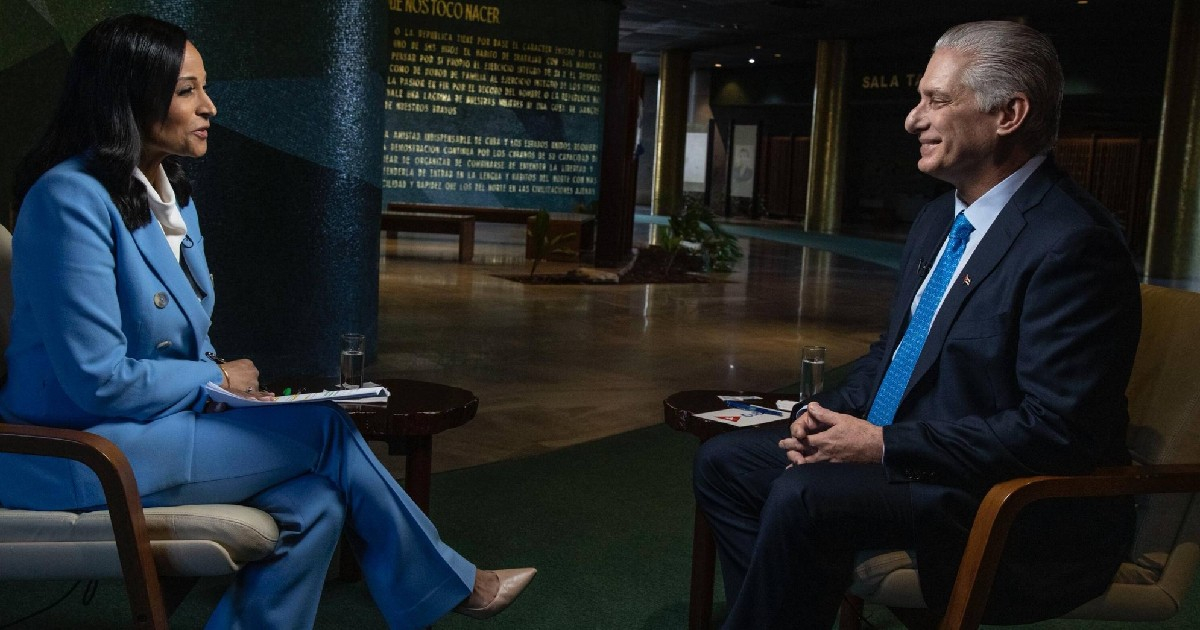
The independent Cuban journalist Mónica Baró Sánchez described Miguel Díaz-Canel's interview on NBC News' "Meet the Press" as a success for Castro's propaganda, and she stated that the host, Kristen Welker, provided a comfortable platform for the Cuban leader with barely any questions.
"Ay, Kristen, my dear. The monster of Castro's propaganda got you by the leg," Baró wrote in one of several Facebook posts shortly after NBC aired the full 47-minute episode, considered the first appearance of a Cuban leader on U.S. television in decades, since Fidel Castro in 1959.
Baró described Díaz-Canel as a "stone-faced" individual who "outrageously lied about everything he wanted with hardly any objections," and criticized his condescending tone: "Every time I heard him start each response with an 'let's see,' or a 'look,' as if he were talking to a primary school student instead of a journalist, I had to take a deep breath."
One of the most revealing moments, according to Baró, was when Welker asked Díaz-Canel if he was willing to release the rapper Maykel Osorbo and other political prisoners: his first reaction was to laugh.
After the laughter, the leader denied the existence of political prisoners in Cuba, labeling that narrative as a "capsule" and "slander to discredit the revolution," and claimed that "no one goes to jail" for protesting during blackouts because the leaders listen to the people, which is "a democratic exercise." "Yes, my dears: the hard-faced person we have in the presidency of Cuba said that," Baró remarked ironically.
When Welker asked him if he was willing to commit to Washington's demands—releasing political prisoners, holding multiparty elections, and allowing a free press—Díaz-Canel responded that no one has made those demands to him and that the "paraphernalia" about whether Cuba is a tyranny should be set aside because "we are defenders of human rights, [...] we are not a dictatorship."
Baró pointed out that Welker did not respond at any of those moments, allowing the leader to use the program as a propaganda platform aimed, according to the journalist, "at American citizens, not at Cubans."
Díaz-Canel also acknowledged in the interview that he has never spoken with Secretary of State Marco Rubio, and showed, in Baró's words, "zero, zero, zero willingness to change," even when Welker mentioned the examples of China and Vietnam as models of economic opening. "If left to his own devices... he would completely exterminate the country and keep saying 'lift the embargo'," the journalist noted, who won the Gabo Prize for Latin American Journalism in 2019.
The leader was so comfortable that he felt encouraged to share two anecdotes, the analyst noted, including one about "novel clinical trials" involving Alzheimer in collaboration with Colorado, which would have left "very happy" American patients, after Welker told him there was no time for that.
Baró also dismantled the democratic legitimacy of those who speak on behalf of the "Cuban people": Díaz-Canel was proposed as the sole option by the Parliamentary Nomination Commission in April 2018, a day before his birthday, and was approved with 99.8% of the votes by 604 deputies without competing against anyone. "That is a terrible parody of participation. A mockery," wrote the journalist.
A disturbing moment arose when Díaz-Canel invoked Antonio Maceo to warn that "anyone who attempts to seize Cuba will gather the dust of its soil drenched in blood, if they do not perish in the struggle." For Baró, when the leader speaks of a "war of the entire people," "what he is really saying is that he is willing to sacrifice an entire population to protect a totalitarian and repressive system that has lasted for 67 years."
The interview takes place in a context of maximum pressure: since January 2026, President Donald Trump signed Executive Order 14380, declaring the regime an "extraordinary threat" to U.S. national security. Subsequently, both he and Secretary of State Marco Rubio have repeatedly referred to the urgency of a regime change on the Island.
Cubans, caught in the worst crisis the country has faced in decades, have expressed in ongoing protests their desire for freedom. The Island's government and its military institutions have responded with increased repression and propaganda.
Filed under: