
Related videos:
A U.S. federal appeals court has temporarily authorized the continuation of the construction of the controversial ballroom promoted by Donald Trump in the White House, amidst an intense legal dispute over the limits of his authority and the implications of the project.
The decision, made by a panel of three judges from the D.C. Circuit Court of Appeals with a vote of two to one, allows the work to continue at least until April 17, while the administration seeks a possible review by the Supreme Court.
In addition, the court ordered District Court Judge Richard Leon to clarify key aspects related to national security, one of the government's central arguments.
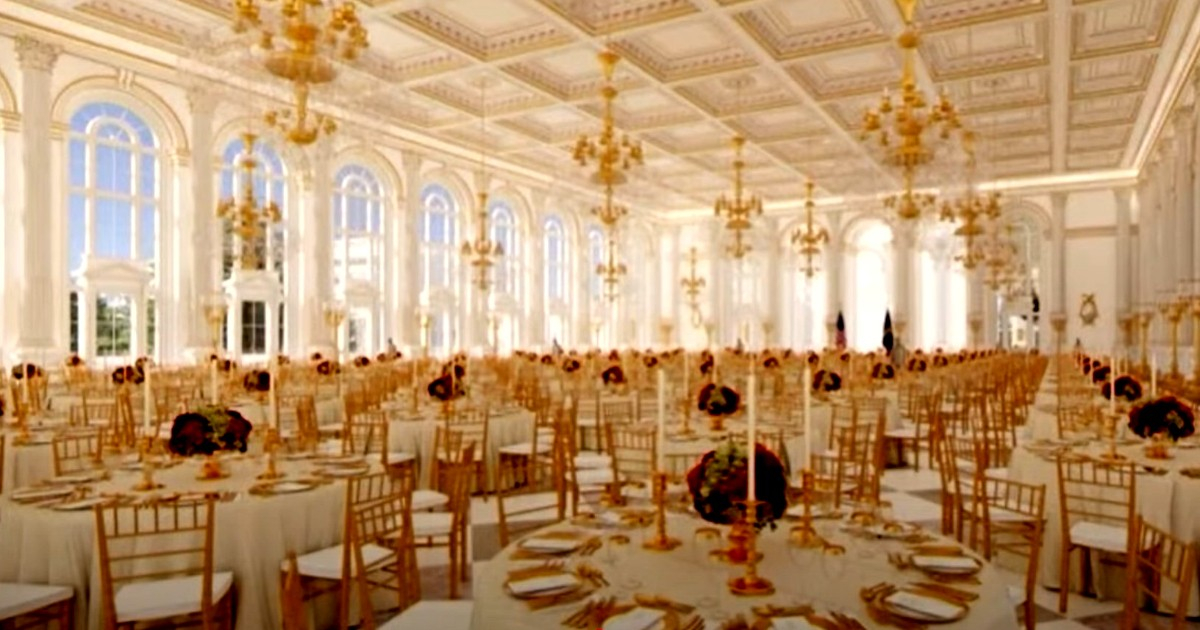
The project, valued at around 400 million dollars, involves the construction of a ballroom measuring approximately 90,000 square feet in the space where the East Wing of the White House used to stand, a historic structure that traditionally housed the First Lady's offices and was demolished in September. This wing was originally built in 1902 during the presidency of Theodore Roosevelt and expanded in 1942.
The initiative has been promoted by Trump as a flagship project of his administration, aimed at accommodating foreign leaders and hosting major events without relying on temporary facilities like tents in the South Lawn.
The leader has personally been involved in the design and promotion of the project, showcasing models and highlighting its features on multiple occasions.
"It will be the largest and most beautiful ballroom ever built. This space will serve our country for centuries," he wrote in a post along with an image of the project design.
However, the plan faces strong legal opposition led by the National Trust for Historic Preservation, which filed a lawsuit in December, arguing that the president exceeded his authority by ordering the demolition of the East Wing without congressional approval, a requirement they deem essential for intervening in federally owned properties of significant historical value.
In March, Judge Leon initially ruled in favor of the conservation group and ordered a halt to the construction, considering that the president acts as "administrator" of the White House and not as its owner, and that no law grants him the authority to undertake a project of this magnitude without legislative approval.
The Trump administration appealed the decision, arguing that halting the construction left the presidential residence "exposed and vulnerable," putting the safety of the president, his family, and the staff at risk.
According to their lawyers, the ballroom is part of a set of essential protective measures, describing it as a "fundamental project for safety."
Among the arguments presented to the court, details include advanced security elements already integrated or in the process of installation, such as missile-resistant steel columns, ceilings designed to withstand drones, bulletproof glass, and structures prepared for explosions. Air raid shelters, medical facilities, and highly confidential military equipment are also mentioned.
These statements are connected to the revelation that under the ballroom, a large-scale underground military complex is being constructed.
Trump himself acknowledged that the Armed Forces are developing this facility and went on to describe the hall as a sort of "cover" for the underground infrastructure, the existence of which came to light following the lawsuit.
The Republican leader justifies these measures in the context of global threats and recent conflicts, pointing out that the current international environment requires strengthening the security of the presidential complex.
In fact, the project recalls historical precedents, such as the construction of the bunker under the East Wing during World War II, ordered by Franklin D. Roosevelt following the attack on Pearl Harbor, which was later used during the September 11 attacks in 2001.
However, the conservation group has strongly questioned these arguments, deeming the security concerns exaggerated.
In its arguments, it maintains that preventing the construction of the ballroom does not constitute a national security emergency and reminds that the White House has functioned for decades without such a structure.
They also point out that many of the works related to security, especially the underground ones, were not prohibited by the court order and could continue regardless of the venue.
According to the group, the administration changed its narrative by linking both constructions only after the main project was blocked.
The litigation also brings to the forefront a broader debate about the separation of powers in the United States, particularly regarding the role of Congress in infrastructure projects on federal properties.
While the administration insists that these decisions rest solely with the president, their opponents argue that they require legislative oversight.
For now, the appellate court's decision does not resolve the heart of the conflict; rather, it grants a temporary extension that allows work to continue while the legal and safety aspects are clarified.
The future of the project will depend on the upcoming judicial rulings, which could escalate to the Supreme Court in the coming weeks.
Filed under: