
Related videos:
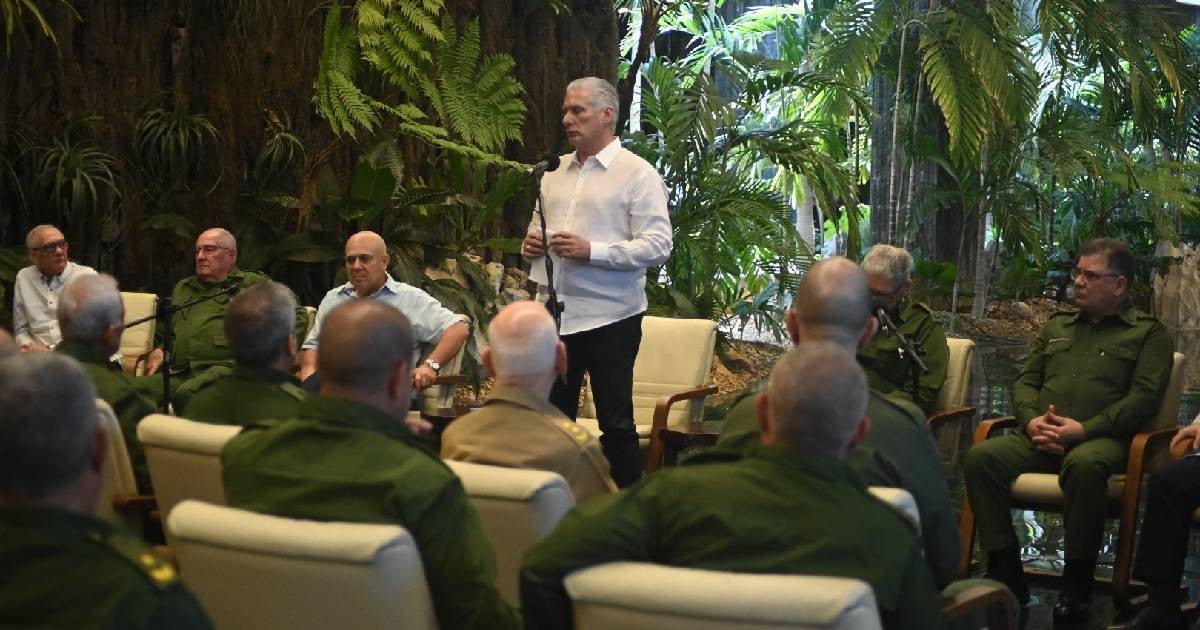
The ruler Miguel Díaz-Canel proclaimed this Saturday before veterans and youth of the Association of Combatants of the Cuban Revolution that for the homeland, the revolution, and socialism, "we will always overcome," while the island has experienced a 23% decline in its economy since 2019 and has lost more than 10% of its population in four years.
According to the website of the Presidency, the meeting lasted about two hours and took place in the René Portocarrero Hall of the Palace of the Revolution, gathering fighters from the Rebel Army, Playa Girón, internationalist missions, and border guards who, according to the regime, repelled weeks ago an attempted infiltration in the northern keys of Villa Clara.
The event was part of the celebrations for the centenary of the birth of the dictator Fidel Castro (1926-2016) and the 65th anniversary of the proclamation of the socialist nature of the Cuban revolution and the victory at Playa Girón.
The triumphalist rhetoric of Díaz-Canel contrasts with the reality he himself described just two days earlier when he admitted that Cuba absolutely lacks fuel for almost everything.
Power outages exceed 20 hours daily in several provinces, and the electricity generation deficit reached peaks of 1,945 megawatts in April, along with multiple disconnections of the National Electric System and its outdated thermal power plants.
The Economist Intelligence Unit projects an additional contraction of the Gross Domestic Product (GDP) of 7.2% for 2026, and the projected fiscal deficit exceeds 74.5 billion Cuban pesos.
In terms of migration, it is estimated that around two million Cubans have left the island since 2021, which reduces the effective population to between 8.6 and 8.8 million, compared to the historical figure of 11.3 million residents.
In 2024, only 71,374 births were recorded compared to 130,645 deaths, resulting in a very negative balance that exacerbates the demographic collapse.
The comedian and actor Ulises Toirac described the exodus as the worst migratory tragedy in all of Cuban history and warned that its future consequences are disastrous.
The number of asylum applications from Cubans in Brazil exceeded 41,900 in 2025, a 88% increase compared to the previous year, making Cubans the largest nationality requesting asylum in that country for the first time.
In the political realm, Cuba recorded 953 protests just in January 2026 according to the Cuban Observatory of Conflicts, and the U.S. Department of State counted over 1,200 demonstrations since that month. In 2025, there were 11,268 documented protests against the regime, marking a historical record.
The week was also notable for the meeting in Havana on April 11, between officials from the United States Department of State and Raúl Guillermo Rodríguez Castro, grandson of Raúl Castro, where Washington warned that the Cuban economy is in free fall and the time to implement substantive changes on the island is running out, according to a report from the American media Axios.
The absence of Díaz-Canel in those discussions was interpreted as a sign that real power in Cuba does not reside with the appointed president.
Alina Fernández, daughter of Fidel Castro, summarized the moment with a phrase that encapsulates six decades of dictatorship: decades living in misery due to an ideological madness.
Filed under: