
Related videos:
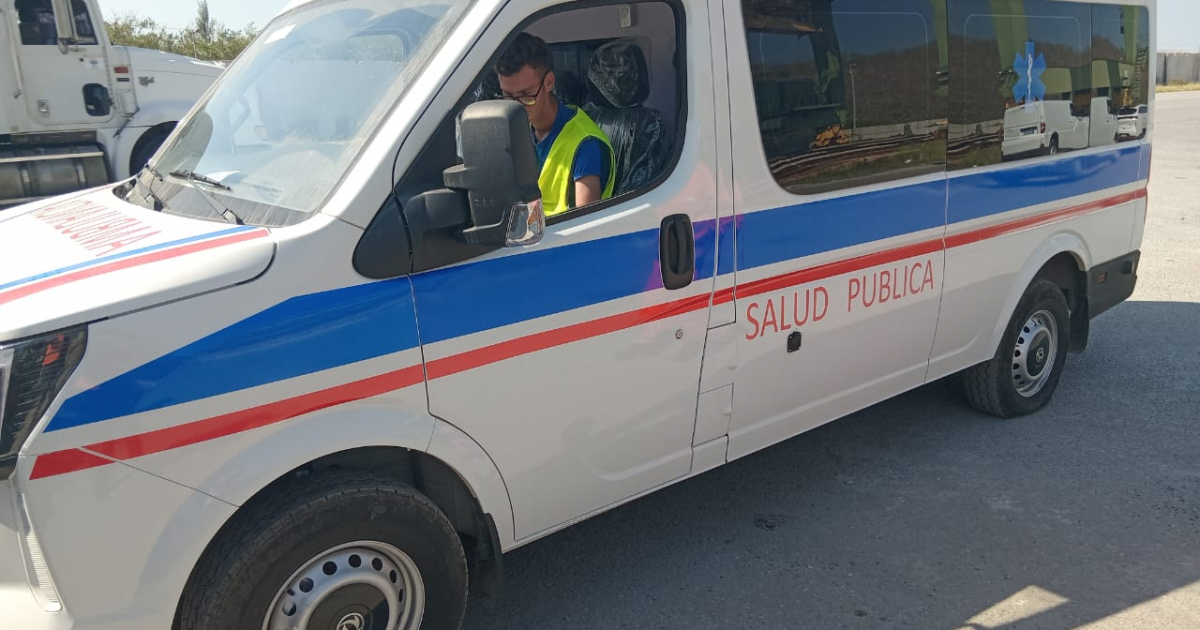
The state-owned company Transimport, in coordination with the Ministry of Public Health and the port authorities, began the extraction of a new batch of ambulances that have just arrived in Cuba, as reported by the Cuban News Agency on April 30.
Among the vehicles in the lot are Dongfeng ambulances, some of which are 100% electric and others diesel, requested by the Integrated Medical Emergency System (SIUM) of Havana. At the same time, the Public Advertising Agency Publicentro of the Ministry of Transportation began labeling the equipment. Its executives stated that participation in these efforts "provides visual support to the process of revitalizing the emergency medical service in Cuba."
The official announcement, however, omits a key detail: the exact number of units in the batch was never disclosed.
This delivery adds to a series of partial acquisitions that the regime presents as progress. In February, Cuba acquired 25 Chinese electric ambulances for transportation in Havana, and in January the government announced the purchase of 50 ambulances to be distributed across several provinces.
But the actual figures for the deficit make each delivery seem insignificant. The MINSAP itself acknowledged in 2023 that Cuba only has 39.6% of the necessary ambulances nationwide. Matanzas, for example, received three units in January, but the province barely operates 16 of the 54 ambulances it needs, meaning less than one third of its minimum required fleet.
The shortage of ambulances is just one of the symptoms of a much deeper healthcare collapse. Minister José Ángel Portal Miranda described in February an "accelerated deterioration" of the system, worsened by blackouts lasting up to 20 hours a day and a lack of fuel. The Cuban healthcare system is on the brink of collapse, according to his own words before Parliament.
More than 96,000 surgeries have been postponed, only 30% of the essential medicines are available in pharmacies and hospitals, and the hospital infrastructure is deteriorating at an accelerated pace: the Calixto García Hospital experienced a partial ceiling collapse in November 2025, and the Juan Bruno Zayas Clinical Surgical Hospital reported sewage water under the patients' beds in January 2026.
Infant mortality has more than doubled in less than a decade, rising from 3.9 per thousand in 2018 to approximately 8.2 per thousand in 2025. In Guantánamo, the figure reached 13.9 per thousand in May of last year. Miguel Díaz-Canel himself acknowledged a "truly critical" situation before the full assembly of the Communist Party.
The international community can no longer ignore the magnitude of the disaster. The Director-General of the WHO described the Cuban health situation as "deeply concerning" in March, while the UN activated an emergency humanitarian plan of 94.1 million dollars to assist nearly two million people in 63 Cuban municipalities.
Sixty-seven years of communist dictatorship have dismantled what was once presented as the pride of the Island's healthcare system: between 2010 and 2022, the regime closed 63 hospitals, 187 maternity homes, and 45 dental clinics, according to official data, while more than 12,000 doctors and over 7,400 nurses emigrated between 2021 and 2022. In the face of this abyss, a batch of ambulances with an unknown number can hardly be called "strengthening."
Filed under: