
Related videos:
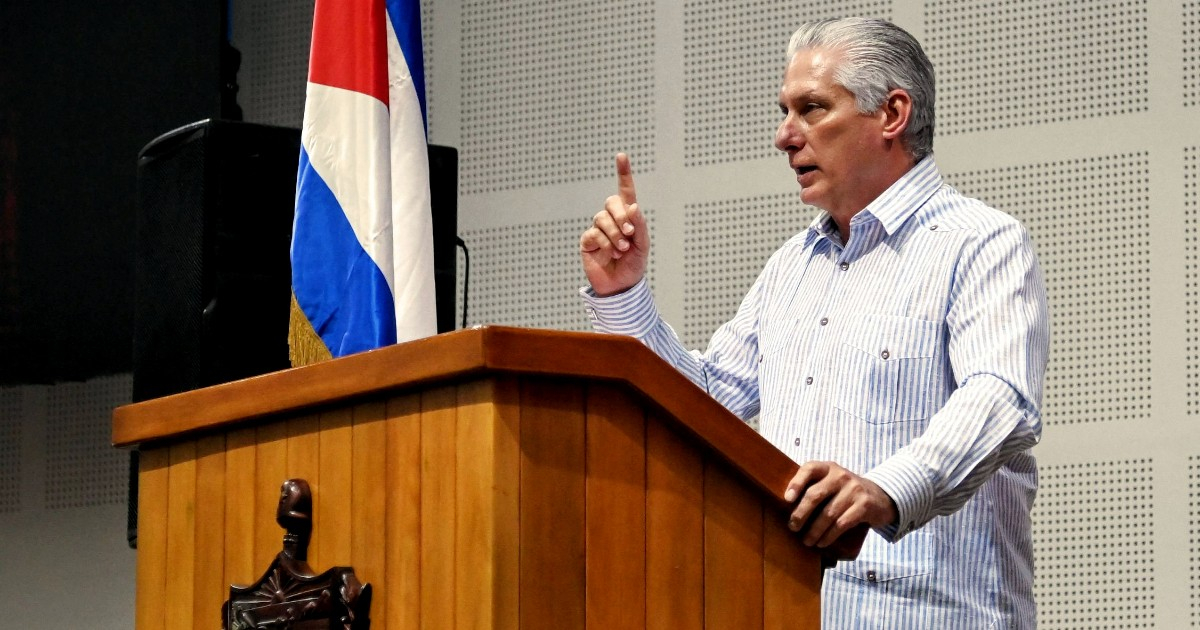
The Cuban leader Miguel Díaz-Canel stated this Saturday, before 766 foreign delegates gathered at the Palace of Conventions in Havana, that he does not understand why Washington considers Cuba an "extraordinary and unusual threat" to national security.
"I try to answer that question every day," said the also first secretary of the Communist Party of Cuba, speculating that perhaps what the U.S. considers a threat is the "example of resilience and creativity of the Cuban people."
The statement, delivered at the International Solidarity Meeting with Cuba "For a World Without Blockade: Active Solidarity in the Centenary of Fidel," is the regime's propagandistic response to the Executive Order 14380 signed by President Donald Trump on January 29.
The order, which declared a national emergency due to the threat posed by the Cuban regime, established an energy embargo that has reduced Cuban crude oil imports by 80% to 90%, worsening the daily blackouts that the population has been experiencing for years due to the collapse of the energy infrastructure.
Washington's arguments, however, are concrete and well-documented. Russia maintains its largest intelligence base abroad in Cuba, located less than 100 miles from U.S. territory.
The Center for Strategic and International Studies (CSIS) has documented at least 12 Chinese signal intelligence installations on the island, with confirmed expansions from satellite images in 2024 and 2025.
The Secretary of State Marco Rubio summarized it bluntly on April 28: "Cuba has welcomed adversaries of the United States to operate within Cuban territory against our national interests, with total impunity".
This includes the regime's ties with Iran, Hamas, and Hezbollah, as well as the recruitment of up to 25,000 Cuban mercenaries to fight for Russia in Ukraine, with at least 54 Cubans identified as having died in Russian ranks.
Another 32 Cubans died serving in the personal guard of Nicolás Maduro in Venezuela, and Díaz-Canel himself mentioned them in his farewell speech as an example of sacrifice, without recognizing the contradiction with his narrative of a "nation of peace."
Internal repression completes the picture: more than 800 active political prisoners, the highest number in the Americas according to human rights organizations, with 359 detainees from July 11 still imprisoned with sentences of up to 22 years.
The narrative of "peaceful Cuba" that Díaz-Canel and Chancellor Bruno Rodríguez Parrilla promote also clashes with the regime's own military doctrine.
In the same event, Rodríguez Parrilla stated that «Cuba would be a hornet's nest; Cuba would be a death trap» in the face of any aggression, invoking the doctrine of the «People's War of All».
The victimization strategy of the regime consists precisely in portraying itself as a defenseless nation while actively maintaining a doctrine of total armed resistance.
The immediate context of the speech is one of maximum tension. On May 1, the day before, Trump signed a second executive order expanding sanctions against Cuban officials responsible for repression, and at a private dinner in West Palm Beach threatened to send the USS Abraham Lincoln aircraft carrier "within 100 meters of the Cuban shore."
Díaz-Canel responded on social media that " no aggressor, no matter how powerful, will find surrender in Cuba", while at the event on Saturday he emphasized that the island poses no threat whatsoever.
The contradiction between both messages encapsulates the regime's dual narrative: helpless victim on the outside, combative power on the inside.
In October 2025, Cuba experienced its worst result in three decades in the UN vote regarding the embargo, a sign of the declining international support for a regime that has been in power for over 67 years and is facing a humanitarian crisis that can no longer be solely attributed to Washington.
Filed under: