
Related videos:
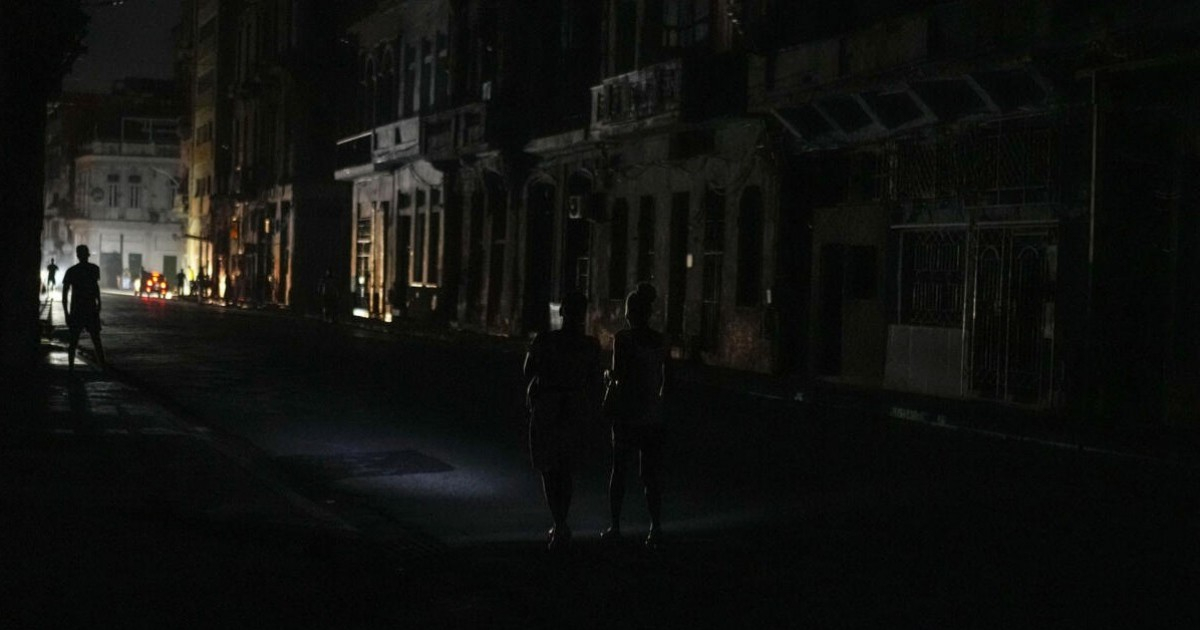
Cuba wakes up this Sunday to a new day of severe blackouts.
According to the official report from the Electric Union (UNE), at 6:00 am the availability of the National Electric System (SEN) was only 1,700 MW compared to a demand of 2,700 MW, with 989 MW affected at that time.
At peak hours, an impact of 800 MW was estimated.
The nighttime scenario is even more critical: the UNE forecasts a capacity of 1,760 MW during peak hours against a demand of 3,200 MW. This results in a deficit of 1,440 MW and an impact of 1,470 MW, equivalent to nearly half of the country without electricity during peak consumption hours.
Saturday was equally devastating.
The UNE details that the service was affected by a capacity deficit for 24 hours, and this condition persisted throughout the night. The peak record was 1,742 MW at 8:30 PM, higher than planned due to greater demand than forecasted and the non-delivery of Fuel Moa.
The Electric Company of Havana reported that on Saturday, the service was interrupted in the capital for six hours and 15 minutes, with a peak impact of 325 MW at 8:30 PM. It was necessary to shut down circuits due to an emergency with 95 MW, and the service was not restored until 4:45 AM on Sunday.
At the end of their report, the capital-based company warns that "the impact on the blocks and circuits due to the energy contingency, without a scheduled time, depends on the availability conditions of the SEN," which in practice means that the outages could return at any moment.
Among the main incidents of the day are breakdowns in two units of the CTE Lidio Ramón Pérez and Antonio Maceo, as well as maintenance work on three units of the Mariel, Renté, and Nuevitas power plants.
In addition, there are 462 MW out of service due to limitations in thermal generation. The only reinforcement planned for the night is the entry of the Regla barge with just 60 MW.
The 54 solar photovoltaic parks installed by the government produced 4,708 MWh on Saturday, reaching a maximum output of 710 MW at noon; however, their contribution drops to zero during the night hours of peak demand, highlighting the failure of this solution to address the structural crisis.
While Havana endures blackouts lasting several hours, eastern provinces such as Granma and Holguín are suffering from power outages of up to 24 hours daily.
The fuel shortage exacerbates the collapse. Cuba needs eight oil tankers per month, but from December 2025 to April, it only received one, and the shipment from the Russian tanker Kolodkin ran out at the end of that month.
The country produces only 40,000 barrels of oil daily when it needs between 90,000 and 110,000.
The humanitarian impact is devastating: 96,000 Cubans are awaiting surgery, including over 11,000 children, and 16,000 cancer patients are not receiving radiotherapy as a direct consequence of the blackouts.
In light of this reality, Foreign Minister Bruno Rodríguez rejected that Cuba is an "inefficient state" and attributed the crisis to external "siege."
Meanwhile, the official data from the UNE documents a structural deficit that has fluctuated between 1,400 and 1,945 MW in recent months, with seven total system collapses in the last 18 months.
Filed under: