
Related videos:
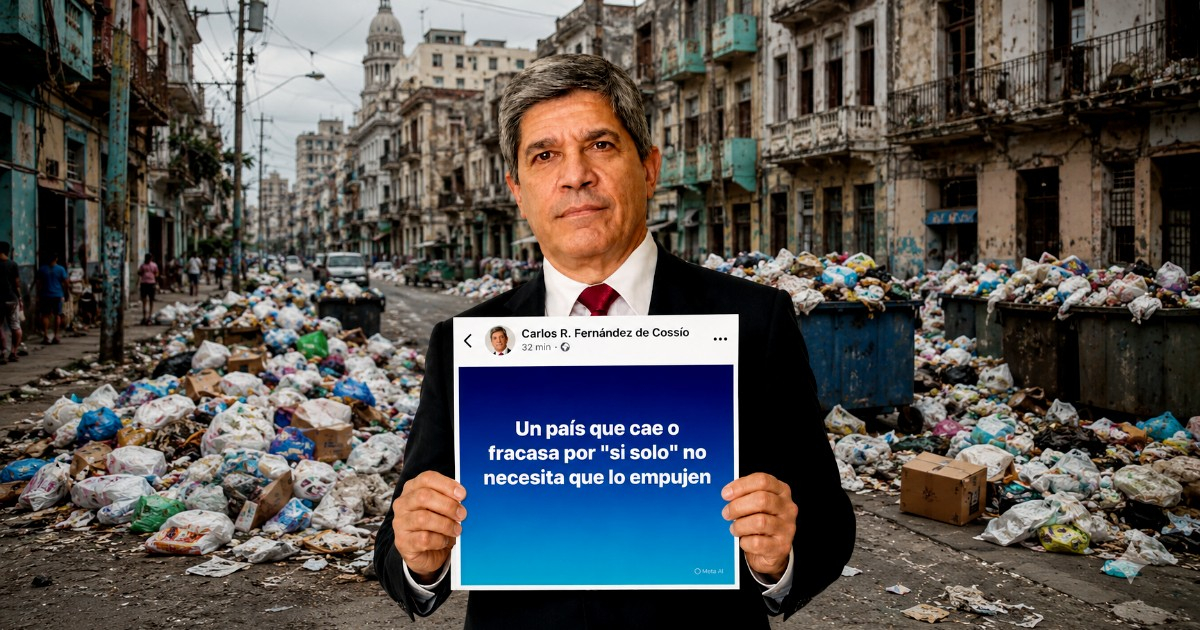
Carlos R. Fernández de Cossío, Deputy Minister of Foreign Affairs of Cuba, published a phrase on his public Facebook profile this Wednesday that turned into a diplomatic boomerang in less than 30 minutes.
A country that falls or fails due to 'if only' does not need to be pushed, said the diplomat in a message generated against a faded blue background that was deleted before it could go viral... although not before being captured on screen by this editorial team.
The intention was to respond to the repeated statements by Donald Trump and Marco Rubio regarding the imminent collapse of the regime. The result was the opposite: instead of refuting Washington, the Deputy Foreign Minister ended up confirming the premise of his opponents.
If the country collapses "on its own," as Fernández de Cossío wrote, the lingering question is obvious: does the regime then acknowledge that it is indeed falling?
The semantic slip did not go unnoticed. The logic of the argument requires accepting the collapse as a given fact and then discussing who is to blame, which is equivalent to conceding exactly what Havana has been denying for months: that they have become a failed state.
The context in which the publication occurs is one of maximum U.S. pressure. Trump stated on January 27 that Cuba was "a nation that is very close to failing" and on March 30 he repeated that it "will fail very soon."
Additionally, this Monday, according to reports, Trump pressured his cabinet demanding quick results in light of the slow collapse in Cuba.
Rubio, for his part, has described Cuba as a "failed state without a real economy," characterized by "extreme misery, chronic energy crisis, rampant inflation, and a lack of freedoms," governed by "incompetent communists", and has advocated for new sanctions against GAESA and other entities of the regime.
In response to that sustained rhetorical offensive, Fernández de Cossío attempted a clever reply that self-destructed at the moment of publication, highlighting the communication breakdown that underlies the "creative resistance" of the government of Miguel Díaz-Canel.
This is not the first time the official has encountered a setback of this kind.
At the end of April, he defended the revolutionary expropriations of the 1960s on Facebook invoking the 1940 Constitution as a legal basis, without realizing that the same text guaranteed private property and required compensation — exactly what the regime did not do.
The pattern is consistent: the most active official from the Ministry of Foreign Affairs on social media resorts to arguments that, upon examination, reinforce the criticisms he aims to dismantle.
In practice, the deleted publication from this Wednesday is the most pointed expression of that rhetorical fatigue: an attempt to reframe the crisis that ultimately confirmed its magnitude, quickly erased when someone in Havana noticed the mistake, although it was already too late.
Filed under: