
Related videos:
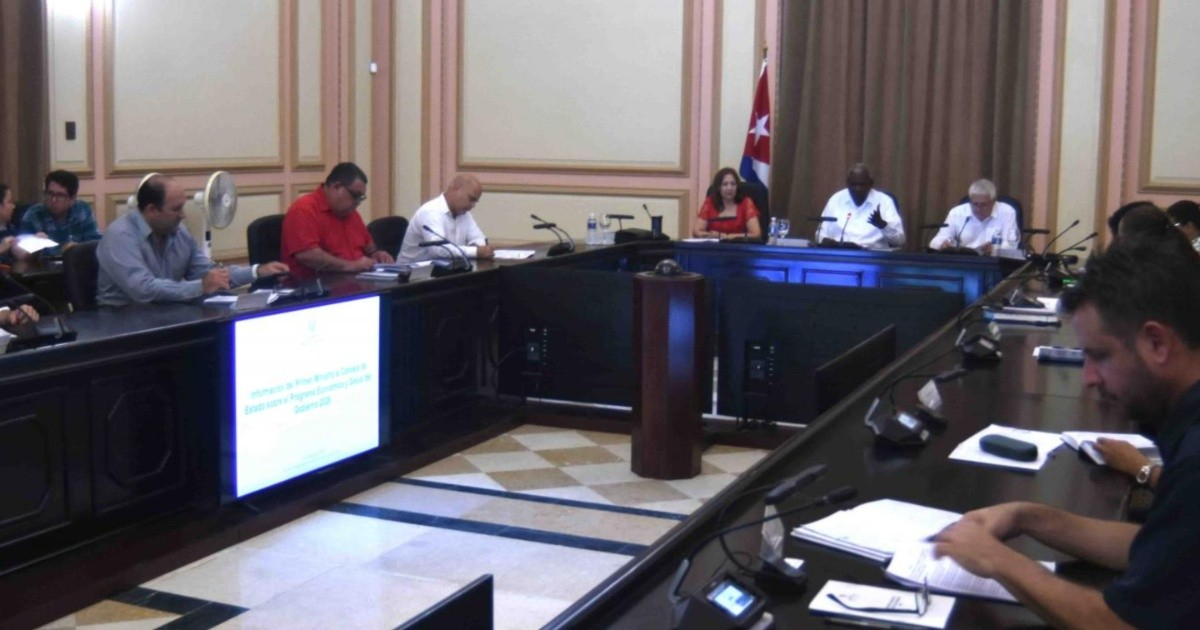
The Cuban State Council assessed on Wednesday the progress of the Government's Economic and Social Program for 2026 in an ordinary session presided over by Esteban Lazo Hernández, with participation from Miguel Díaz-Canel and Prime Minister Manuel Marrero Cruz, as the Cuban population endures power outages of up to 25 hours a day and a food crisis that international organizations describe as severe.
The program, formally presented in April 2026, includes 10 general objectives, 111 specific objectives, 505 actions, and 309 indicators and targets. However, the official data itself reveals partial compliance: out of 81 evaluated specific objectives, only 32 have been implemented and 49 are in process, while of the 158 planned actions, only 65 have been completed.
The underlying figures are more revealing. Only 43% of the plan for the recovery of the National Electrical System was executed in the first quarter, and Marrero Cruz himself warned about the breaking of the trend towards containing the fiscal deficit, projected at 74.5 billion Cuban pesos for the entire year.
In light of this situation, the Prime Minister called to "raise the standards in the implementation of the Program and Government Directives, using innovative formulas to maximize the use of endogenous capabilities and resources."
In the same session, the popular-participatory movement "My Neighborhood for the Homeland" was formally presented, structured around three pillars —Safe Neighborhood, Participatory Neighborhood, and Productive Neighborhood— and projected across more than 12,000 constituencies nationwide. Independent analysts describe it as an updated version of the Committees for the Defense of the Revolution, with a greater emphasis on social control than on real economic solutions.
The Council of State also approved the law decree "On Oil and Gas," which regulates the exploration, exploitation, refining, transportation, storage, and commercialization of hydrocarbons in land and marine areas, with the stated goal of ensuring the country's energy sovereignty.
The reality experienced by the population contrasts sharply with the official narrative. On May 11, the Electric Union reported a mere availability of 1,245 MW against a demand of 3,200 MW, resulting in a deficit of 1,955 MW that exacerbated power outages across the country.
In terms of food, surveys from the Food Monitor Program indicate that nearly one in three Cuban households reported that at least one member went to bed hungry in the past 30 days, and 79.75% of respondents attribute the shortages to "poor state management," rather than the U.S. embargo.
The inflation in the non-state market rose by 31.9% in the first quarter of 2026, with transportation experiencing an increase of 17.17% in the first four months. The regime, on the other hand, systematically attributes the crisis to the embargo and the executive orders of the President of the United States.
CEPAL projects a decline of 6.5% in Cuba's GDP by 2026 —the worst contraction in Latin America and the Caribbean— while The Economist Intelligence Unit estimates a contraction of 7.2%, which would total an approximate fall of 23% since 2019, marking seven years of deterioration that no government program has managed to reverse.
Filed under: