
Related videos:
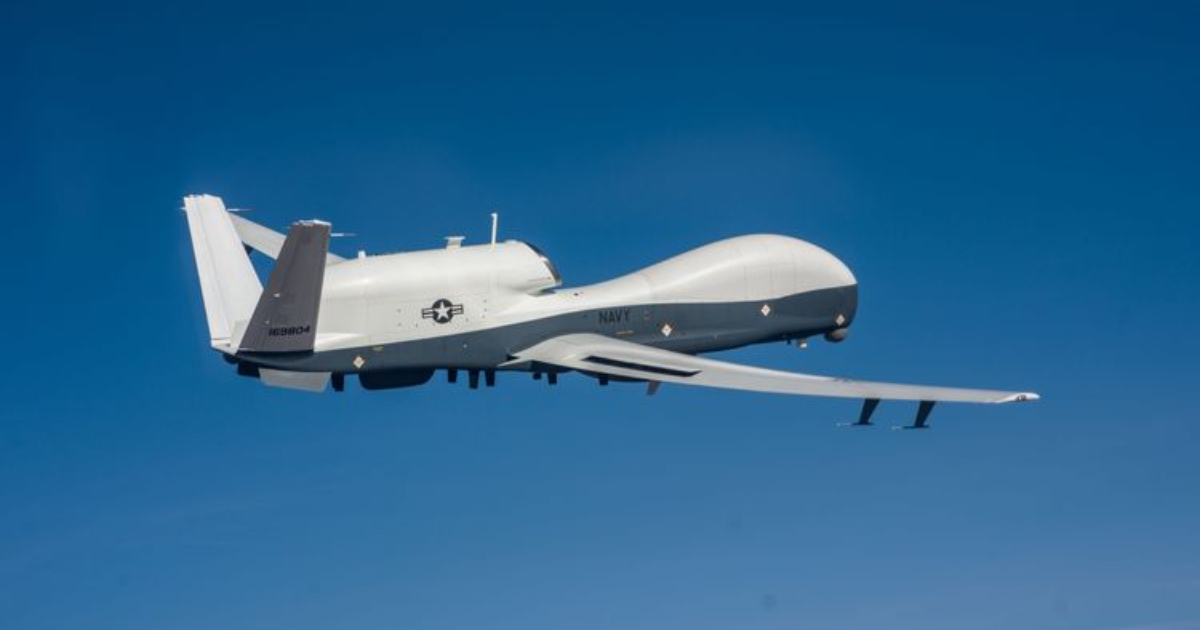
A US Navy MQ-4C Triton surveillance drone was detected this Thursday conducting reconnaissance maneuvers south of Cuba and north of the Cayman Islands, according to data visible on Flightradar24 and shared by accounts specializing in military air tracking.
The unmanned aircraft, identified by the code BLKCAT6 and registration number 169659, was operating at an altitude of approximately 46,975 feet —over 14 kilometers high— performing repetitive flight patterns typical of long-range maritime intelligence missions.
The MQ-4C Triton took off from Jacksonville, Florida, at 9:32 AM local time and was monitored in real-time by users on the aerial monitoring platform.
This drone is one of the most advanced surveillance systems in the U.S. Navy and is designed for HALE (High Altitude Long Endurance) operations, capable of remaining airborne for over 24 hours while monitoring vast maritime and coastal areas with high-precision radars and sensors.
During the day, an F-5N Tiger II aircraft from the U.S. Navy appeared on Flightradar24, identified by the code CESSNA9 and registration number 761562. The aircraft disappeared from public radar before reaching Key West, and there is no official confirmation that it flew over Cuba.
A black line shown in some screenshots circulated on social media corresponds only to an estimated trajectory based on the direction the plane was heading before turning off its transponder, not to a confirmed route.
On the same day, flight SAM554 landed in Havana, a Boeing C-40B Clipper used to transport high-ranking officials of the United States government coming from Joint Base Andrews in Maryland.
The presence of U.S. military drones near Cuba has become frequent in recent months. Since February, multiple surveillance and reconnaissance flights in the region have been documented with aircraft such as the MQ-4C Triton, the P-8A Poseidon, and the RC-135V Rivet Joint.
Military intelligence experts believe that the public visibility of such operations often sends strategic messages during times of regional tension and sensitive diplomatic movements related to Cuba.
Filed under: