
Related videos:
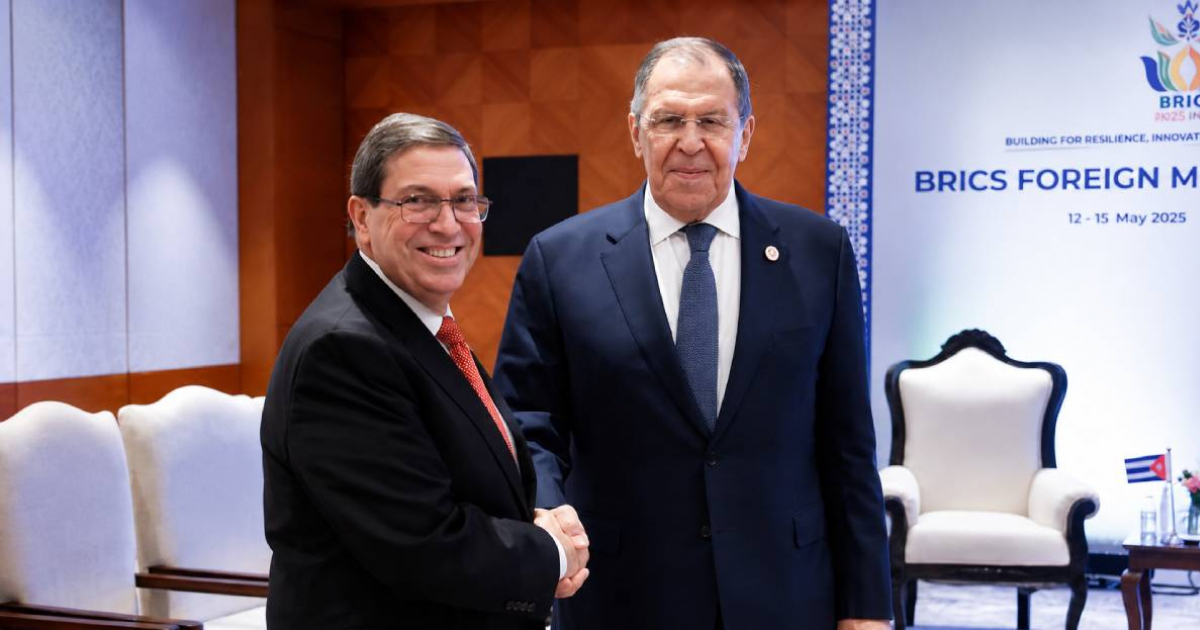
Russian Foreign Minister Serguéi Lavrov and Cuba's Foreign Minister Bruno Rodríguez Parrilla met on Friday on the sidelines of the BRICS Foreign Ministers' Meeting in New Delhi.
Moscow reaffirmed its willingness to provide Havana "the corresponding political, diplomatic, and material support" in what it described as an "unprecedented escalation of the situation," referring to the tensions between Cuba and the United States.
The bilateral meeting took place during the diplomatic summit that brought together the foreign ministers of the bloc on May 14 and 15.
According to the official statement from the Russian Foreign Ministry, Moscow expressed its willingness to assist Havana "in implementing its just demand for the immediate cessation of the commercial, economic, and financial blockade of the island by the U.S.," as well as in the removal of Cuba from the U.S. list of "state sponsors of terrorism."
Both parties highlighted the "inadmissibility of applying unilateral sanction measures that circumvent the UN Charter," in a coordinated stance against the pressure from the Trump administration.
The day before, Rodríguez Parrilla had requested during the open session of the BRICS that the international community mobilize to “prevent a military adventure against Cuba” that “would provoke a humanitarian catastrophe, bloodshed, and the death of Cubans and American youth.”
The Trump administration has accumulated over 240 sanctions against the Cuban regime since January 2026, reinstated the island on the list of state sponsors of terrorism on January 20, and signed Executive Order 14380 on January 29, imposing an energy embargo that has reduced oil imports by between 80% and 90%.
On May 5th, Trump threatened to deploy the aircraft carrier USS Abraham Lincoln off the Cuban coast, and the Secretary of Defense, Pete Hegseth, confirmed before Congress on May 12th that Cuba poses a "threat to the national security" of the United States.
The Russian support for Cuba has a dense timeline in 2026. In February, Putin stated in Moscow that Russia "has always stood by Cuba in its struggle for independence," and the Russian Embassy in Havana announced the shipment of crude oil and fuels as "humanitarian aid."
In April, the Russian Deputy Minister Serguéi Riabkov visited Havana for inter-ministerial consultations with Rodríguez Parrilla.
This Friday's meeting is the first in which Russia explicitly mentions "material" support in the context of tensions with Washington, a signal that raises the tone of the alliance between Moscow and Havana at a time when Cuba is experiencing its worst energy crisis in decades.
Filed under: