
Related videos:
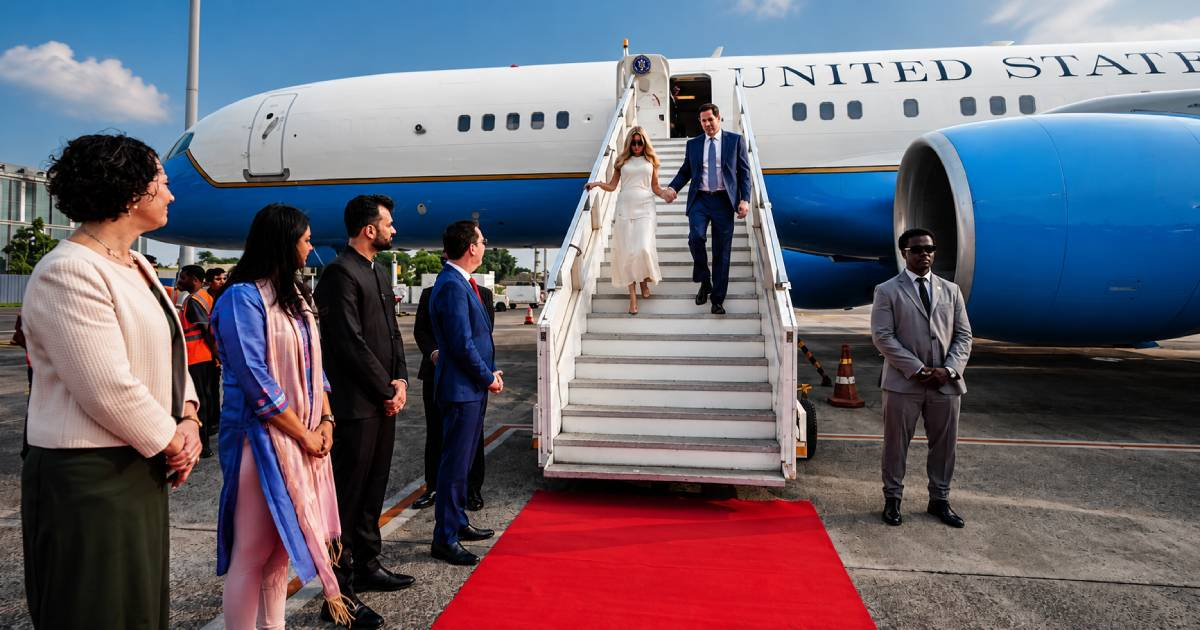
Marco Rubio landed this Saturday in India for an official visit, as confirmed by the U.S. Secretary of State himself.
"I landed in India. I look forward to a great visit!", said Rubio on his X account, where he shared an image of his arrival in the country alongside his wife. They are seen descending the steps of a U.S. government plane, welcomed with a red carpet and formal diplomatic protocol.
The visit, which extends until May 26 and includes stops in Kolkata, Agra, Jaipur, and New Delhi, is Rubio's first trip to India since he took office as Secretary of State in the Trump administration.
Before arriving in New Delhi, the official visited Sweden as part of a diplomatic tour that began on May 21.
The central theme of the tour is energy
Rubio stated before departing that "India is a great ally and a great partner" and that Washington wants to sell "as much energy as India is willing to buy," in the context of a global oil crisis.
The highlight of the trip will be the Quad ministerial meeting —the strategic forum comprising India, the United States, Japan, and Australia— scheduled for May 26 in New Delhi.
Is immediate change in Cuba drifting away once again?
The trip has a straightforward interpretation for those closely following Washington's policy towards Havana: as long as Rubio is outside the United States, it is unlikely that any significant movement will occur.
There are persistent rumors circulating on social media suggesting that "this weekend is the one" in reference to a significant development in Cuba. The absence of the Secretary of State keeps those comments in the realm of speculation.
Rubio is the chief architect of the pressure policy against the Cuban regime within the Trump administration. Since January 2026, the United States has accumulated more than 240 sanctions against Cuba, including Executive Order 14404, signed on May 1, which directly targeted GAESA, the military conglomerate that controls approximately 70% of the island's economy.
On May 7, the United States imposed sanctions on GAESA, its executive president Ania Guillermina Lastres Morera —a major general of the Revolutionary Armed Forces— and Moa Nickel S.A. Rubio described GAESA as "the heart of the Cuban kleptocratic communist system" and warned that the goal is to "deprive the communist regime and the Armed Forces of Cuba of access to illicit assets".
The consequences of these sanctions are already being felt: shipping companies like Hapag-Lloyd and CMA CGM have suspended cargo bookings to and from Cuba, and shares of Sherritt International have dropped by as much as 30% in the stock market. Foreign companies have until June 5 to sever ties with sanctioned Cuban entities, under the threat of secondary sanctions.
On May 21, Rubio described Cuba as a "failed state" and asserted that its economic system "is broken" and cannot be fixed under the current political system.
One day before, he proposed a new relationship with Cuba that included 100 million dollars in food and medicine, conditioned on the distribution being carried out by the Catholic Church or other charitable organizations, not GAESA, although he considered the chances of reaching an agreement with Havana to be "low".
Probably, with Rubio in India until May 26, any significant movement in Washington's policy towards Cuba will have to wait, at least, until next week.
Filed under: