
Related videos:
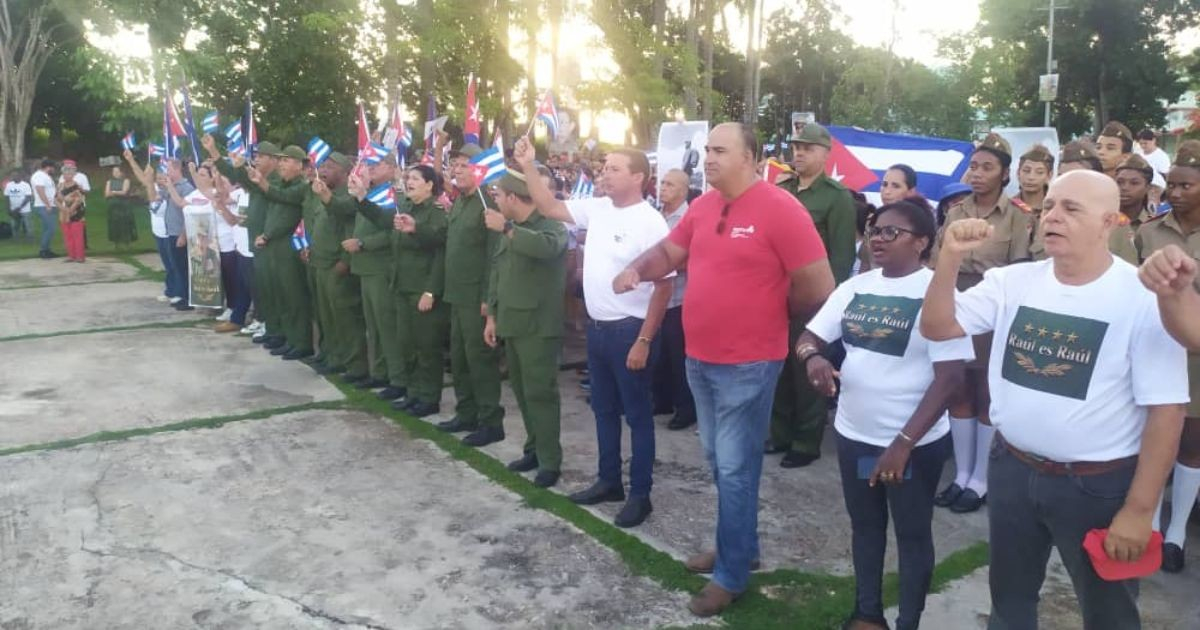
The Cuban regime added Artemisa to its series of propaganda events in defense of Raúl Castro this Friday, with a gathering held at the Mausoleum of the Martyrs of that province, where official speakers condemned the criminal charges brought by the United States Department of Justice against the former dictator.
The event, which began at 7:30 in the morning, took place in the same location where the young individuals who accompanied Castro in the assault on the Moncada in 1953 are laid to rest, a setting rich in symbolism that the regime did not miss to envelop the day in revolutionary epic.
The meeting was chaired by Gladys Martínez Verdecia, a member of the Political Bureau and president of the Provincial Defense Council, alongside Ricardo Concepción Rodríguez, her vice president, and other leaders from the Municipal Defense Council, reported the provincial newspaper el artemiseño.
The speakers followed the prescribed script: Bárbara Lucía Pérez González, representing the local jurists, delivered what the official press described as a speech of "legal and political condemnation of external interference"; Lisniel Rodríguez Morales, a medical student, spoke on behalf of "the new generations"; and Yury Belén Ramírez emphasized "the steadfastness of the Cuban people." The event concluded with songs, improvised décimas, and a display of photographs of the Army General.
The final message, as reported by the local newspaper, was that "the people of Artemisa do not remain silent in the face of injustice, do not bow to power or the unexpected actions of the Government of the United States. We will always be loyal to our leaders."
Artemisa thus joins a chain of Anti-imperialist Open Forums that the regime has deployed throughout the country since May 22, in response to the declassified accusation made on May 20 by acting U.S. Attorney General Todd Blanche at the Freedom Tower in Miami. This accusation charges Castro and five co-defendants with conspiracy to murder American citizens and four counts of homicide for the downing of two Brothers to the Rescue planes over the Florida Strait on February 24, 1996, which resulted in the deaths of Armando Alejandre Jr., Carlos Costa, Mario de la Peña, and Pablo Morales.
The accusation currently has mainly symbolic significance—there is no extradition treaty between Cuba and the United States—but the regime has made it the cornerstone of a campaign that mobilized public transportation, military personnel, and state workers to fill the events, all amidst a fuel crisis that leaves millions of Cubans without electricity for 20 to 25 hours a day.
The contrast with everyday reality is hard to ignore. The Electric Union reported deficits exceeding 2,000 MW in May; 33.9% of Cuban households had at least one member who went to bed hungry in 2025, according to the Food Monitor Program; and CEPAL projects a GDP contraction of -6.5% for 2026.
The regime also mobilized in Pinar del Río with an identical script this Friday. In the stands of that province, while a health official labeled the U.S. accusation as "an action devoid of validity and morals, an undignified and vile provocation," they admitted that 1,630 patients — including 71 children and 365 cancer patients — have not been able to undergo surgery due to a lack of resources.
All the machinery will culminate on June 3, the date when Raúl Castro will turn 95, making the campaign simultaneously a legal defense act and a nationwide birthday celebration, funded with the limited resources of a country in free fall.
Filed under: