
Related videos:
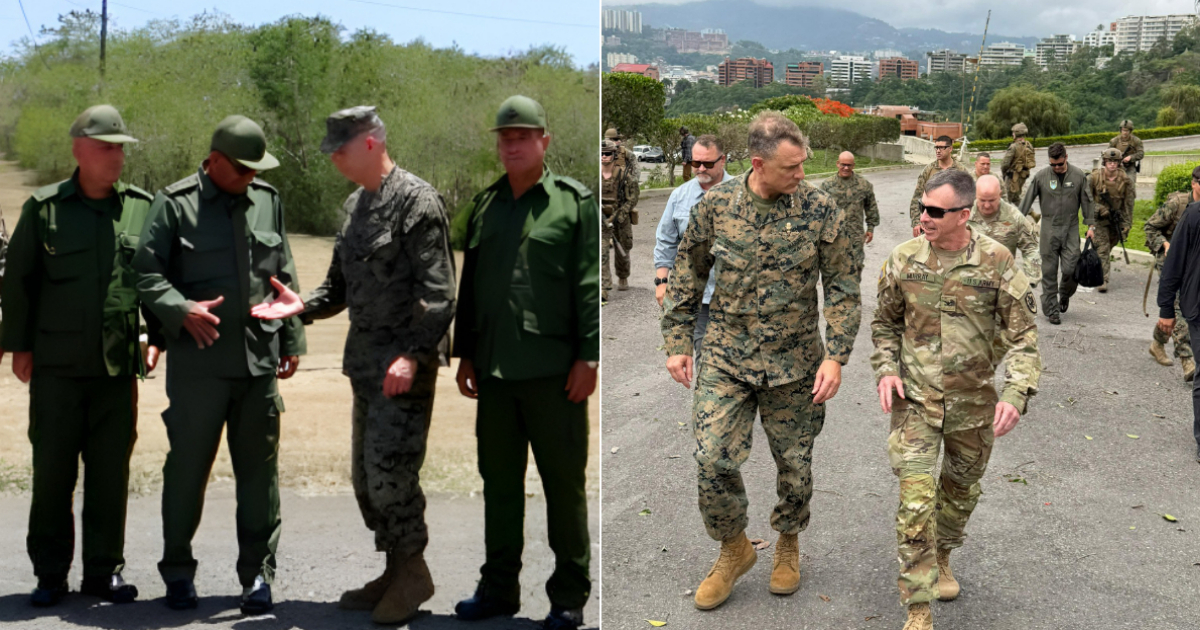
When the Ministry of the Revolutionary Armed Forces (MINFAR) confirmed the meeting held on May 29 between Army Corps General Roberto Legrá Sotolongo and the head of the United States Southern Command (SOUTHCOM), Francis L. Donovan, the official statement presented it as a technical exchange related to security around the perimeter of the Guantánamo Naval Base.
According to the official statement, both delegations positively assessed the meeting and agreed to maintain communication between their military commands. However, for many observers, the significance of the meeting extends far beyond the security issues discussed during the encounter.
The reason has a name: Francis Donovan.
The photograph is particularly striking because Cuba maintained a close strategic alliance with chavismo for over two decades. And Donovan is associated, in the perception of many analysts and observers, with the U.S. military apparatus that accompanied the process that culminated in the capture of Nicolás Maduro and completely transformed the Venezuelan political landscape.
For years, Caracas was Havana's main international ally.
The arrival of Hugo Chávez to power marked the beginning of a privileged relationship that extended to virtually all areas: political cooperation, energy assistance, intelligence advice and repression of opponents, the presence of Cuban personnel in Venezuelan state bodies, and close coordination between both governments.
After Chávez's death, Nicolás Maduro maintained that alliance and turned it into one of the fundamental pillars for the economic and geopolitical survival of the Cuban regime.
That is why the events that have taken place in Venezuela in recent months were watched with great concern from Havana.
The capture of Maduro by U.S. forces profoundly disrupted the regional balance and represented the hardest blow suffered by the Caracas-Havana axis since the rise of Chavismo to power.
Although Donovan had not yet officially assumed command of SOUTHCOM at the time of the operation on January 3, he was serving as the deputy commander of the United States Special Operations Command (SOCOM), the structure responsible for coordinating U.S. special forces.
His professional career has been closely linked to special operations, irregular warfare, and high-complexity joint missions.
Subsequently, as the head of Southern Command, Donovan took on a central role in managing the new regional landscape that emerged after Maduro's fall.
Recently, he landed for the second time in Caracas—the first visit was in February—to meet with representatives of the new Venezuelan authorities and conduct military maneuvers on Venezuelan soil, in addition to carrying out an intense regional agenda linked to the new U.S. strategy for the Western Hemisphere.
That strategy has gained increasing relevance within the current U.S. administration.
The Southern Command itself released a photograph on May 5 of Donovan alongside Secretary of State Marco Rubio in front of a large map of Cuba during the Conference of Chiefs of Mission held in Doral, Florida.
The message accompanying the image highlighted the objectives of the National Security Strategy for the Western Hemisphere, the fight against narcoterrorism, and the need to prevent adversarial actors from consolidating positions in the region.
The photograph had a wide impact as many observers interpreted it as a demonstration of the importance that Cuba currently holds within Washington's strategic priorities.
The symbolic significance of the meeting in Guantánamo is further heightened when another fact is recalled.
According to information acknowledged by the Cuban authorities themselves, during the operations that concluded with the capture of Maduro, 32 Cuban personnel from the FAR and the Ministry of the Interior died who were deployed in Venezuela.
The casualties constituted one of the most sensitive episodes for the Cuban military apparatus in recent years and reflected the extent to which the Venezuelan crisis had direct implications for Havana.
In that context, the image of Donovan sitting in front of the head of the Cuban General Staff takes on a meaning that goes far beyond a technical meeting on border security.
The paradox is difficult to ignore.
For decades, the official Cuban discourse portrayed Southcom as one of the main expressions of "imperialist" military power in the region. At the same time, the alliance with Caracas was elevated to the status of a fundamental strategic partnership for the survival of the totalitarian regime in Havana.
However, the photograph of Guantánamo reveals a very different reality.
It shows high-ranking officials of the FAR warmly gathered with one of the military figures most associated with the regional landscape that emerged after Maduro's capture and the new hemispheric strategy promoted by Washington.
The contrast is also evident in the language used by MINFAR itself.
For decades, the Guantanamo Naval Base has been portrayed by Cuban authorities as illegally occupied territory and a lasting symbol of confrontation with the United States.
However, the statement released after the meeting avoided any reference to the occupation, sovereignty, or the historical conflict surrounding the base. Instead, it emphasized perimeter security, communication among military commands, and the positive assessment of the meeting.
For some analysts, this change reflects pragmatism and the need to keep communication channels open at one of the most sensitive borders in the hemisphere. For others, it represents an example of the new strategic reality facing Havana following the events that occurred in Venezuela.
The truth is that the meeting between Donovan and Legrá cannot be understood outside of that context. It was not simply a discussion about perimeter security. It was a photograph filled with political and historical symbolism.
An image in which the main Cuban military leader is seen meeting with one of the key figures associated with the new regional landscape that emerged after Maduro's fall, the main geopolitical ally Havana had for over two decades.
Filed under: