
Related videos:
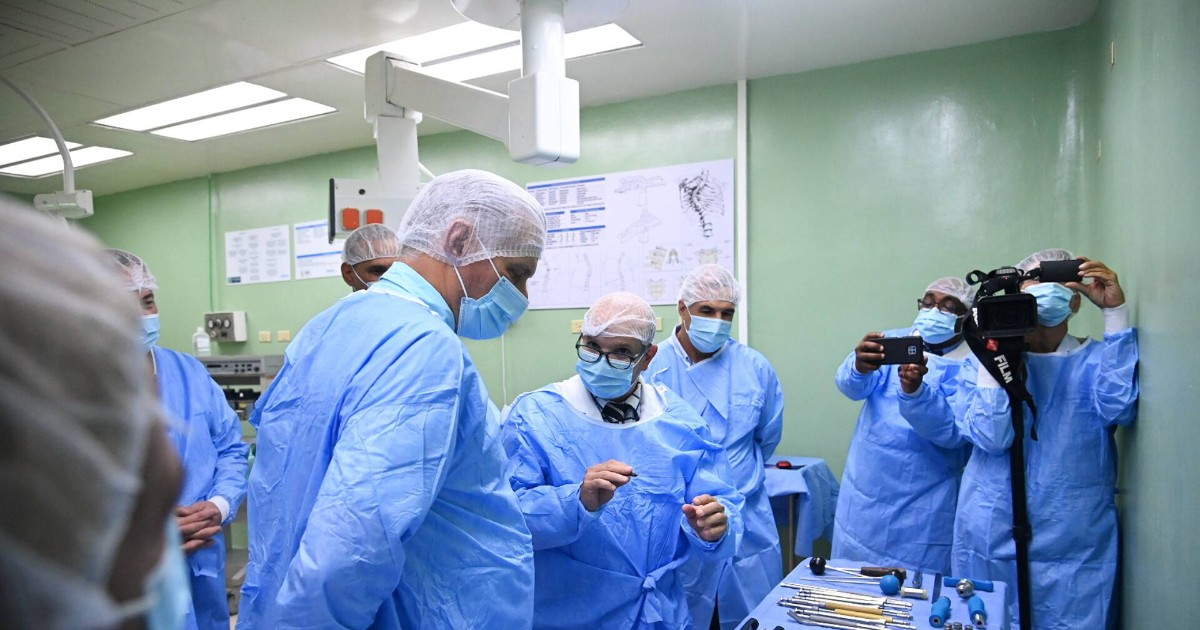
Miguel Díaz-Canel visited last Friday the International Orthopedic Scientific Complex "Frank País" in Havana, which the Cuban Presidency presented on social media as a recognition of the "effort, dedication, professionalism, and humanism" of its workers.
It was the eighth visit of this kind made by the leader to health centers as part of the digital transformation process that began at the end of 2025, accompanied by Deputy Prime Minister Eduardo Martínez Díaz, Public Health Minister José Ángel Portal Miranda, and Communications Minister Mayra Arevich Marín.
The public reaction was swift. Hundreds of Cubans flooded the official publication with criticisms, describing the event as a "circus," "facade," "charade," and "cheap propaganda."
A comment labeled the leader as "the visitor of trivial matters," a phrase that reflects the indignation expressed by many users. Another summed up a sentiment shared by numerous commentators: "It seems that there are two Cubas: one of Díaz-Canel and another of the Cubans."
Users noted that Frank País is an internationally renowned hospital that serves foreigners and the elite of the regime, and they demanded unannounced visits to centers such as Calixto García, the National Hospital, Saturnino Lora in Santiago de Cuba, or the hospitals in Pinar del Río, Camagüey, and Ciego de Ávila.
"Let him come to the Hospital of Ciego de Ávila... but let him come WITHOUT WARNING. From today to tomorrow. Let him enter the restrooms in the wards," wrote one of the commentators.
Workers from the health system itself spoke up. An employee of a Cuban pediatric hospital stated, “We live day by day striving to improve the quality of care for these children... not due to a scarcity of resources, but due to a complete lack of them... not because of a fictitious blockade designed for deception, but because of the incompetence of the very leaders.” “Today marks six months since we last operated due to a lack of resources and electricity,” added someone who claimed to work at the hospital in Jobabo, in Las Tunas.
The director of Frank País, Dr. Osvaldo García Martínez, admitted during the visit that "many times we have to sterilize materials in other institutions, and often we have to adapt, create, or transform devices for the treatment of patients," a confession that highlights that even the "showcase" hospital is not immune to the crisis.
Díaz-Canel, for his part, wrote in the visitors' book that the staff overcomes "the adversities imposed by the collective punishment stemming from the maximum pressure policy of the United States government," and he described them as "a bulwark of creative resistance."
The contrast with the reality of the Cuban healthcare system in collapse is devastating: the national surgical waiting list exceeded 96,387 patients in March 2026, including more than 11,000 children.
The minister Portal Miranda had admitted in July 2025 that there was coverage for only 30% of the basic medicine supply across the island.
The infant mortality rate closed 2025 at 9.9 per 1,000 live births, the worst record in decades, compared to 4.0 in 2018, an increase of 148%.
Hospitals such as Calixto García —which experienced a partial roof collapse in November 2025— and Juan Bruno Zayas in Santiago de Cuba —where there have been reports of sewage under the beds and cockroaches in the delivery room— illustrate the structural collapse that the Cuban people are denouncing while the regime organizes photographic visits to its reference centers.
"Now our president has taken to visiting hospitals and discussing digital transformation and artificial intelligence, how nice, but he does not acknowledge or talk about the hospital catastrophe, the lack of all kinds of supplies, the shortage of medications, not even a single aspirin to bring down a child's fever," summarized another commentator on the official post.
Filed under: