
Related videos:
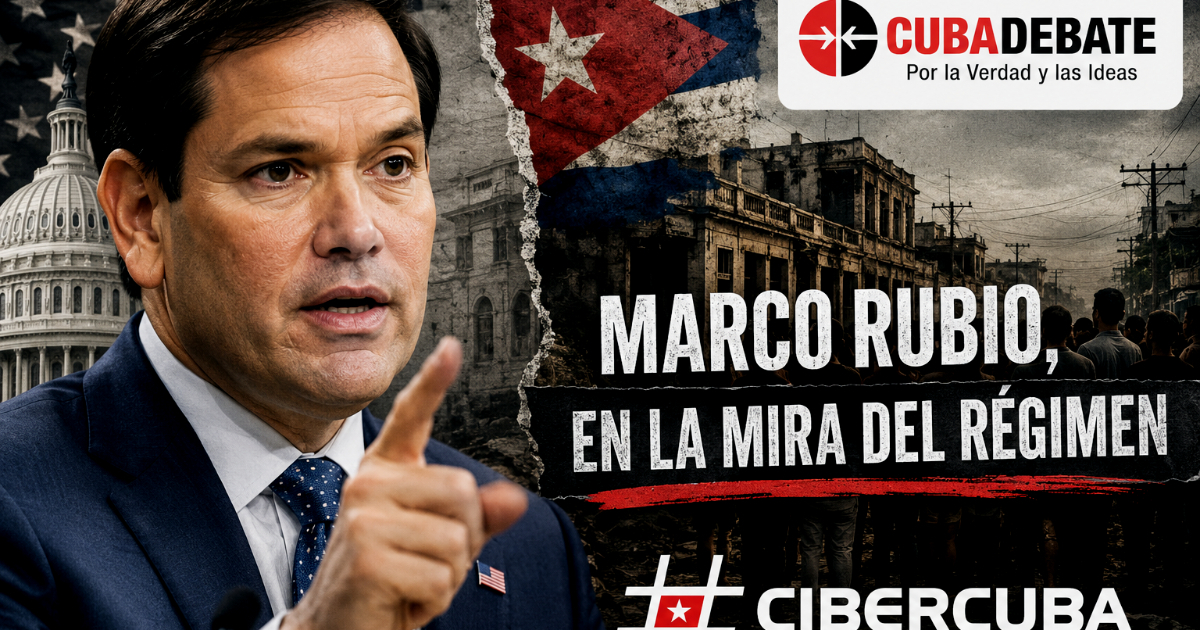
There is a question that hovers over the more than 10,000 words that the Media Observatory of Cubadebate dedicates to analyzing the presence of Marco Rubio in CiberCuba, Cubanet, El Toque, and other digital platforms: if the U.S. Secretary of State is irrelevant to the future of Cuba as the official propaganda claims, why does the regime invest so much time and resources in studying, measuring, and combating his influence?
The answer seems quite evident. The issue with Cubadebate is not CiberCuba. Neither are Mario Pentón, Cubanet, or El Toque. The real issue is that Marco Rubio has become one of the most influential international voices when it comes to denouncing the economic, political, and social failures of the Cuban model.
And, above all, that a significant part of their diagnoses find support in a reality that millions of Cubans experience daily.
It is revealing that the report dedicates thousands of words to analyzing posts on Facebook, Instagram, and YouTube; that it counts interactions, studies emotions, and describes supposed architectures of influence; and yet, it barely allocates space to address a fundamental question: Are the allegations made by Rubio about the situation in Cuba false?
Because that is the central issue.
When Rubio describes Cuba as a failed state, Cubadebate does not attempt to dismantle that claim by examining the state of the national economy, energy infrastructure, or the country’s productive capacity. Instead, it prefers to analyze how many times his statements were shared on social media.
When Rubio denounces the economic collapse of the island, the report does not provide figures that demonstrate a sustained recovery in production or the standard of living of citizens. Instead, it devotes entire pages to studying patterns of digital virality.
And when Rubio holds the regime responsible for the massive emigration of Cubans, the study avoids delving into the core of the issue and focuses on describing how certain media amplify those messages.
However, the data is hard to ignore.
The sugar industry, for decades a symbol of the Cuban economy, is one of the most evident examples. Cuba produced over eight million tons of sugar annually in the 1980s.
Today, the sugar harvests report figures that represent barely a fraction of those historical levels. It was not Marco Rubio who closed the sugar mills. It was not CiberCuba or Facebook that led to the collapse of one of the most important productive sectors in the country.
Something similar happens with agriculture. Cuba imports a substantial portion of the food it consumes despite having millions of hectares of arable land. The national production of rice, coffee, milk, and other basic products is far from the levels needed to meet internal demand.
Meanwhile, food prices keep rising in a country where salaries and pensions are losing value in the face of persistent inflation.
The energy crisis provides another example that is difficult to fit into the narrative of Cubadebate. Over the past few years, Cubans have endured prolonged blackouts, record deficits in generation, and several complete collapses of the National Electric System.
When a family spends a good part of the day without electricity, they do not need any media to explain that there is a crisis. They experience it directly.
Emigration may be the most compelling argument against the thesis of the Media Observatory. More than a million Cubans have left the country in just a few years, marking one of the largest exoduses in national history.
Thousands have crossed the Darién, traversed multiple borders, or risked their lives at sea. It is hard to maintain that such a phenomenon is primarily due to a media campaign when it is the citizens themselves who make the decision to leave.
It is precisely there that the report from Cubadebate reveals one of its greatest weaknesses. It systematically confuses the coverage of a crisis with the cause of that crisis.
The media speaks of blackouts because blackouts exist.
They talk about emigration because emigration exists.
They talk about scarcity because scarcity exists.
They talk about Marco Rubio because he holds one of the most influential positions in U.S. foreign policy and because his statements have direct consequences for Cuba.
Rubio's popularity among certain sectors of the Cuban public opinion is not the result of a media conspiracy. It is a consequence of many Cubans believing that his criticisms depict the country's situation more accurately than the official speeches.
Another striking aspect of the report is its insistence on portraying certain media outlets as political operators funded from abroad. The argument would be valid if it came from an independent institution. However, the one making this accusation is Cubadebate, a media outlet funded by the Cuban regime and aligned with the political apparatus that has been governing the country for more than six decades.
If the existence of a coherent editorial line constitutes evidence of political subordination, then the official Cuban press would face serious difficulties in passing that same test.
The most significant aspect of the study, however, is not what it affirms, but what it omits. In thousands of words, there is scarcely a serious reflection on the regime's responsibility for the current situation in Cuba. There is no in-depth analysis of the productive decline, the failure of multiple economic reforms, the loss of population, the decline in purchasing power, or the collapse of essential services.
On the contrary, there is a significant effort to attribute social discontent to a supposed communication operation organized from abroad to "discredit the revolution," as if the one-party dictatorship were not the cause of the growing disaffection among Cubans toward the totalitarian regime.
It is a well-known strategy. For decades, official propaganda has tried to present Cuba's difficulties as a result of external enemies, media campaigns, or international conspiracies. However, that explanation is becoming increasingly difficult to maintain as millions of Cubans experience daily the consequences of a crisis that did not start on Facebook or YouTube.
In the end, the report from the Media Observatory ends up functioning as an involuntary confession. It aims to demonstrate that Marco Rubio is a media construct driven by certain outlets.
But what it ultimately demonstrates is something very different: that the regime feels compelled to devote extensive analysis to discredit a foreign politician because it cannot convincingly refute the criticisms this politician makes about the Cuban reality.
Perhaps that is why Cubadebate dedicates so many pages to studying the influence of Rubio and so few to discussing the reasons behind that influence.
Because the problem is not that Cubans listen to Marco Rubio.
The problem is that more and more Cubans believe that their diagnoses resemble too closely the reality they live every day.
Filed under: