
Related videos:
The report by journalist Christian Arbolaez regarding the water crisis in Boca de Camarioca triggered a flood of testimonies on social media that depict the magnitude of an emergency that local residents describe as "inhumane conditions": a fishing village in the province of Matanzas, just a few minutes from Varadero, which has gone over a year without regular access to potable water.
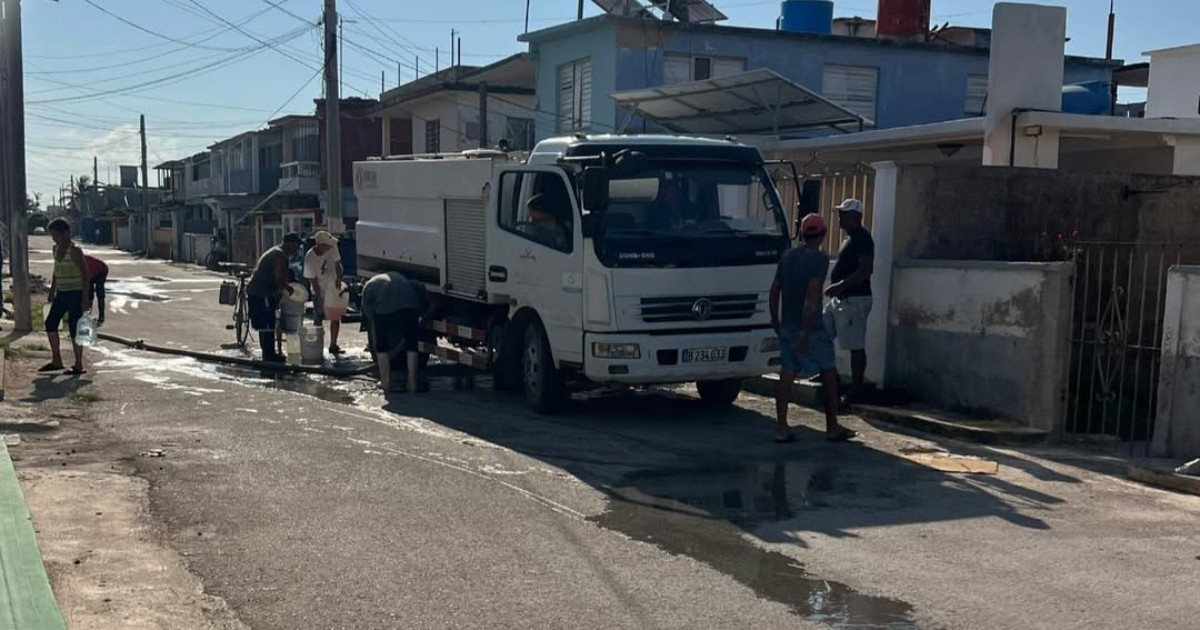
Arbolaez published a chronicle on Facebook titled "When Water Becomes a Wait," in which he describes how everyday greetings in the town have changed: "Has the water arrived? When is the truck coming?" are now the most frequently asked questions among the neighbors. According to his account, the community relies on a single water truck that "barely manages to supply the buildings once a week," a frequency insufficient to meet the basic needs of families.
Comments on the post reflect years of accumulated neglect. “The water issue in Boca is not something that started months ago; rather, it has been a problem for years,” wrote one neighbor. Another resident described the physical consequences of the shortage: “People have fallen from the cliffs and ended up with stitches on their bodies, others have hernias from carrying so much weight.” Another resident summarized the collective exhaustion with a powerful statement: “This is our day-to-day life, without hope, without the desire to live. The most essential thing a human being can ask for: water.”
Another commentator reported that the water truck available "belongs specifically to Raicel, only for his home and friends," and that the neighborhood known as "las latas" has gone a month and a half without receiving a single drop. From the town of Carbonera, a resident warned that the situation is even worse: "more than a month without water and no hope for a water truck." The same commentator asserted that private trucks are charging nearly 20,000 pesos.
Other neighbors reported differences in the distribution of the resource. "The neighborhood over there by the bridge gets it almost every day, but we haven't seen a drop here in a month," wrote one resident, while another claimed that "the trucks come with names and surnames."
"Boca is already an underworld of a town; the electricity is only on when they feel like it, with power cuts lasting 48 hours or more, and water is almost forgotten. Many adults, like my mother and my 73-year-old aunt, are unable to walk and are hauling water from the sea," wrote another resident.
The posts also reflect the human impact of the crisis. "It is a complete disrespect to human dignity to live in those conditions," wrote a neighbor. Another recounted the daily struggle to obtain water: "Our hands and shoulders ache from carrying buckets and even tanks, and we draw strength from nowhere when we hear the call of the pipe."
The complaints are not new. On May 31, Marilyn Lemus posted in the Facebook group "Revolico Compra y Venta Boca de Camarioca" that the town had been without water for a month: "How long are they going to keep torturing us while the leaders drive around in their cars wasting fuel as they please? The response we receive is that there is no fuel for the turbines."
Earlier, in March, Daniela Rocío Castaño de Armas had already reported over a month without water in the Costa Azul neighborhood, asking: "Where are the high-ranking officials who are supposed to look after the well-being of the people?"
Neighbors point out in Arbolaez's post that the root of the problem is the lack of cables and electrical poles to connect the town of La Conchita with Gómez, where the wells and turbines that could supply the community are located. Without stable electricity, the turbines do not work. Several commentators directly blame Aguas Varadero, the local government, and the electric company: "It's not the blockade, it's irresponsibility." Some residents went further and reported alleged misappropriation of resources and informal businesses related to water distribution. "The latest is that the water from over there is being sold in the neighborhood," stated one commentator, an accusation that could not be independently verified.
The crisis in Boca de Camarioca is part of a provincial water supply collapse. Over 300,000 residents in Matanzas faced instability in their water supply last April, with more than 29,000 suffering from permanent shortages. The National Institute of Hydraulic Resources acknowledged that the system was operating with only 37% of the necessary fuel, affecting nearly 10 million people across Cuba. The Antonio Guiteras thermoelectric power plant, located in Matanzas, went out of service on April 6, further worsening the electrical deficit in the province.
A commentator noted that last week the issue was mentioned on Mesa Redonda, "implying that a definitive solution will be given to the problem. Let's hope, at least there's a sense of hope in the air, to see if it materializes."
"A town without water does not live, it survives," summarized another resident while describing the situation facing the community. Arbolaez, for his part, concluded his appeal with a phrase that encapsulates the feelings of the people: "And the people continue to wait. No answers. Solutions."
Filed under: