
Related videos:
The population of the municipality of Manatí, in the province of Las Tunas, has gone over a month without receiving a stable water supply through the distribution networks, following a breakdown at the main pumping station that halted service in an infrastructure spanning more than 122 kilometers, as reported by the Cuban News Agency this Saturday.
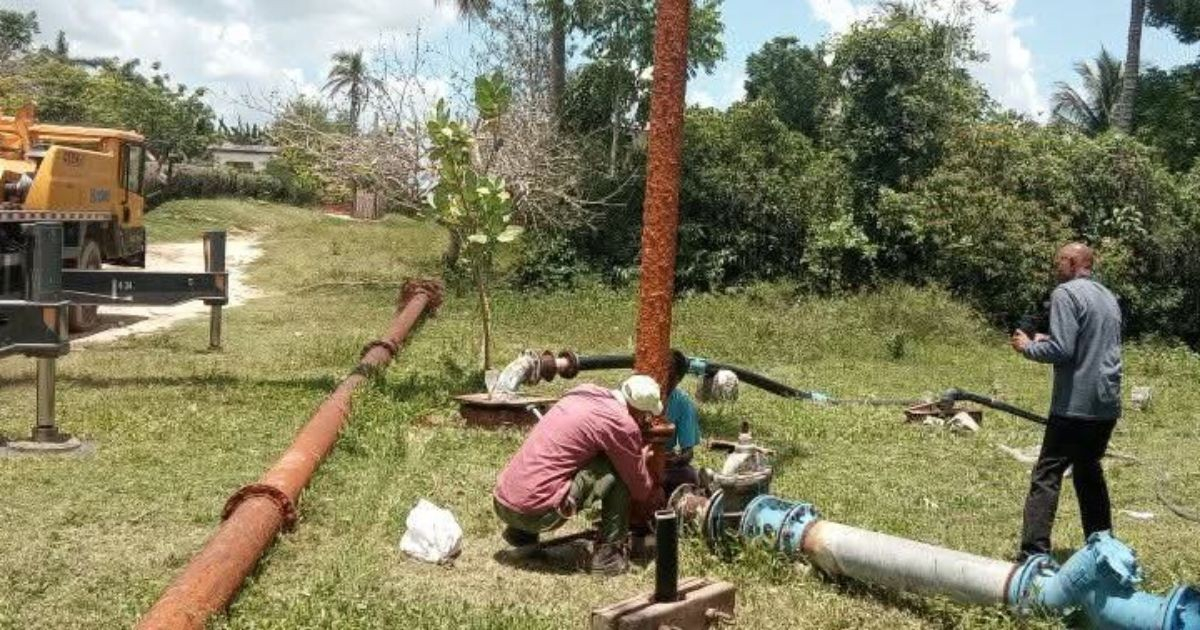
The failure originated in the well of Cerro de Caisimú, the main source of the local water system. Once that technological issue was resolved, technicians and workers from the Base Business Unit (UEB) Aqueduct of Manatí began looking for solutions to the accumulated problems throughout the network.
As part of the recovery efforts, the UEB has completed a new pipeline of 10 kilometers in length that connects the community of Las Margaritas — the point where water from the Cerro de Caisimú reaches — with the urban area of Manatí, according to the broadcaster La Voz del Faro.
Authorities acknowledge, however, that the work does not fully resolve the issue. "The fundamental objectives of this investment have been met, but efforts are ongoing to achieve greater stability in the distribution of this essential liquid," stated ACN, which also urged the public to "make the most of the pumping when there is availability of electrical fluid."
That warning reveals one of the structural roots of the crisis: the supply system relies directly on electricity, and the prolonged blackouts experienced in Cuba—which in many circuits exceed 20 hours daily—halt the pumping. On a national scale, 87% of the water supply system depends on the electrical grid, and only 135 out of 480 essential pumping stations were protected from the outages.
The situation is particularly serious for 12 rural communities in the municipality that do not have their own wells and rely entirely on centralized pumping. The UEB conducts visits to those localities to assess, on a case-by-case basis, the possibility of ensuring water access for each family, the source indicated.
La crisis de Manatí no es un hecho aislado. El Consejo de Gobierno Provincial de Las Tunas It was held on May 24 y reconoció la proliferación de pozos perforados por la propia población como respuesta desesperada al desabasto crónico, señalando a Jobabo y Manatí como los municipios más afectados. En marzo de 2026, el colapso del acueducto en la provincia impulsó un mercado informal de pipas con precios de hasta 7,000 pesos por viaje.
The background goes back years. In September 2025, the distribution cycles in Las Tunas were extended to 10 days per circuit, affecting more than 90,000 people. In November of that same year, despite the reservoirs reaching 96% of their capacity after Hurricane Melissa, households still did not have water because the pumps at the water treatment facility remained broken. In 2022, the delivery cycle in the urban area of Manatí reached 27 days.
The problem reflects a structural water deterioration that 67 years of communist dictatorship have left unresolved. On a national scale, almost 2.7 million Cubans are suffering from water shortages, which means that approximately 28% of the population lacks regular access to drinking water, according to the National Institute of Hydraulic Resources. The hydraulic system also operates with barely 37% of the fuel it needs, and between 40% and 70% of the water pumped is lost due to leaks in aging pipes before it reaches homes.
The crisis in Manatí is just another chapter in a water collapse that affects the entire island.
Filed under: