
Related videos:
A resident of Matanzas made a desperate call on Facebook on Thursday after five consecutive days without water in her community, while warning that the combination of water scarcity, garbage accumulation, and prolonged blackouts could trigger a sanitary crisis of uncontrollable proportions.
Mary Horta Hernandez posted on her Facebook profile: "We need water to live. Please. Among the garbage and the lack of water and hygiene, the outbreak of Hepatitis can reach uncontrollable levels. We have been without water for five days. There are areas in Matanzas with more than 36 hours without electricity. What do we do? Who will help us? Where can we find solutions?"
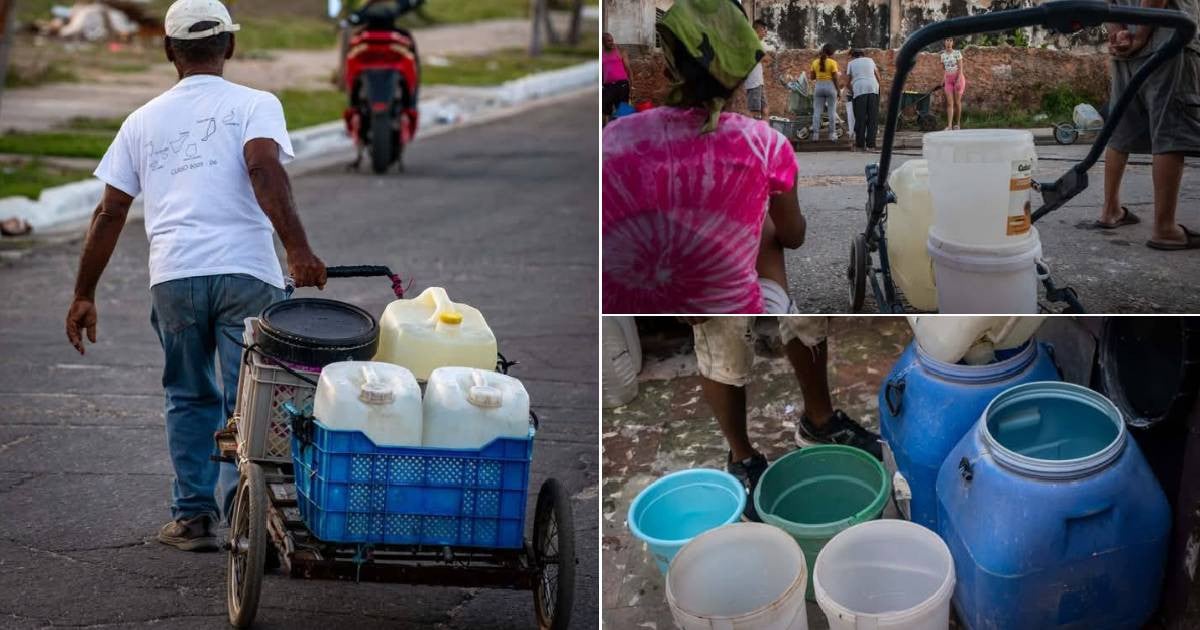
The images accompanying the post show residents transporting jugs and containers on carts, cargo tricycles, and converted baby strollers to collect water in the city's deteriorated streets.
The report comes days after the regime itself acknowledged the seriousness of the issue. On April 8, Deputy Prime Minister Inés María Chapman led a meeting with executives from the Water Supply and Sewage Company and the National Institute of Hydraulic Resources, during which it was admitted that more than 300,000 residents of Matanzas lack stability in their water supply.
In that meeting, it was acknowledged that the ongoing power outages are damaging the pumping motors, that there are thefts of oil from transformers and the removal of solar panels, and that the well fields can only operate for short periods when electricity is available.
An anonymous woman from Matanzas summarized the collective frustration: "I’m tired of seeing this kind of news. Everything just ends up being discussions and information about new bomb setups and blah blah blah, and nothing changes. Then they sit in a well-lit, air-conditioned meeting to talk about strategies that don’t work."
The health background intensifies the urgency. On April 4th, health authorities confirmed 18 active cases of hepatitis in the Versalles neighborhood and seven in La Marina, a municipality of Cárdenas.
Dr. Andrés Lamas Acevedo, director of the Provincial Center for Hygiene, Epidemiology, and Microbiology, tried to reduce alarm by stating that "although this is not a large-scale outbreak, joint actions between the health sector and other organizations will allow us to curb transmission."
The Antonio Guiteras thermoelectric plant, located in Matanzas and responsible for between 20% and 25% of the national thermal generation, went offline on April 6 due to a boiler failure, which increased the national deficit to 1,845 MW and left city circuits with just two hours of electricity supply for every 36 without service.
The 87% of the water supply system in Cuba relies on the National Electric System, which has experienced six total blackouts in a year and a half.
In the face of desperation, residents have resorted to extreme measures: in the Playa district, the number of makeshift wells increased from twenty in October 2025 to over 40 in February 2026, posing a risk of cross-contamination due to their proximity to septic tanks, while private water trucks raised their prices from 4,000 to 10,000 pesos for a 4,000-liter tanker.
The most serious precedent of what could happen if the situation is not controlled is the hepatitis A outbreak of 2024 in the Reina neighborhood of Cienfuegos, which infected over 5,000 people due to contamination of drinking water with sewage.
Filed under: