
Related videos:
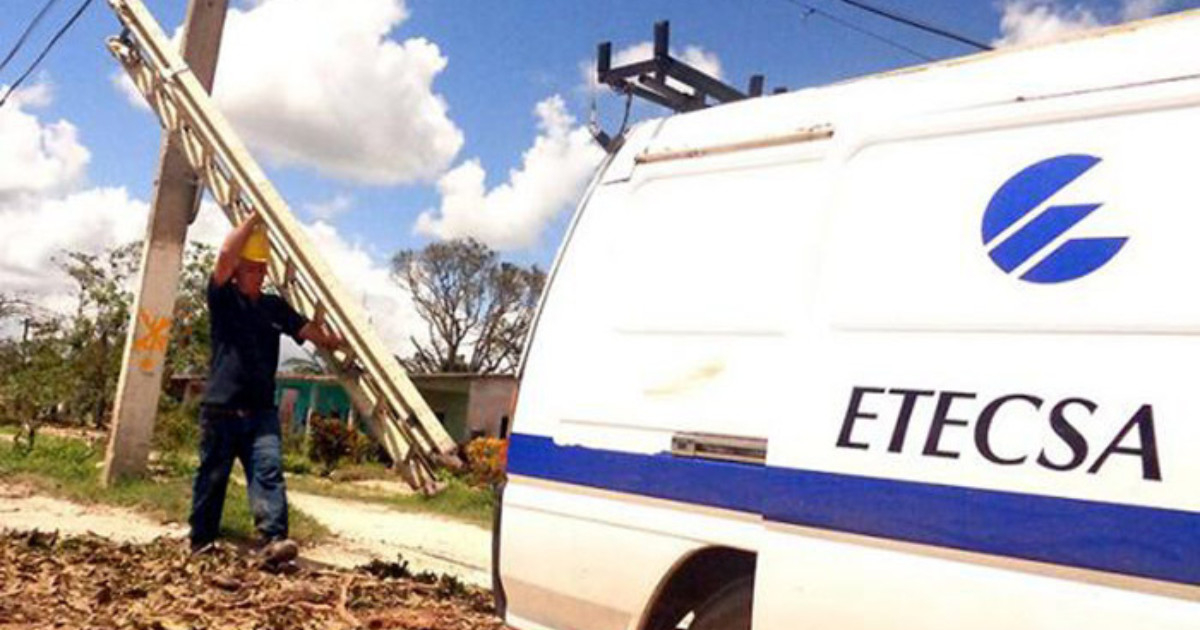
The Cuban film critic and historian Juan Antonio García Borrero reported this Sunday that he has been without a landline or Nauta Hogar service in the city of Camagüey for two weeks following a power surge. Meanwhile, the state-owned and sole telecommunications company in Cuba S.A. (Etecsa) has been unable to repair the issue because, according to its own technicians, they need to send "a truck with a ladder" that never arrives.
García recounted the case on his Facebook profile, where he explained that when he reported the breakdown, the company informed him that they had up to 72 hours to resolve it, a deadline that they failed to meet without any consequences.
"At Etecsa, they told me, after I reported it, that they had up to 72 hours to fix it. But none of that has been fulfilled. Someone came to the house, but according to him, they needed to send a truck with a ladder," wrote the intellectual from Camagüey.
On Saturday, García Borrero saw one of Etecsa's vehicles driving through the Los Coquitos neighborhood and thought that they were finally going to address his case.
"When I asked them, they told me they had no reports for that area," he added, highlighting the fact that the malfunction was not even recorded in the company's system.
García Borrero used the complaint to highlight a contradiction that he had already noticed when the state telecommunications monopoly in Cuba implemented its controversial rate increase in May 2025, which is that the lack of competition eliminates any incentive to improve the service.
"As there is no competition, they know that one is obliged to stay with them," he wrote, also dismissing the official argument of the embargo as a cause of these shortcomings.
"Beyond the blockade that they often blame for all their ills, there are these issues that have nothing to do with external factors," he emphasized.
The film critic lamented, with resignation, that "I will be cut off, or hardly interacting, until Etecsa decides otherwise."
The question raised by the intellectual encapsulates the accumulated discontent of millions of Cubans: "The truth is that several months after the rate hike, we do not know how exactly the Etecsa service has improved after the price increase."
It is the same question that comedian Ulises Toirac posed days ago, when he published a devastating report on the millions collected without visible improvements: "Where is all that money?"
The numbers give reason to both one year after the rate hike mandated by the government of President Miguel Díaz-Canel.
It should be noted that just 46 days after the price increase, Prime Minister Manuel Marrero Cruz acknowledged before the National Assembly that Etecsa raised more than 24.8 million dollars, averaging 540,000 dollars per day.
However, Cuba records only 7.21 Mbps of internet speed according to the Speedtest Global Index from May, placing it last in Latin America.
Paradoxically, in that same context, Etecsa recently celebrated receiving an international award from the International Telecommunication Union for its online services portal, while in Camagüey an intellectual hopes that someone will find a ladder.
Filed under: