
Related videos:
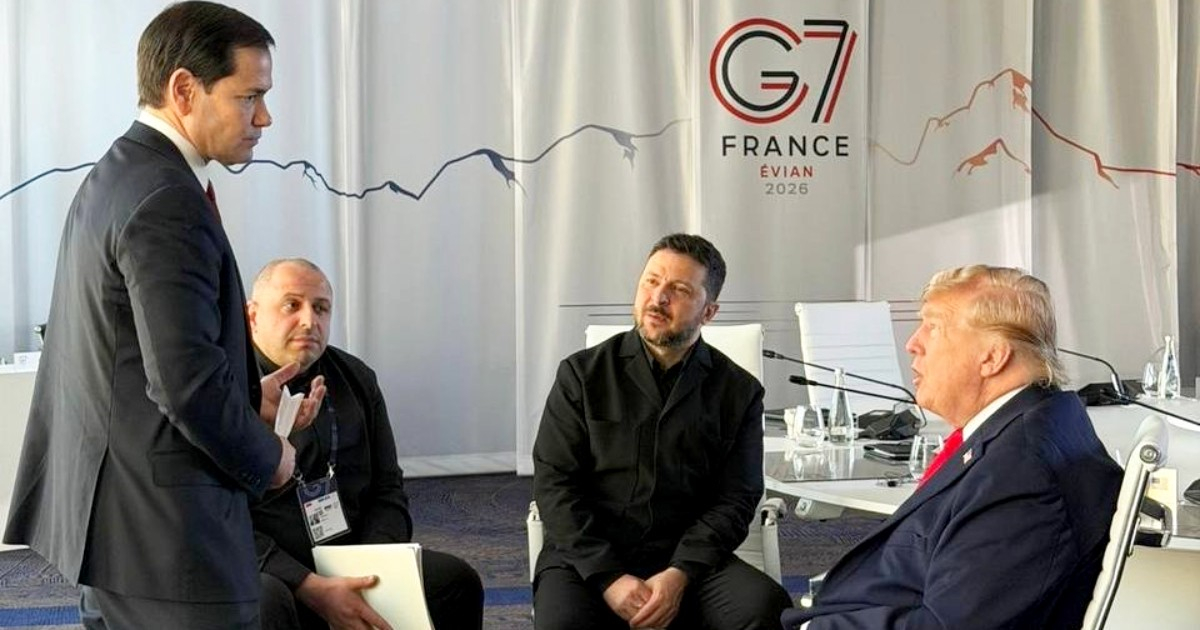
Donald Trump met on Tuesday with Ukrainian President Volodymyr Zelensky on the sidelines of the G7 summit in Évian, France, accompanied by Secretary of State Marco Rubio and Ukrainian Defense Minister Rustem Umerov.
Zelensky posted the images of the meeting on X along with a brief but significant message: "It's always important to coordinate positions." This quote marks the first bilateral meeting between the two leaders since Trump arrived at the G7 following the announcement of a framework agreement with Iran.
Trump confirmed the meeting during an encounter with the emir of Qatar and made clear his new diplomatic focus: “Russia should reach an agreement. Russia has lost a huge number of people, and so has Ukraine.”
The American leader had arrived in Évian on Monday with favorable winds after announcing a memorandum of understanding with Iran to end the conflict in the Persian Gulf. However, that agreement—whose formal signing was scheduled for June 19 in Geneva—raises doubts about its viability as it is an initial framework, with key points on nuclear issues and sanctions still unresolved, Israeli skepticism, and internal divisions in Tehran.
With that momentum, Trump declared on Monday alongside French President Emmanuel Macron: "Yesterday we had a very good conversation with President Zelensky and President Putin, and I see that we might be able to do something there. I really believe it. Both are open to it."
Beyond the bilateral meeting, Zelenski also participated in the multilateral session in the G7+Ukraine format, where he outlined three specific priorities, according to EFE: more air defense missiles along with licenses to produce them, a support package for the winter, and increased pressure on Russia.
The Ukrainian president emphasized that "the U.S. is ready to support these lines of effort" and cautioned that "Russia must learn that its war will never be normalized."
According to the German media DW, G7 leaders, including Trump, supported the sovereignty and territorial integrity of Ukraine and agreed to increase pressure on Moscow, including potential new sanctions on Russian oil exports, facilitated by the expected reopening of the Strait of Hormuz.
French diplomatic sources indicated that Trump congratulated Zelenski on the current dynamics of the conflict, in which Ukraine no longer appears to be the losing party.
However, the path to peace remains fraught with obstacles. The spokesperson for the Kremlin, Dmitri Peskov, denied receiving an official invitation from Kiev for a meeting between Zelenski and Vladimir Putin at the G7 and clarified that "there are no official channels between Moscow and Kiev."
Zelensky, who sought that meeting in vain during the summit, proposed holding it in the United States as "a format in which it would be more difficult for Putin to refuse."
The context is bleak: on Monday, Russia launched attacks that resulted in at least 11 deaths and set the Orthodox Cathedral of the Assumption in Kyiv on fire, which is listed as a UNESCO World Heritage site.
The war has been ongoing for over four years and has surpassed the duration of World War II. In June, Putin rejected both a broad ceasefire and Zelenski's proposal for direct negotiations, after a three-day truce had been agreed upon in May involving the exchange of 1,000 prisoners from each side.
Rubio, present at the bilateral meeting, stated on May 26 that the war "needs to come to an end" and that the U.S. is "ready and prepared to facilitate" that outcome.
After the G7, Trump's diplomatic agenda points to new fronts: the president himself stated in June that once the crisis with Iran is resolved, he would make "a brief stop" to address Cuba, in line with what he told Rubio in March: "Your next project will be Cuba".
Filed under: