
Related videos:
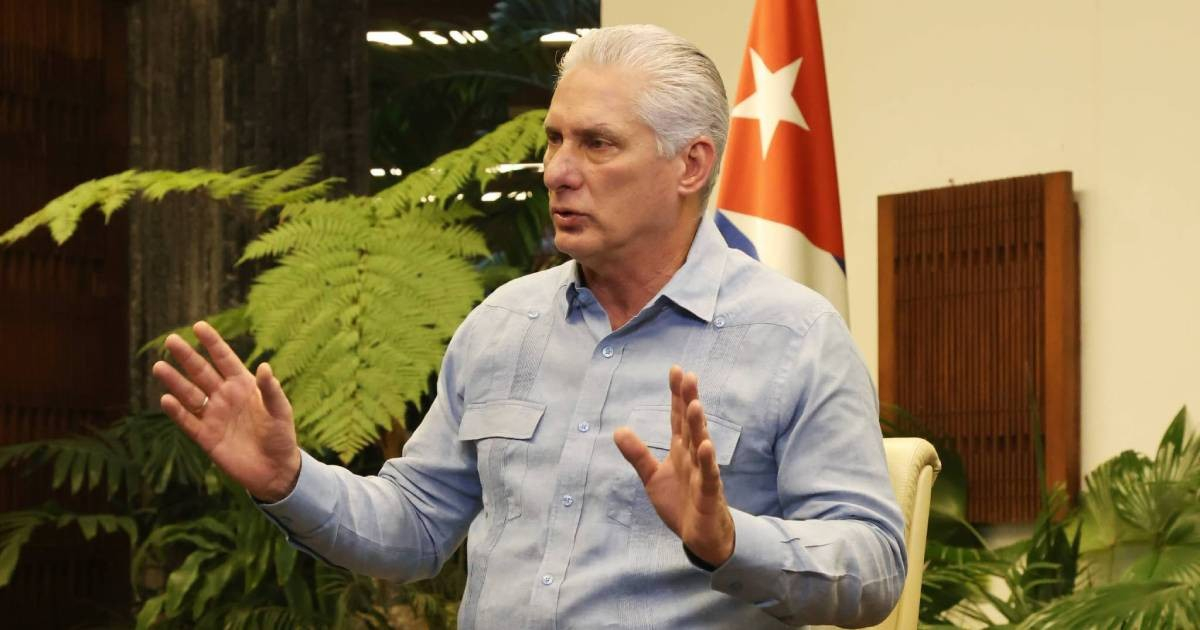
Miguel Díaz-Canel will return this Wednesday to an international media platform to defend the official position of the Cuban regime regarding the crisis the island is facing, in an interview he will give to journalist Roberto Cavada on Dominican television.
According to Hoy, the conversation will be broadcast at 10:00 PM on Telesistema, Channel 11, during the prime time edition of Telenoticias. As announced by the media outlet, the discussion will address Cuba’s economic situation, the energy crisis that has subjected millions of Cubans to prolonged blackouts, and the government's perspective on the internal and international challenges facing the country.
The interview will be conducted by Roberto Cavada, one of the most recognized journalists on Dominican television and the main face of Telenoticias. Born in Ciego de Ávila, Cuba, in 1971 and naturalized as a Dominican, Cavada has developed much of his professional career in the Dominican Republic, where he has established himself as one of the most influential figures in television journalism.
The show will be broadcast on Telesistema, Channel 11, one of the main private television networks in the Caribbean country. Through Telenoticias, its flagship news program, the channel maintains a broad national audience and often serves as a platform for interviews with political leaders, officials, and figures of regional significance.
The television appearance occurs during one of the most challenging moments for the regime, characterized by the decline of the economy, the worsening of the electricity crisis, and the growing social discontent caused by shortages of food, medicine, and fuel.
The interview is part of a communications offensive that Díaz-Canel has intensified in recent months to present his narrative to international audiences. In these statements, he has insisted on attributing the Cuban crisis to U.S. sanctions, has rejected any possibility of relinquishing power, and has denounced what he considers media campaigns against his government.
During 2026, the ruler has spoken with several foreign media outlets. In March, he was interviewed by the Spanish politician Pablo Iglesias for Canal Red América Latina. A month later, he spoke with the magazine Newsweek, where he stated that "there is a lot of media manipulation, a great deal of hatred has been sown."
He also featured in a interview with journalist Kristen Welker on the show "Meet the Press," from NBC News, becoming the first Cuban leader to participate in a U.S. television program of that caliber since Fidel Castro appeared on American television following the victory of the Revolution.
That intervention generated strong criticism among sectors of the exile community and the Cuban opposition. Independent journalist Mónica Baró Sánchez described it as "a success of Castroist propaganda," while Republican Senator Rick Scott accused NBC of "giving a megaphone to Díaz-Canel".
In that exchange, the leader was asked about the possibility of resigning to facilitate a solution to the Cuban crisis. His response was abrupt: "Do they ask that question to Trump?" He then added that "resignation is not part of our vocabulary."
The ruler has also granted interviews to the channel Al Mayadeen and to the Spanish newspaper elDiario.es, platforms where he has maintained similar arguments about the political and economic situation of the island.
The promotion of the interview in the Dominican Republic also received support from the Cuban embassy in that country, which shared the announcement through its social media.
The context in which the meeting with Cavada takes place is particularly delicate. Cuba is facing one of the worst energy crises in its recent history. In May 2026, the electricity generation deficit reached 2,174 megawatts, leaving large areas of the country without service. For this Wednesday, the Electric Union expects outages exceeding 2,000 megawatts, while more than 1,200 remain offline due to a lack of fuel.
In some areas, power outages have reached extreme levels. In early June, residents of a circuit in Matanzas reported being without electricity for up to 85 consecutive hours.
The interview will also have a particular nuance: Roberto Cavada was born on July 4, 1971, in Ciego de Ávila and later became a Dominican citizen, which means he will be conversing with the leader of the country where he was born before developing his entire professional career in the Dominican Republic.
The importance the regime places on such spaces was reflected in a statement by Díaz-Canel in April 2025, when he asserted, "We are going to fight on social media... and we will fight to win."
Filed under: