
Related videos:
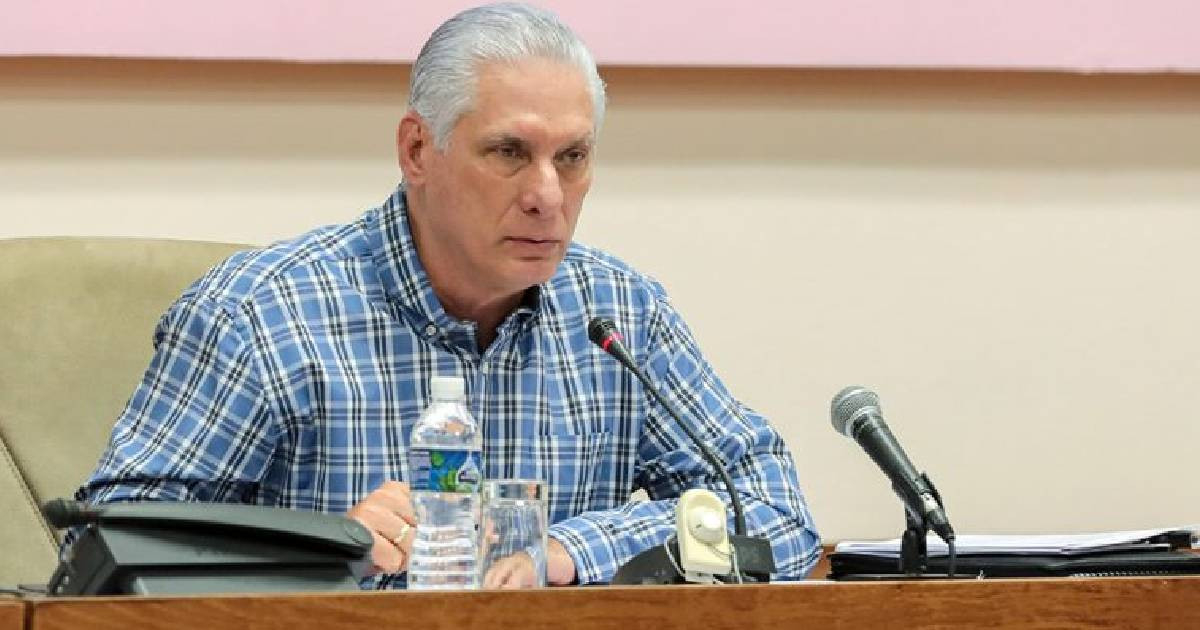
The ruler Miguel Díaz-Canel stated this Friday that power in Cuba belongs to the workers and not to the wealthy or the bourgeois, in a speech at the XXII Congress of the Central Workers' Union of Cuba held at the Palacio de Convenciones in Havana, where he attempted to justify the opening to market elements and private property included in the largest package of economic reforms approved since 1959.
"The key to everything lies in the issue of power. If power belongs to the people, if it belongs to the workers, not the rich, not the bourgeoisie, then a policy in favor of the people can be implemented. And that is what we will have in socialism. We are a government of workers for the workers, even if there are capitalists among us," stated the president, according to a report from the official site Cubadebate.
At the same time, he acknowledged that the economic direction involves an unprecedented opening: "More elements of private ownership, private production, capitalism, and market activity will necessarily be introduced. We must do this because the most basic common sense dictates it, but with the strength of the revolution, we should not fear it."
The speech comes one week after the National Assembly approved in an extraordinary session 176 economic and social transformations organized into 23 strategic axes, which include private banking, private exchange houses, a digital exchange market, and the elimination of the 100-worker limit for small and medium-sized enterprises.
In response to the criticism regarding the delay in implementing these measures, Díaz-Canel stated that the transformations were outlined in the directives from the VI Congress of the Communist Party and listed reforms promoted by Raúl Castro, such as the easing of travel restrictions, the new Constitution, the Family Code, the expansion of the non-state sector, and the allocation of idle land for usufruct.
The head of state defined the current moment as a "war economy" and established five priorities within what he called a "defense shield of sovereignty," of which the first would be military preparedness and the second the implementation of the Economic and Social Program for 2026.
Regarding the exchange market, one of the most sensitive points of the reform package, Díaz-Canel attempted to ease concerns by stating that the informal market currently determining the exchange rate "is illegal" and that its legalization will also allow for the participation of state-owned enterprises.
"In the end, there will be a currency movement that will better support the economy," he assured.
The congress, held under the motto "Reaffirmation of Resistance and Unity," brought together 759 delegates, of whom 561 participated via videoconference.
While the regime presents the reforms as a triumph of socialism, Cubans responded with irony to their announcement on social media: "Download them and you can eat and light up with the paper measures," wrote an internet user, referring to the blackouts and shortages that the population is suffering.
The economist Mauricio de Miranda, from the group Cuba Transformación, warned that without democratic institutional checks and balances, economic opening could lead to a "Russian-style transition" that benefits the party elites rather than the population, while the United States Department of State described the reforms as "superficial smoke signals."
The implementation of the 176 measures will require modifying more than 148 legal provisions and approving 32 new regulations, a process that Díaz-Canel himself acknowledged as complex but, as he stated, "necessary to save the revolution."
Filed under: