
Related videos:
Cuban Foreign Minister Bruno Rodríguez Parrilla assured this Tuesday that the recently approved economic reforms by the regime do not respond to pressures from Washington and announced that Havana has requested a special session of the United Nations General Assembly for July 7 aimed at denouncing the tightening of U.S. sanctions.
During a press conference in Havana, reported by Cubadebate, the Minister of Foreign Affairs rejected that the package of 176 economic and social measures is related to the sanctions policy promoted by the administration of President Donald Trump.
"The measures adopted are a matter of sovereignty. We have not heard, nor are we interested in the opinion of the United States," he stated when asked about the reaction of the State Department to the reforms approved by the National Assembly in mid-June.
The statements come after Washington described these measures as "modest" and "superficial" and reiterated that any change in its policy toward Cuba will depend on more far-reaching political and economic reforms.
Rodríguez also admitted that the bilateral conversations initiated between both governments at the beginning of this year remain stalled.
"Negotiations between Cuba and the U.S. show no progress. The behavior of the U.S. government delegations—generally respectful—has been accompanied by constant threats against Cuba, the implementation of coercive measures, and offensive statements regarding the independence of our country," he stated.
Despite that diagnosis, he assured that Havana remains open to the possibility of dialoguing "on the basis of mutual respect and non-interference in Cuba's internal affairs."
In parallel, the Cuban government announced that it has requested an extraordinary session of the UN General Assembly for July 7, with the purpose of presenting to the member states the impact of U.S. sanctions and what it termed an "energy blockade" against the island.
The chancellor also accused the U.S. permanent mission to the United Nations of trying to obstruct the holding of that meeting through diplomatic efforts directed at other countries.
"They are trying to censor his voice and his right to speak on an issue directly related to international peace and security," he stated in reference to the member states of the organization.
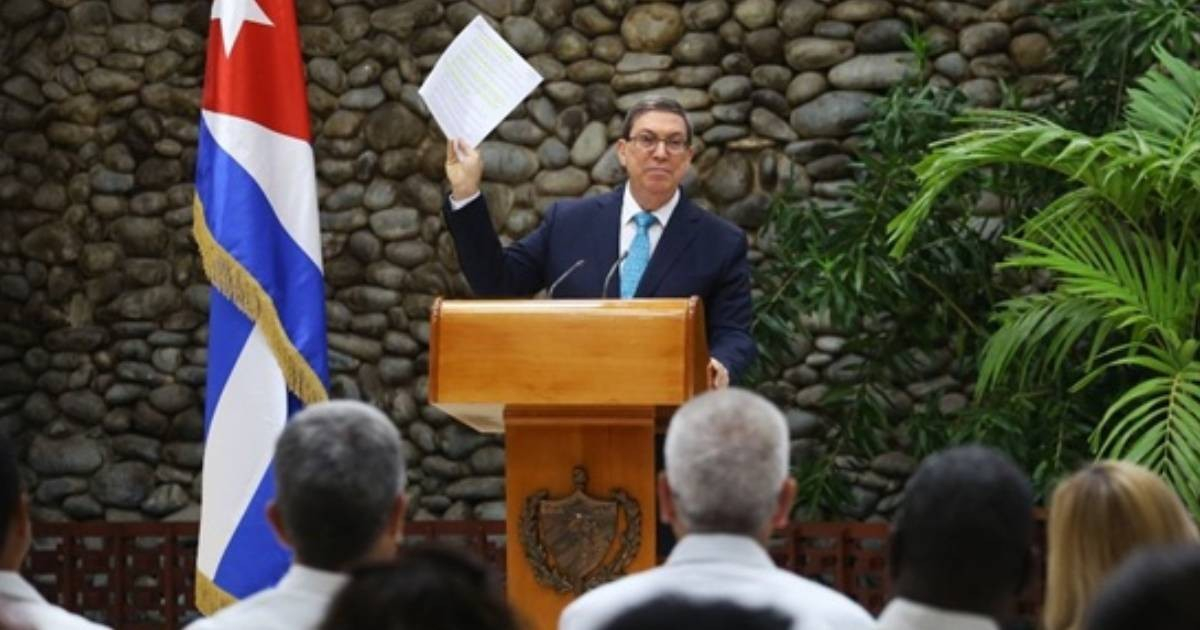
During the conference, he displayed three documents that, as he stated, are circulating among various foreign ministries as part of those efforts. One of them is titled "It's Time to Change in Cuba"; another, "The Regime Must Reform, Don't Vote with Its Propaganda"; and a third attempts, according to the minister, to link Cuba to the war in Ukraine "without a single piece of evidence."
Rodríguez also reported that the United States attempted to block a food assistance program from the World Food Program (WFP) worth 116 million dollars for Cuba. He explained that the initiative was approved on June 26 with 29 votes in favor and only two against: the United States and Morocco.
In economic matters, the chancellor asserted that the embargo has resulted in accumulated losses exceeding 170 billion dollars and stated that in 2025 alone, the damages amounted to over 7 billion, nearly 50% more than the previous year.
He also questioned the humanitarian aid announced by Washington for the island. According to him, out of a program initially valued at nine million dollars —which was later reduced to six million— only about 90,000 dollars had actually been implemented, even though the Secretary of State recently announced a new assistance package of 100 million dollars.
The call on July 7 will be held independently from the traditional annual resolution on the U.S. embargo, which the General Assembly debates each October. In the last vote, held in 2025, the initiative presented by Cuba received 165 votes in favor, seven against, and 12 abstentions, the lowest support received by Havana in over three decades.
Filed under: