
Related videos:
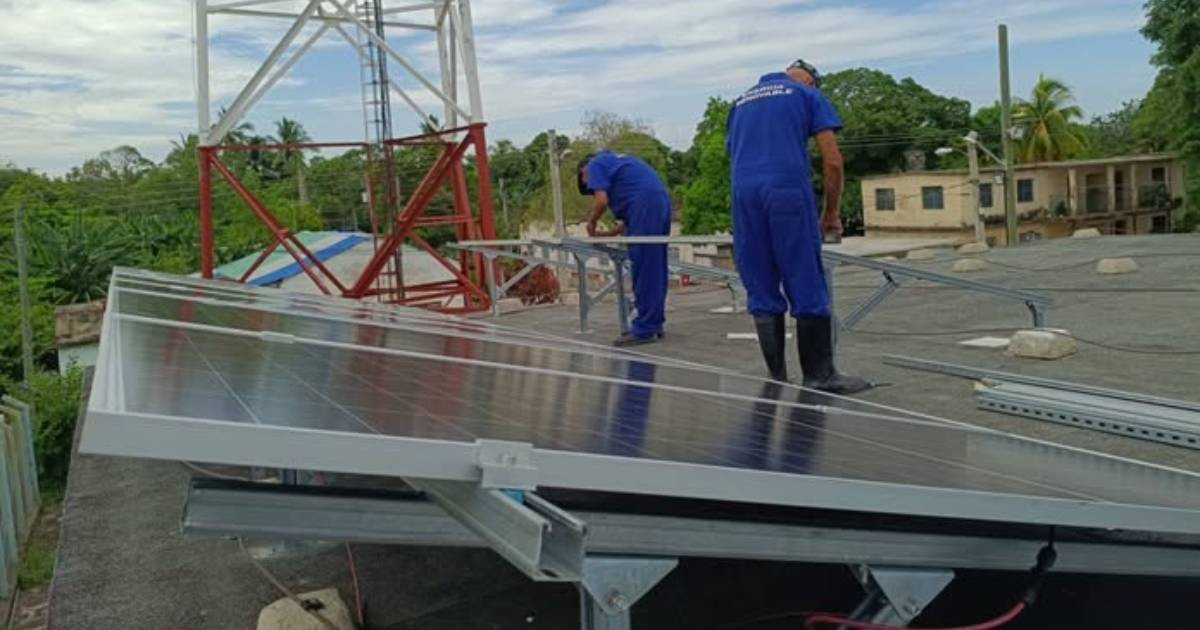
ETECSA is advancing in the installation of photovoltaic systems in the telephone centers of all municipal capitals in Pinar del Río, in an effort to maintain operational communications amid the worst energy crisis Cuba has experienced in decades. According to the official Granma, the installation has already been completed in eight centers and is ongoing in those located in Viñales, Sandino, and the Hermanos Cruz neighborhood in the provincial capital.
The territorial director of ETECSA in the province, Manuel Milián Villar, set a goal with an evident political load: to have all operating systems in place before July 26, the date on which Pinar del Río will host the national event for the 73rd anniversary of the assault on the Moncada and Carlos Manuel de Céspedes barracks. "We have all the necessary equipment to achieve this," the executive stated, according to the state media.
The systems vary in power according to the technical needs of each center. "Some are 10 kilowatts (kW) in power, others are 30, others are 50, and there is even one of 100," clarified Milián Villar. With this support, the official stated that the improvement in landline services could reach around 60% of ETECSA customers in Vueltabajo—more than 50,000 services—with a more moderate impact on mobile telephony.
The magnitude of the investment reflects the extent of the collapse that the province has suffered. Milián Villar acknowledged that the crisis of the National Electroenergetic System resulted in nine of the 11 municipal capitals in Pinar del Río being cut off, with only the plants in Sandino and the provincial capital remaining operational thanks to generators, the source indicated.
This is not the first time that solar energy has been used as a stopgap measure in response to the electrical disaster. Prior to the new investment, the province received a donation of 18 two-kW photovoltaic systems from China, located in cabinets across four municipalities. In November 2025, China had donated 5,000 photovoltaic systems valued at over 114 million dollars, of which 240 units were allocated to ETECSA nationwide.
What the official report omits is that the usual autonomy of these systems is far below the actual duration of the outages, which in Pinar del Río have exceeded 30 consecutive hours. The outages have forced ETECSA to install emergency solar panels in several provinces, without addressing the underlying issue. Additionally, the regulations from the National Office for the Rational Use of Energy prevent the batteries from being recharged from the conventional grid, meaning they rely solely on solar radiation.
ETECSA has admitted that blackouts leave telecommunications service unavailable: nationwide, power outages disable nearly 47.5% of mobile base stations and 56.5% of telecommunications cabinets. Gustavo López Cruz, head of the commercial department of ETECSA in Sancti Spíritus, stated it bluntly: "The reality is that it is not possible to keep this technology running for more than 24 hours without power from the grid."
The structural fragility is compounded by the theft of solar panels. In Santiago de Cuba, there were reported at least three thefts of ETECSA infrastructure panels between May and June 2026, leaving hundreds of users without service. An engineer from the company expressed his outrage on social media: "Once again, the honorable criminals are at it again, taking away the efforts and sacrifices of us workers who get up early every day to move forward and for the well-being of the people."
The official report also highlights that residents of the popular council 10 de Octubre, in the city of Pinar del Río, and the community of Calderón, in San Juan y Martínez, organized themselves to acquire and donate backup photovoltaic systems for the cabinets in their areas, indicating that the government is shifting part of the burden onto the citizens themselves.
The Political Bureau of the Communist Party designated Pinar del Río as the venue for the central event on July 26 on June 27, citing advancements in renewable energy, which sparked outrage among Cubans who are facing power outages lasting more than 20 and 30 consecutive hours in that same province. Meanwhile, Cuba ranks last in internet speed in Latin America, according to recent data from the Speedtest Global Index.
Filed under: