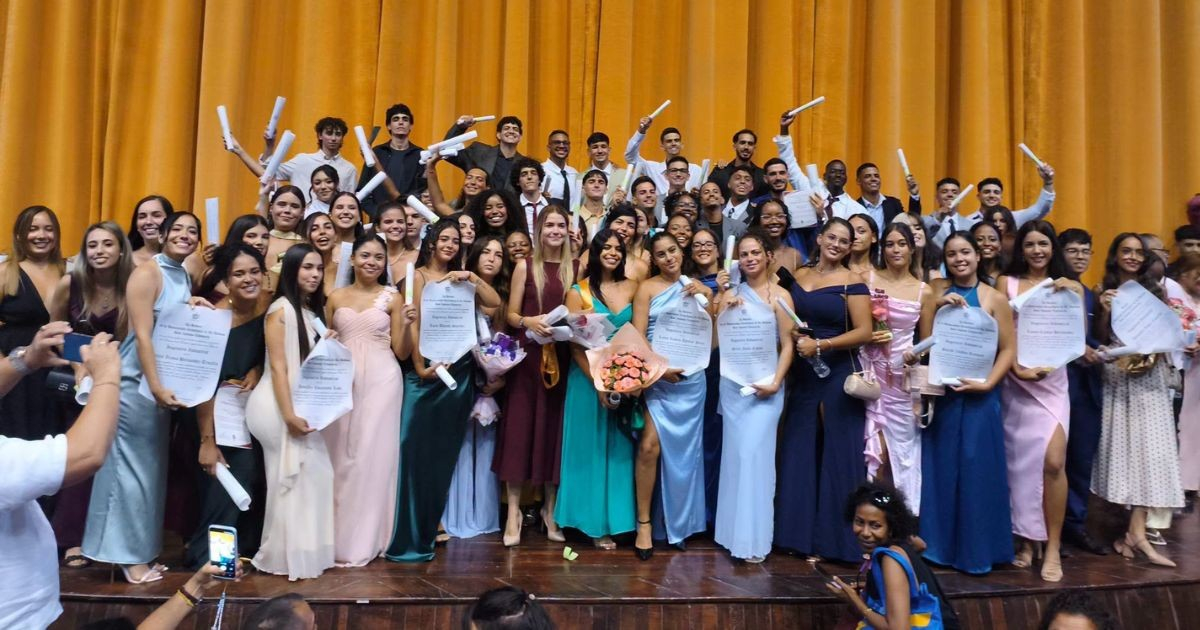
The José Antonio Echeverría Technological University of Havana (CUJAE) held its graduation ceremony for the 2025-2026 academic year this Thursday, during which more than 300 engineers and 33 senior technicians received their degrees in a ceremony filled with official symbolism, yet overshadowed by the reality of a country in crisis.
The event was presided over by the Minister of Higher Education, Walter Baluja García, and the rector Martha Dunia Delgado Dapena, along with representatives from the Communist Party, the Government of Havana, the National Assembly of People’s Power, the provincial Union of Young Communists, and the national University Student Federation.
The institution dedicated the graduation to the Centenary of Fidel Castro's Birth, the 50th Anniversary of the Ministry of Higher Education, and the 94th Anniversary of José Antonio Echeverría Bianchi's Birth, whose birthday coincides precisely with the date of the event and names the university.
During the ceremony, awards for scientific merit, gold titles, and recognitions were presented to the most outstanding graduates, in addition to the FEU CUJAE Distinction, the highest honor awarded by the University Student Federation at that institution.
The engineering specialties that received diplomas cover areas such as industrial, chemical, computer, electrical, biomedical, automation, civil, hydraulic, geophysical, mechanical, metallurgical, and telecommunications. The graduated higher-level technicians belong to specialties such as Logistics, Water and Sanitation, Metrology, and Maintenance, as reported by the Radio Reloj station.
The official CUJAE publication on social media captured the spirit of the event with these words: "To each graduate: thank you for putting your heart into every practice, every exam, every late night of study. Today, Cuba gains what you built here. The CUJAE spirit goes with you wherever you go."
However, the phrase "wherever they go" takes on an involuntarily precise meaning in the current context. Cuba is experiencing the largest migration exodus in its recent history: more than one million people have emigrated since 2021. The population has decreased from 11.3 million to between 8.6 and 8.8 million in 2025, according to independent estimates. The majority of those emigrating are in the age range of 20 to 40 years.
Recent graduates in engineering will earn salaries that, if adjusted to the national average, would not exceed 7,000 Cuban pesos per month, which is equivalent to less than 15 dollars, while minimum monthly expenses exceed 90,000 pesos, according to unofficial economic estimates. This gap turns a university degree, for many young people, into a passport for emigration rather than a tool for national development. In fact, over 90% of young people who remain on the island wish to leave if they could, according to data from 2026.
In this context, the Cuban university system is also facing a severe energy crisis. Power outages lasting up to 50 consecutive hours forced the regime to suspend the entrance exams for higher education for the 2026-2027 academic year, replacing them with the accumulated academic average from pre-university education, and to advance the end of the school year.
Universities like the University of Oriente adopted hybrid modalities since February 2026 due to the inability to guarantee minimum conditions for in-person teaching. In March, students from the University of Havana held a sit-in on the steps to protest against blackouts, lack of connectivity, and the impact of the crisis on their studies.
Cuba also faces a deficit of over 20,000 teachers, and those who remain in the profession earn salaries that do not allow them to live with dignity. Additionally, the country has seen more than 30,000 doctors emigrate between 2021 and 2024. In the first half of 2025, more than 5,500 Cubans validated their university degrees in Spain, including engineers, doctors, and nurses, surpassing the figures for all of 2024.
CUJAE graduated 697 professionals in July 2025, marking the largest documented graduation from the institution in recent history. The figure for this year, although lower, occurs under more adverse material and social conditions, leading many observers to wonder how many of these new engineers will remain in Cuba to practice their profession.
Related videos:
Filed under: