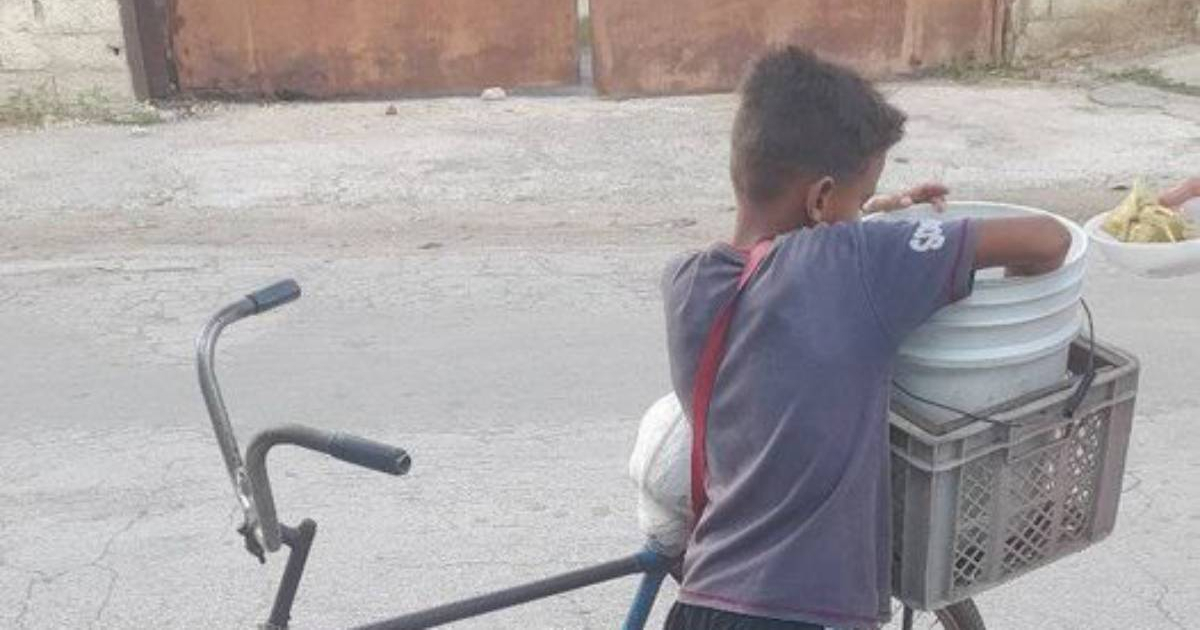
This Sunday, Children's Day in Cuba, Miguel Díaz-Canel shared a festive message on social media in which he promised that the regime will always look after Cuban children, accompanied by images of Fidel Castro with pioneers.
"Congratulations to the little giants, guardians of the future of the Homeland on this special day. We will always look after our children, even in the most difficult times," wrote the leader, who also recalled Fidel Castro as the "giant pioneer" who promoted the celebration, remembering that the dictator "more than once allowed himself to have the scarf tied while conversing with Cuban pioneers."
However, the contrast between the festive message and the harsh reality that the children face is simply devastating.
Infant mortality closed 2025 at 9.9 per 1,000 live births, the highest level in more than two decades and a cumulative increase of 148% since 2018, when the rate was 4.0. In Havana, the figure reached 14 per 1,000 in the first months of 2026.
More than 100,000 children are not receiving their daily milk, and the Ministry of Food Industry itself admitted that the children's supply plan is "impossible to fulfill."
According to the World Food Program, 48.5% of Cuban schoolchildren aged six to eleven do not receive food or snacks at their educational institutions.
UNICEF reported that 9% of children under five experience severe child food insecurity, as they consume food from only two or fewer of the eight essential groups.
In addition, in this context, the organization Food Monitor Program warned that the food crisis in Cuba is pushing children and adolescents to assume survival tasks that should be the responsibility of adults, socially disguised as mere "family assistance."
They affirmed that the phenomenon is not isolated but rather a direct consequence of the collapse of basic conditions in Cuban homes and schools.
Just two days before Díaz-Canel's message, Cuban mother María Acuña Cruz posted on Facebook photos of her one-year-old baby sleeping on a cot outside the home, exposed to mosquitoes and without water, while suffering from a diarrhea virus due to the blackouts.
“Do you ever think during the day about the Cuban people who are in your hands, about the children, the elderly, the parents we have to invent in order to bring some food to the table?” she asked directly to the ruler in that heartbreaking testimony of a Cuban mother.
At the beginning of the month, a viral video showed children sleeping on the floor of a portal in Havana during blackouts of up to 30 consecutive hours.
"Look at the children sleeping on the floor. There is still no light," denounced Teresa Calderín Elias in the video.
Recently, another mother, Dayany Sol Lopez, wrote an open letter to the ruler, accompanied by a photo of her seven-month-old baby sleeping on a cot in the yard after 48 hours without electricity: "President, my son does not know what it means to endure, and my son does not understand the awful country he lives in," as reported in that desperate appeal from a Cuban mother.
In the face of the state's collapse, it is the churches that feed the most vulnerable children. Cáritas de El Cobre inaugurated the children's dining hall "Horizontes" in Santiago de Cuba on Friday to serve 20 children three times a week, as reported by that Cáritas dining hall for children in Santiago.
“There are so many people asking for help. And the help is not enough,” acknowledged the Archbishop of Santiago de Cuba, Dionisio García Ibáñez.
Related videos:
Filed under: